
RESP vs RRSP and TFSA: What’s the best option for education savings? + MORE Aug 28th

Government Extends Tax Deadline in COVID-19 Economic Response Plan Mar 21st

RRSPs, DCPPs, CPP, oh my! + MORE Oct 5th

4 Things You Should Do Now So You Can Save on Taxes in the New Year Dec 14th

Bank of Canada Raises Overnight Rate to 1.75%; Cites New Trade Policy and Growing Economy Oct 25th
The tuition always rises
– moneysense.ca
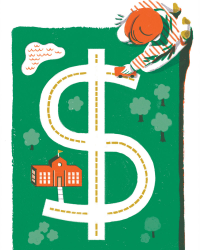 (Illustration by Christy Lundy)
So you’ve got a little ankle-biter at home you’d like to see in a graduation gown one day? Take a deep breath: While Statistics Canada pegged the average 2015 tuition fee at $6,191, and previous studies found that graduates expect it’ll take 7.4 years to pay off their loans, the projected tuition cost in 2035 is a jaw-dropping $17,200 per year, according to the Canada Student Loans Program. That doesn’t even include the cost of books, lodging or the occasional Martian craft beer. One recent estimate put the total cost of a four-year degree in 2035 at more than $102,000. Here’s how to build a financial flotation device to keep your head above the rising cost of education.
.cbR{box-sizing:border-box;display:block;width:100%;margin:1em 0;border:1px solid #bbb;padding:.5em}@media (min-width:480px){.cbR{width:250px;margin:0 0 1em 1em;float:right}}Keep back to school costs under control this year
Get a leg-up from the government
There’s no doubt about it: The Registered Education Savings Plan (RESP) is a sledgehammer against future student debt…
Start RESP savings early: experts
– moneysense.ca
 OTTAWA – Parents looking at the bills rolling in as students head off to university and college may be wishing they had saved more.
But if you’re not at that stage yet, financial advisers say, it’s important to start early and put aside as much as possible.
Jamie Golombek, managing director at CIBC Wealth Strategies Group, says parents’ biggest mistake is waiting too long before they start saving with a registered education savings plan, or RESP.
“You can’t catch up on the tax-deferred compounding. Depending on the rate of return, this can really be significant,” he said.
If you can afford it, Golombek advises putting $2,500 a year per child into an RESP to maximize federal government grants.
“If you can set aside that money in the year the child is born and start saving every single year to maximize the grants … that really is the best way to accumulate the most amount of money over the long term in an RESP,” he said.
.cbR{box-sizing:border-box;display:block;width:100%;margin:1em 0;border:1px solid #bbb;padding:…
Half Of Working Canadians Live Paycheque To Paycheque
– walletpop.ca
The survey released Wednesday by the Canadian Payroll Association found that 48 per cent of respondents said they rely on each payday to cover their bills, with 40 per cent admitting they spend an amount equal to all or more of their net pay each week.
A quarter of those polled also said they wouldn’t be able to scrounge up $2,000 if an emergency situation happened within the next month.
The CPA said the survey highlights the growing number of Canadians who are living paycheque to paycheque, and unable to put away savings due to mounting debt and a weak economy.
Debt an overwhelming worry
Half of those polled said they are able to save five per cent or less from their earnings, with 39 per cent saying they’re “overwhelmed” by their debt.
The most common type of debt cited by respondents was a mortgage (26 per cent), followed by credit-card debt (18 per cent), car loans (17 per cent) and a line of credit (16 per cent)…
The best way to fund your retirement
– moneysense.ca
 Q: I am 66 and retired with no defined benefit pension – just CPP and OAS. I do have RRSPs, both in savings and in mutual funds. I own my own home and it’s mortgage-free. I have some TD shares and Bell shares which are not within the RRSP portfolio.
My question is…in the future when I need funds, is it better to cash in some shares or to cash in from the RRSP?
I want to be sure that what I do is the most efficient for tax purposes (for example my roof needs re-shingling next year, costing approximately $10,000).
—Julie
A: Without knowing all the facts, Julie, it’s hard to give you a perfect “how-to” in your case, but I can give you a number of different considerations.
If you have a spouse, depending on their sources of income, my answers might change. But I’ll assume you’re single since you didn’t mention a partner.
Depending on the amount of your CPP and OAS pensions, you may be entitled to additional government benefits like Guaranteed Income Supplement (GIS), the GST/HST credit and based on your province of residence, various provincial tax credit and incentive programs…
Should I work past 70 while collecting CPP and OAS?
– moneysense.ca

Q: I turned 67 in February of 2016. I still work full time and my yearly income is about $96,000 annually. I also collect a survivor benefit of $389 per month and have contributed to CPP for 14 years. I would like to delay collecting CPP and OAS until 70 but can I still work after age 70 while I’m still collecting CPP and OAS? What would be the pros and cons of working past 70 while collecting CPP and OAS.
—Marie M.
A: If you plan in any case to work until age 67 or 70, then that’s probably when you should start collecting your CPP. You can use the tool at cppoptimizer.com to make an exact calculation, one that factors in some variables you’ve not specified such as: presence or absence of an employer pension plan, RRSP or TFSA savings to date, non-registered investments and whether you have prospects of working part-time once you cease full-time work. But generally speaking, the later you can wait to collect CPP, the better, and this applies double in your case because you’ve only contributed to the plan for 14 years so far…

