
There are plenty of retirement plan options in Canada! Stay on top of the best plans right here.
Latest News



You won’t believe the size of the Canadian ETF market + MORE Aug 5th
Mutual funds may still rule in Canada, but exchange traded funds are gaining ground fast. According to the latest industry snapshot the Canadian ETF industry just hit an important milestone.
There are now more than 500 ETF now trading on the TSX and TSXV, controlling $129 billion worth of investo.... More »
Making sense of the markets: Looking at 2025 + MORE Jan 3rd
Kyle Prevost, creator of 4 Steps to a Worry-Free Retirement, Canada’s DIY retirement planning course, shares financial headlines and offers context for Canadian investors.
Can we make sense of the 2025 markets?
Stock market predictions rarely age well. (As you can read from our look at 2024..... More »
Caisse to sell off remaining oil assets by next year - CBC.ca Sep 28th
Caisse to sell off remaining oil assets by next year CBC.caQuebec pension giant Caisse to exit remaining oil-producing assets, setting up $10-billion green fund The Globe and MailCaisse de dépôt to exit oil production by end of next year in new climate strategy Fin.... More »
How long can you put off saving for retirement? Surprisingly, waiting until your 50s makes sense for some + MORE Jan 6th
Ideally you should draw up a saving plan in your late 30s or early 40s. But it can still be an enormous help if you don’t manage to get to it until your late 40s or 50s or even later..... More »
How to calculate the taxable amount for a cashed-in whole life insurance policy + MORE Apr 19th
Ask MoneySense
I cashed in my whole life insurance policy last year and received a T5 suggesting I have to pay tax on the full amount of my cash value. Is this correct? The cash surrender value was $27,000, I paid $28,000 in premiums, and they told me my pure cost of net insurance was $30,000, whate.... More »
How to avoid splitting CPP credits
– moneysense.ca

Q: Many years after my marriage failed, my spouse and I finalized our divorce, but we remained on good terms. Can we choose not to split the CPP credits? If so, what do I need to do to make this happen?
—Kate Thorburn, Vancouver
A: Here is one case where doing nothing will get you what you want. (If only this happened when it came to six-pack abs!) What I mean is that unless you file an application with Service Canada, you will not be splitting the CPP credits.
Many soon-to-be-former couples want to split the CPP credits and do the paperwork as a part of their separation. It can make a big financial difference if one spouse was out of the workforce for an extended period. The rules are complex and include some limitations so check out the Service Canada website for details.
If you really are sure that not splitting CPP is the best path for both of you, you have saved yourself some work. But you should go back and check your separation agreement, just in case it mentioned anything about CPP, says Rona Birenbaum, a CFP with Toronto-based Caring for Clients…
Am I on track to quit my job now?
– moneysense.ca
 (Photograph by Gemma Robillard)
The current situation
Lana, 42, works in Toronto’s financial sector and is the mother of two children aged 8 and 10. “I have been working for 15 years and now I’m ready to step away from the corporate ladder and be a full-time mom,” she says. However, her husband Jeremy, 43, is nervous they won’t make ends meet even on his take-home pay of $7,500 a month. The couple currently owns $1.1 million in real estate, but owe $350,000 in mortgages and an auto loan. They plan to pay $20,000 annually to eliminate their mortgages, until Jeremy retires in 11 years. But despite the plan, doubts remain. “I don’t want to jeopardize a comfortable retirement since we won’t be able to save much when we switch to living on just one salary,” says Lana.
The verdict
According to Janet Gray, a certified financial planner with Money Coaches Canada in Ottawa, Lana’s on track to leave her job now with enough in her RRSP to last until she’s 100, provided Jeremy doesn’t retire before age 54 and remains a member of his employer’s defined-benefit pension plan…
The new rules of retirement
– moneysense.ca
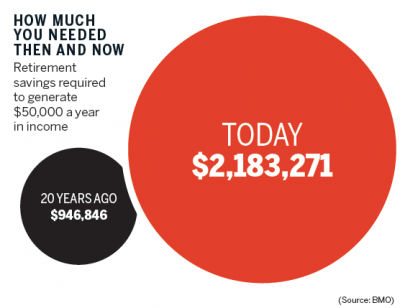 If you’re anything like my dear departed father, you may not need to read any of my new “Retired Money” columns, which are dedicated to solving money management challenges for retirees. You see, my dad was an Ontario high-school teacher and the fortunate beneficiary of the famous defined benefit (DB) teachers’ pension plan.
He didn’t need to worry about investing—he owned only GICs and would proudly declare that he didn’t know a stock from a bond. Unlike you, dear reader, he didn’t need to. With a paid-for home, his GICs, teacher’s pension and government CPP and OAS, Dad was laughing in his classic “do-nothing” retirement. He could take long walks, read to his heart’s content and entertain neighbours with glasses of sherry. Oh, and cheer for the Montreal Canadiens.
His two sons, and readers of their generation, may be less fortunate. For starters, only a minority of workers enjoy the kind of inflation-indexed guaranteed pension that Dad—and his widow—enjoyed…

