

The Run Down on Reverse Mortgages: What Are They and Why Do Home Owners Get Them? + MORE Jun 17th
Q4 Earnings Mortgage Morsels: Scotiabank & RBC + MORE Dec 5th

Mortgage debt rising fastest among Canadians nearing retirement, data show Apr 27th

Should You Accept That Pre-Approved Credit Limit Increase? Jun 5th

The Canadian mortgage stress test, explained + MORE Jul 19th
TD Canada Trust Hikes Prime Mortgage Rate – What’s Next?
– ratesupermarket.ca

It was a move that came as a shock to some but not was not a surprise to others. On November 1st, TD Canada Trust became the first of the big five banks in Canada to raise its prime mortgage rate from 2.7 per cent to 2.85 per cent. The news comes only two weeks after the implementation of brand-new federal mortgage rules, subjecting future homeowners to stricter measures in order to qualify for mortgage insurance, as well as a “stress test” if they are putting down less than 20 per cent on a home purchase.
In a release from TD, the bank says raising the rate is not a decision it takes lightly and they considered the full impact on customers before moving forward with the change. The release states that the bank will communicate directly with their customers whose mortgages are affected. Currently, the move only affects customers with variable rate products, not fixed-rate mortgages or lines of credit.
This Change Affects My Mortgage, so What are My Options?
If you’re affected by the rate hike or if you’re currently negotiating a mortgage with TD, this means the cost of a variable rate mortgage ultimately will increase over the long term…
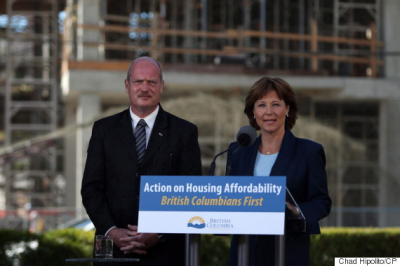 B.C. Premier Christy Clark thinks it’s a shame that Canadians can’t buy more house than they can afford.
That’s the impression one takes away from a recent tweet, which shows her challenging new mortgage rules that were implemented by the federal government last month.
B.C. Premier Christy Clark, at right, stands with Finance Minister Michael de Jong at the Legislature in Victoria on July 25. (Photo: Chad Hipolito/CP)
On Tuesday, Clark tweeted her agreement with a Facebook post by one of her candidates in the upcoming provincial election. It called on B.C. Housing Minister Rich Coleman to pressure the federal government to make more changes.
But to make his point, candidate James Lombardi used an example in which a family intends to buy more house than they can afford under the Canada Mortgage and Housing Corporation (CMHC)’s guidelines.
Lombardi wrote a Facebook post on Monday that was critical of the new rules that aim to ensure borrowers can afford their mortgages.
In doing so, he cited The Globe and Mail’s example of a family making $100,000 qualifying for a mortgage of up to $665,000 with a $40,000 down payment — in other words, the home would cost $705,000, with a down payment of six per cent…
Mortgage Career: VERICO Canada
– canadianmortgagetrends.com
Sloppy Journalism
– canadianmortgagetrends.com
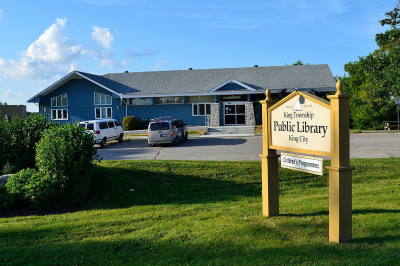 Homeowners in King Township, Ont., have basically won the lottery.
House prices in the region north of Toronto have nearly doubled in just the past year — up 89.6 per cent since October, 2015, according to data released this week by the Toronto Real Estate Board.
The average house price in King is now $1.919 million, up from $1.012 million a year earlier. House prices there have nearly tripled since 2013.
King Township near Toronto has seen house prices nearly double in a year. (Photo: Raysonho @ Open Grid Scheduler / Grid Engine)
With Toronto house prices rising relentlessly year after year, more and more city inhabitants are moving out to the edges, forcing up house prices in places as far from Toronto as Kitchener-Waterloo and St. Catharines.
But the strongest house price growth over the past year has been in some of the most distant parts of Toronto’s 905 suburban region, where many cities have seen nearly 40-per-cent price growth.
It’s this sort of wild price appreciation that the federal Liberals are trying to cool off with the tougher new mortgage rules they introduced last month…

