
What is the “Best” Mortgage Rate? + MORE Sep 19th
Bond yields are back on the rise. Will fixed mortgage rates follow? + MORE Jul 27th
80,000 variable-rate mortgages will reach their trigger point by year-end: RBC + MORE Aug 27th
Mortgage rates going up a little.. for now. What should you do? Jul 2nd

Mortgage risks fading thanks to higher rates, tougher rules, says Bank of Canada report Nov 15th
CREA expects home sales to dip in 2017
– canoe.ca
B.C. Just Made Feds' New Mortgage Rules Pointless
– walletpop.ca
The province will offer homebuyers loans of up to $37,500, or up to 5 per cent of a home’s value, with no payments, interest or otherwise, for the first five years. Any household with an income under $150,000 can qualify.
“The dream of home ownership must remain in the grasp of the middle class here in British Columbia,” Premier Christy Clark said.
B.C. Premier Christy Clark. (Photo: Bloomberg via Getty Images)
According to mortgage comparison site Ratehub, this will significantly boost the maximum price an average British Columbia homebuyer can afford.
“A buyer with $25,000 of their own money has a sufficient down payment for a $500,000 house under the standard rules. With the B.C. government matching their down payment, they will now be able to afford that $750,000 home,” Ratehub said in a statement…
But whether your finances are limited or you simply don’t want to overextend yourself, there are other options.
Location, location, location
For home buyers willing to commute or relocate, affordability may be within their grasp.
Take Toronto, for example, where recent statistics show the median family income is $75,270 and the average home costs $762,975. Using these figures, prospective homebuyers wouldn’t be able to qualify for a mortgage.
“The maximum purchase price this median family’s income could support is $620,935, and they’d need to put six per cent down,” says Rob McLister, founder of RateSpy.com.
Joggers make their way through Majors Hill Park in downtown Ottawa on March 17, 2010. An average home in Ottawa costs only $366,639, compared to Toronto’s $762,975.
But affordability starts to come into the picture about an hour west of the city in the Hamilton-Burlington area where the average home is $507,131…
3 alternatives if you want to own a home
– moneysense.ca
But whether your finances are limited or you simply don’t want to overextend yourself, there are other options.
Move to an affordable market
For home buyers willing to commute or relocate, affordability may be within their grasp.
Take Toronto, for example, where recent statistics show the median family income is $75,270 and the average home costs $762,975. Using these figures, prospective homebuyers wouldn’t be able to qualify for a mortgage.
“The maximum purchase price this median family’s income could support is $620,935, and they’d need to put six per cent down,” says Rob McLister, founder of RateSpy.com.
First time buyers rethinking home ownership dreams »
But affordability starts to come into the picture about an hour west of the city in the Hamilton-Burlington area where the average home is $507,131…
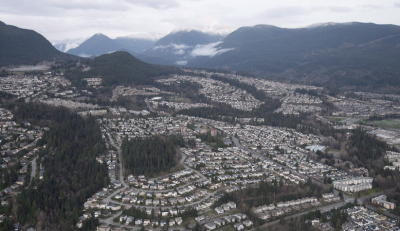 Houses are pictured from the air in Port Moody, B.C. THE CANADIAN PRESS/Jonathan Hayward
With an election less than five months away, Christy Clark’s B.C. Liberal government is into full-on election mode and the countless government spending announcements that come with it. This past Thursday, the government rolled out its newest election season offer: the B.C. Home Owner Mortgage and Equity Partnership Program, carrying a price tag of $703 million over three years. The program’s stated goal is to “ensur[e] the dream of home ownership remains within reach of the middle class” by providing first-time home buyers in the province with 25-year, matching loans worth up to $37,500 for their down payment. No interest would be accrued or payments required over the first five years of the loan.
The response from economists and other housing experts has been nearly unanimous: in the words of Professor Tom Davidoff of UBC’s Sauder School of Business, “it’s terrible policy.” In an overheated housing market with substantial constraints on the supply side like Vancouver or Victoria, this kind of demand shock will simply lead to increased home prices, with the vast majority of benefits accruing to existing homeowners and developers…

