
Most mortgage borrowers to see payments rise 34% to 54% vs. early 2022: Bank of Canada + MORE Dec 22nd
Do I really need life insurance? + MORE Mar 11th
Proof of down payment: The biggest hurdle for mortgage professionals + MORE Aug 4th

More Canadians Living Single: Ways They Are Actually Saving Money + MORE Oct 13th

Bank of Canada Leaves Interest Rate at 1.75%, Markets React + MORE Jan 23rd
Mortgage premium hikes reduce case for borrowing to boost down payment
– canadianbusiness.com
But mortgage brokers say recent government rule changes lessen the case for doing so because people may end up paying a higher interest rate on their mortgage in addition to the additional debt they will have to repay.
“What we’re seeing in the market now is people that have insured mortgages are getting much better interest rates than someone with 20 per cent down,” says Steve Pipkey, co-founder of Vancouver-based Spin Mortgage.
Ottawa announced new restrictions last fall to portfolio insurance, a type of bulk insurance that lenders would use to insure mortgages with down payments of 20 per cent or more.
That has made it more difficult for lenders to insure mortgages with lower loan-to-value ratios and resulted in more competitive rates for borrowers with smaller down payments, brokers say…
BMO chief economist Douglas Porter crunched the numbers and found that someone earning $225,000 a year — right at the cutoff line for being in the one per cent — would not be able to afford to buy an average-priced single-family home in Toronto.
Read more:
New York Metro Area Now More Affordable Than Greater Toronto, Vancouver
12 Charts About Canadian Housing That Will Make You Go WTF
Toronto’s Housing Bubble Has 24 Months To Live: BMO
That’s despite the fact this earner would be considered rich under tax rules. Anyone in Ontario earning above $220,000 pays a combined top marginal tax rate of 53.53 per cent.
Taking into account the “stress test” for mortgages that the federal Liberals instituted last year, Porter estimated that a couple earning $225,000 with $100,000 for a down payment would be able to afford a house of $987,289…
The Case Against Subject-Free Offers
– canadianmortgagetrends.com
What the CMHC premium hike means for you
– moneysense.ca
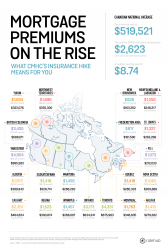 The CMHC is raising mortgage insurance premiums as of today.
Luckily, if you already have a mortgage or if you applied for one before March 17, these changes won’t affect you. If you’re planning to buy a home with a down payment of less than 20%, however, be aware that you’ll have to pay a little more every month—which adds up to quite a lot over a typical 25-year amortization period.
The premium rates for new mortgage loan applications are as follows:
Down payment %
Standard premium (current)
Standard premium (before March 17)
5% to 9.99%
4%
3.6%
10% to 14.99%
3.1%
2.4%
15% to 19.99%
2.8%
1.8%
Depending on where you live in the country and the price of your home, you could pay anywhere between $2 and $17 extra a month in CMHC premiums. On average, Canadians could pay an extra $2,600 over the course of 25 years.
RateHub has crunched the numbers to show Canadians exactly how much more they can expect to pay monthly across the country. See their helpful infographic below…

