
The “Big Five” Canadian banks offer investment funds and include Royal Bank of Canada, Toronto Dominion Bank (TD Canada Trust), Bank of Nova Scotia, Bank of Montreal and Canadian Imperial Bank of Commerce (CIBC). Let’s explore the best place for you to invest.
Latest News




This couple's situation cries out for a financial plan + MORE Aug 14th
A properly conceived financial plan will allow them to consider such worst-case scenarios objectively and plan for different outcomes..... More »
TSX crosses into bear market territory after COVID-19 declared a pandemic - CTV News Mar 11th
TSX crosses into bear market territory after COVID-19 declared a pandemic CTV NewsCanada Stocks Plunge, Putting Them on Pace to Enter Bear Market Yahoo Canada FinanceGordon Pape: There will be more gut-wrenching volatility going forward. Here's how to adjust your portfolio .... More »
Should you join your money with your honey? Jun 3rd
Joint accounts can help you plan your financial future..... More »
Floor collapses at stock exchange in Indonesia, injuring dozens - The Guardian + MORE Jan 15th
The GuardianFloor collapses at stock exchange in Indonesia, injuring dozensThe GuardianA floor at Indonesia's stock exchange has collapsed into the building's lobby, injuring at least 50 people. Part of the floor on the first level gave way, sending debris crashing on to the ground level, .... More »
Alamos Gold to acquire Richmont Mines in friendly offer worth US$770 million + MORE Sep 11th
TORONTO _ Alamos Gold Inc. (TSX:AGI) has signed a friendly deal to acquire Richmont Mines Inc. (TSX:RIC) in an all-stock offer valued at about US$770 million.
Under the agreement, Richmont shareholders will receive 1.385 Alamos shares for each Richmont share they hold.
The offer implies a value of C.... More »
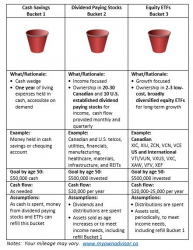
Our bucket approach to earning income in retirement
– myownadvisor.ca
 Save, invest, prosper with My Own Advisor.
Earning income in retirement
There is a wealth of information about asset accumulation, how to save within your registered and non-registered accounts to plan for retirement – when you’re no longer working. Or maybe you are working? Potentially you have income from other sources? Might there be an inheritance or another cash flow source in your future?
My point is, unfortunately there is little information (or not nearly enough written) about asset decumulation including approaches to earning income in retirement.
One of my favourite books about generating retirement income is one by Daryl Diamond, The Retirement Income Blueprint. This is one of the best I’ve read. It is my hope to start exploring this subject more on my site – including for my own benefit – to figure out what earning income in retirement can and needs to look like for us.
Thinking about this subject recently I realized the less I know and the more I need to learn…
As legalization looms, Canada’s volatile marijuana stocks are a risky bet
– canadianbusiness.com
 Tweed employee Ryan Harris works inside the Flowering Room with medicinal marijuana at Tweed Inc. in Smiths Falls, Ontario, on December 5, 2016. (Lars Hagberg/AFP/Getty)
It doesn’t take much to move the dial—up or down—on cannabis stocks. The last five months alone have been a roller coaster for Canadian medical marijuana producers on various stock exchanges, whose investors tend to flinch at the faintest whiff of news that’s just off-neutral in tone.
The latest trigger for investors was a recent CBC report that the Liberal government would stick to its plan to table legislation for recreational marijuana production, distribution and use this spring, and have laws in effect by July 1, 2018.
.cbR{box-sizing:border-box;display:block;width:100%;margin:1em 0;border:1px solid #bbb;padding:.5em}@media (min-width:480px){.cbR{width:250px;margin:0 0 1em 1em;float:right}}How players are jockeying for position in Canada’s nascent pot market
This information wasn’t actually new; it reinforces the general timeline the government had already talked about…
Bombardier reminds us how easy governments make it to forget taxpayer investments: Don Pittis
– cbc.ca
The invisible hand analysis insists executives create wealth and so deserve sky-high salaries. But often it’s quickly forgotten handouts from taxpayers that make their wealth possible.

