
The “Big Five” Canadian banks offer investment funds and include Royal Bank of Canada, Toronto Dominion Bank (TD Canada Trust), Bank of Nova Scotia, Bank of Montreal and Canadian Imperial Bank of Commerce (CIBC). Let’s explore the best place for you to invest.
Latest News


GM proposes $2.8-billion, 10-year investment in South Korea + MORE Feb 21st
Investment would be on top of over $2.2-billion debt-for-equity swap
.... More »
Key financial habits of self-made millionaires Jul 3rd
Adopting these millionaire habits will help you realize savings almost right away, Lesley-Anne Scorgie writes..... More »
Saving For Your IRA + MORE Mar 2nd
Saving for retirement is a must do for any person that wants to be comfortable in their golden years. There is no excuse for not starting early. Even if you are just putting away 50 bucks a month after you are in your first job out of school, that money will grow by leaps and bounds as long as you d.... More »
The best GIC rates in Canada for 2024 Jun 20th
Investing
The best GIC rates in Canada
Find the best GIC rates in Canada. Plus, everything you need to know about how they work.
Compare now
Why trust us
MoneySense is an award-winning magazine,.... More »
Bullish on Best Buy + MORE Dec 30th
A technical look at the stock
.... More »
A national infrastructure bank will ensure Canada’s long-term prosperity
– theglobeandmail.com
For sustained growth, we need to increase investment and leverage private capital
OECD latest international body to call out Canada on housing markets
– canadianbusiness.com
The OECD is calling on Canada to do more to address risks associated with high-priced housing markets in cities such as Toronto and Vancouver, the latest international body to draw attention to the country’s real estate sector.
The Paris-based economic think tank released a report Wednesday saying there should be further tightening of macro-prudential measures undertaken last year, echoing recent advice by the International Monetary Fund.
In particular, the OECD calls for greater use of policy tools such as national debt-to-income constraints that could be more restrictive in areas where house prices are inflated.
It also criticizes some of the Ontario government’s recent efforts to slow the rapid rise in Toronto-area home prices _ specifically the expansion of rental control, which it said could discourage the supply of new rental housing and have broader economic ramifications.
“Low rental supply would hamper labour mobility _ particularly for the poor and the young _which will make adjustment to globalization more costly and prolonged,” the report says…
 Canadian Army instructors discuss mechanized infantry defence tactics with their Ukrainian Armed Forces colleagues during Exercise RAPID TRIDENT in Starychi, Ukraine on June 30, 2016. (Joint Task Force Ukraine)
OTTAWA – CCanada will increase annual defence spending by $13.9 billion over the next decade, Defence Minister Harjit Sajjan said Wednesday as he unveiled the Liberal government’s long-awaited vision for expanding the Canadian Armed Forces.
The money will be used to put another 5,000 troops in uniform and add new modern capabilities, such as letting the military conduct cyberattacks and to buy armed drones for unmanned airstrikes.
It will also go towards offsetting the skyrocketing financial – and political – cost of buying new warships and fighter jets.
“If we’re serious about our role in the world, we must be serious about funding our military,” Sajjan told a news conference.
“And we are.”
Sajjan described the plan as being focused on necessary outputs and capabilities in order to ensure Canada is strong at home, secure within North America and able to meet its international responsibilities…
Is Toronto’s housing market decline for real?
– macleans.ca
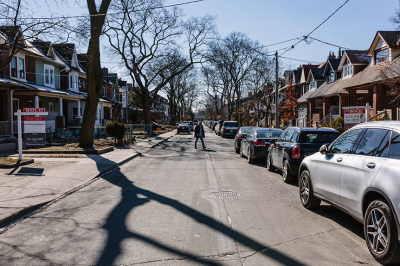 (Mark Sommerfeld/Bloomberg/Getty Images)
It’s official: after a long period of extraordinary home sales and home price growth, the Toronto Real Estate Board (TREB) reported that the Greater Toronto Area’s housing market posted the first set of this year’s declines in May for a market that’s been hot for at least the last two years. But will this be a one-month blip, or a turning point followed by falling prices and sales in the coming months?
Forecasting real estate market performance is a tricky business. But a closer look at the TREB data seems to provide enough support for a reasonable call: sales and prices will continue to fall for at least two or three more months.
In its news release, TREB states that home sales in May 2017 were 20.3 per cent lower than in the same month last year. This was a second month in a row of falling sales as in April 2017 sales dropped year-over-year by 3.2 per cent. Single-detached home sales fell 26.3 per cent in May, while condominium apartment sales were off 6…
Canada needs a federal investment protection agency, separate from the banking and investment industry, to protect Canadian consumers from some of the practices of Canada’s big banks, says a former longtime bank employee.

