
How to go about securing the best return for your investment in Canada.
Latest News


Canadian bank earnings reports Dec 6th
The Big Six banks in Canada reported on their earnings this week. Here are the takeaways, including revenue, prices and dividends.
Canadian bank earnings highlights
Here’s how Canadian banks performed in the three months ending October 31st, 2024:
BMO Financial Group (BMO/TSX): Adjusted ear.... More »
Never made a budget before? Here are a few budgeting basics for post-secondary students + MORE Aug 17th
Budgeting is probably the most important financial skill every student needs to learn because it’s the cornerstone of financial security and, eventually, success. And, if you learn how to manage a tight budget while in school, you should be able to master budgeting for the rest of your life..... More »
Does crypto belong in a Canadian wealth portfolio? Jul 7th
Should you consider adding bitcoin (BTC), ethereum (ETH), or other cryptocurrencies to your investment portfolio? For long-term investors who can tolerate significant volatility, a small allocation—sometimes around 5%—is increasingly part of the conversation.
Crypto’s appeal lies in its gro.... More »
How will the outcome of the U.S. election affect financial markets? + MORE Nov 1st
Whichever candidate wins the U.S. president election next Tuesday, experts say investors will be relieved to shed some uncertainty over what kinds of policies to expect.
But macroeconomic factors like interest rate cuts and geopolitical tensions will be far bigger influences on markets in t.... More »
Why are mortgages so expensive in Canada? A look at 2024 and 2025 + MORE Jan 21st
Housing affordability—while still extremely expensive in many of Canada’s major real estate markets—was all over the map in 2024, as central bank interest rate cuts reduced mortgage rates, and a lack of demand in the first half of the year kept a lid on buyer competition.
According to the y.... More »
How to invest your money in Canada as a U.S. citizen
– moneysense.ca

Q: I am both a Canadian and American. At this juncture, I will not give up my American citizenship since my family is down there and I am only 33. I have maxed my RRSP and I want to invest in ETFs in a non-registered account but I understand there are issues with U.S. tax liabilities.
There are over a million Americans in Canada. My question is simple: what platform can an American in Canada use to acquire indexes or ETFs with minimal tax liability and simplicity for IRS reporting?
–Megan
A: As you likely know, Megan, American citizens need to file U.S. tax returns every year on their worldwide income, regardless of where they live. That means one million U.S. citizens in Canada should be filing with the IRS. Not all of them do.
There is a bilateral agreement between Canada and the U.S. to avoid double taxation and because Canadian tax rates are generally higher than U.S. rates, many Canadian tax filers have no U.S. tax liability on their U.S. returns. That doesn’t mean you don’t need to file or worry about what you invest in here in Canada…
ICBC rates will be hiked 6.4% starting November
– moneysense.ca
VANCOUVER (NEWS 1130) – Attorney General David Eby has announced ICBC rates will be hiked 6.4 per cent, starting November 1st.
He says “drastic action” is needed to fix financial problems at the insurer.
For the average driver, that means an increase of about $60 a year.
Eby says BC drivers were “deceived” by losses under-reported by the previous BC Liberal government.
He says the 6.4 per cent hike is lower than the 20 per cent rate hike that was recommended by the report commissioned by the previous government and released in July 2017.
Former Premier Christy Clark promised to freeze rate hikes at five per cent and the NDP campaigned on a promise to freeze them up to two years.
The Province will also roll out 24-hour red-light cameras at high-collision intersections, which is up from the current six hours per day.
Eby has also announced a pilot program of new technologies to eliminate distracted driving among high-risk groups.
The NDP government says ICBC had its largest financial loss in the organization’s history last year, losing more than half-a-billion dollars in 12 months…
He says “drastic action” is needed to fix financial problems at the insurer.
For the average driver, that means an increase of about $60 a year.
Eby says BC drivers were “deceived” by losses under-reported by the previous BC Liberal government.
He says the 6.4 per cent hike is lower than the 20 per cent rate hike that was recommended by the report commissioned by the previous government and released in July 2017.
Former Premier Christy Clark promised to freeze rate hikes at five per cent and the NDP campaigned on a promise to freeze them up to two years.
The Province will also roll out 24-hour red-light cameras at high-collision intersections, which is up from the current six hours per day.
Eby has also announced a pilot program of new technologies to eliminate distracted driving among high-risk groups.
The NDP government says ICBC had its largest financial loss in the organization’s history last year, losing more than half-a-billion dollars in 12 months…
Cenovus Energy’s $975M Pelican Lake sale a ‘first step’ to reducing debt burden
– canadianbusiness.com
CALGARY — Investors and analysts offered measured praise Tuesday as Cenovus Energy (TSX:CVE) delivered the first of four key asset sales it has promised to help pay for its $17.7-billion purchase of most of the Canadian assets of ConocoPhillips.
The Calgary-based oilsands company announced it is selling its Pelican Lake heavy oil operations in northern Alberta for $975 million in cash to cross-town rival Canadian Natural Resources (TSX:CNQ). The deal is expected to close by the end of September.
Cenovus has been in the doghouse with investors since March 29 when it announced the acquisition of oilsands and conventional assets from Houston-based ConocoPhillips, along with a plan to raise $3 billion by issuing new shares and the marketing of its Pelican Lake and southern Alberta Suffield operations.
Its shares, which had fallen almost 43 per cent by last Friday, were up about three per cent Tuesday morning.
“This represents a significant first step in our strategy to optimize our asset portfolio and deleverage our balance sheet as planned following the acquisition of the ConocoPhillips assets,” said Cenovus CEO Brian Ferguson in a statement…
The Calgary-based oilsands company announced it is selling its Pelican Lake heavy oil operations in northern Alberta for $975 million in cash to cross-town rival Canadian Natural Resources (TSX:CNQ). The deal is expected to close by the end of September.
Cenovus has been in the doghouse with investors since March 29 when it announced the acquisition of oilsands and conventional assets from Houston-based ConocoPhillips, along with a plan to raise $3 billion by issuing new shares and the marketing of its Pelican Lake and southern Alberta Suffield operations.
Its shares, which had fallen almost 43 per cent by last Friday, were up about three per cent Tuesday morning.
“This represents a significant first step in our strategy to optimize our asset portfolio and deleverage our balance sheet as planned following the acquisition of the ConocoPhillips assets,” said Cenovus CEO Brian Ferguson in a statement…
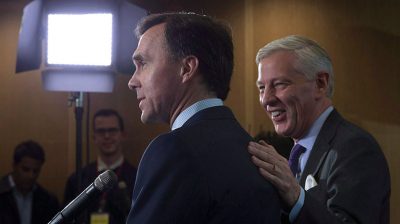 Chairman of the Advisory Council Dominic Barton pats Minister of Finance Bill Morneau on the shoulder during a news conference in Ottawa, Thursday, October 20, 2016. (Adrian Wyld/CP)
Dominic Barton is all about scale. When the global managing partner of McKinsey & Co. gives a talk, he’s prone to showing audiences photographs of Chinese city skylines mushrooming, over what seem to be impossibly short time spans, from roughly Moncton to beyond Manhattan. Barton, a Canadian whose deep experience in Asia lifted him to the pinnacle of McKinsey’s far-flung consulting empire, has a knack for conveying how if you’re not going big, you just don’t get the 21st-century economy.
So when he was named last year by Finance Minister Bill Morneau to chair the federal government’s blue-chip Advisory Council on Economic Growth, nobody who knew him was surprised that Barton set goals of scaled-up ambition. The problem, he warned, is that Canada’s workforce is rapidly aging, while its companies are stuck in a low productivity gear, putting the country on track to generate only half of the annual growth in the next few decades that Canadians have come to expect over the past 50 years…

