
The “Big Five” Canadian banks offer investment funds and include Royal Bank of Canada, Toronto Dominion Bank (TD Canada Trust), Bank of Nova Scotia, Bank of Montreal and Canadian Imperial Bank of Commerce (CIBC). Let’s explore the best place for you to invest.
Latest News



Selling stocks at a loss in a TFSA: What it means for your contribution room Apr 11th
Ask MoneySense
I lost $20,000 dollars in my TFSA account in the market correction, and my broker sold the losing stocks. Can I put more money in to bring me back up the to the limit the government allows?—Wayne
Capital losses in a TFSA
A capital loss is when you sell an investment at a lowe.... More »
Stock news for investors: Spinoffs, acquisitions, and market moves Oct 2nd
Here’s a round-up of news for Canadian investors this week.
Maple Leaf Foods
TMX group
MEG Energy
Stella-Jones
Algoma Steel
Featured RRSP Accounts
featured
EQ Bank
Build .... More »
Planning to use your home equity in retirement Jun 3rd
How much of your net worth is wrapped up in your home? According to Statistics Canada, the median net worth for senior families in 2023 was $1,109,700. The most common type of asset for Canadians was a family home, with a median value of $500,000.
Since home equity makes up such a significant all.... More »
Dating dilemma: When to talk about finances + MORE Mar 15th
When it comes to popular first-date conversation topics, credit scores and debt levels aren’t at the top of the list. Even committed couples may find it hard to broach financial topics like retirement planning or estate planning. But as the cost of living goes up and people try to plan for the fut.... More »
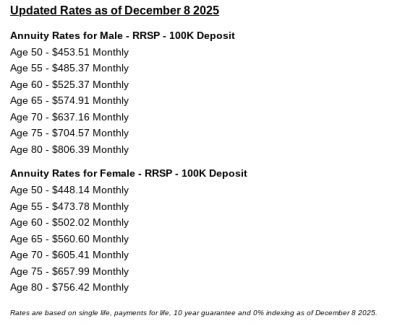
Unlocking the Annuity Puzzle: Why Canadians avoid what seems to be the perfect retirement vehicle + MORE Dec 18th
The Annuity Puzzle is about a curious phenomenon in Canada: while life annuities sold by insurance companies seem to have all sorts of compelling reasons to acquire them, more often than not, retirees shun them.
Financial planner Robb Engen recently tackled this puzzle in his Boome.... More »
For a long time, inflation-linked bonds like TIPs (Treasury Inflation-Protected Securities) in the U.S. or Government of Canada Real Return Bonds (RRBs) seemed like valid alternatives to nominal bonds for inflationary environments. If inflation ticks above certain levels, such bonds—or exchange-traded funds (ETFs) that hold them—tack on extra interest payments twice yearly, commensurate with the rise in the official inflation rate.
Matthew Ardrey, a wealth advisor with Toronto-based TriDelta Financial, says that while inflation’s average 2% annual rate over the last 20 years has been considered “benign,” it’s still 40 basis points higher than the average Bank of Canada overnight rate during that period. “It has been eroding risk-free returns for a long time.”
Prevailing interest rates have been less responsive to inflation dynamics in that time frame, Ardrey adds. “Central banks have communicated a tolerance for higher inflation rates in order to foster growth.”
Duration risk and inflation-linked bonds
TIPS were designed for the U…
Cutting down capital gains tax on real estate sales
– moneysense.ca
Is there any real estate investment I could invest my capital gains in, without being robbed of paying 50% capital gains tax?
I understand there is an exception for the sale of commercial property.
—Dennis
Capital gains tax on real estate
One of the biggest complaints I’ve heard from real estate investors is the dreaded capital gains tax hit, Dennis.
Stock market investors don’t seem to be nearly as patient. Real estate is generally a long-term hold, while stock turnover tends to be more frequent. Real estate investors often end up with larger capital gains as well because real estate is such a large investment, with a market value worth more than many investors’ stock portfolios.
If a rental real estate investor has claimed depreciation, also known as capital cost allowance (CCA), all past CCA gets “recaptured” and taxed in the year of sale in addition to capital gains tax payable.
How much is capital gains tax in Canada?
A capital gain, Dennis, is 50% taxable. I want to clarify this because you referred to paying 50% capital gains tax…

