
‘GTA 6’ vs. Hollywood: Industry Braces for Biggest Entertainment Launch in History - The Hollywood Reporter Nov 11th
Canada’s instant payments network launches after years of delays - The Globe and Mail + MORE Nov 9th
Ottawa readies ban on fees for moving investment accounts - CBC Nov 5th
Bare trust rules for 2026: Do you actually have to file a T3? + MORE Nov 13th
Anthropic stock soars by double-digits in Nasdaq debut - CBC + MORE Nov 19th
How can I leave more money to my children?
– moneysense.ca
Hi Mary. What exactly do you mean by a RRIF meltdown? I used to think a RRIF meltdown was borrowing money to invest and using the tax deduction on the interest to offset or reduce the tax on registered retirement income fund (RRIF) withdrawals. Today it seems a RRIF meltdown is associated with any withdrawals above your income need or starting a RRIF before age 72.
Let’s forget about the term RRIF meltdown and talk about what you really want: getting more money to your children…
At a conference hosted by the Alberta Securities Commission on Tuesday, John McKenzie was asked on stage whether he is concerned about the drop in numbers of issuers trading on the TSX. He said it’s not a phenomenon that’s limited to Canada and that it’s partly a function of there being so much growth concentrated in a relatively few large-cap names.
“We have actually a lot of growth in market capitalization. We have fewer, bigger companies, which in some ways is great. We want to have really large, successful Canadian companies because that allows them to compete on the world stage and you need to have scale to compete globally,” McKenzie said.
“But at the same time, if we hollow out that middle of the market, it makes it more difficult for small big-cap companies to find the capital they need to scale up to become the next Enbridge or Shopify or RBC…
Should Canadian investors break up with their bond ETFs?
– moneysense.ca
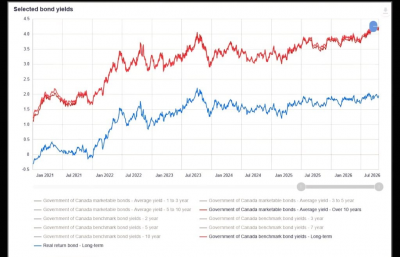 One of the biggest behavioural pitfalls investors need to watch out for is recency bias. This is the tendency to place disproportionate weight on recent events when forming expectations about the future. It can influence everything from which investments we buy to how portfolios should be constructed.
One example I’ve noticed gaining traction on Reddit is the argument that investors should break up with their bond exchange-traded funds (ETFs). We’ve previously explored a variation of this idea through the proposed 40/30/30 portfolio, which allocates 40% to stocks, 30% to bonds, and 30% to alternative investments. Its proponents argue that adding alternatives can provide better risk-adjusted returns than the traditional balanced 60/40 portfolio of equities and fixed income.
This discussion gained momentum following 2022, when an unusual combination of high inflation and rapidly rising interest rates produced historically poor returns for bonds in the same year as a stock market slump…

