
TSX getting you down? There are always sound investment alternatives.
Latest News




Kirstine Stewart to leave Twitter + MORE Jul 21st
The Twitter logo appears on a phone post on the floor of the New York Stock Exchange, Tuesday, Oct. 13, 2015. Twitter is laying off up to 336 employees, signaling CEO Jack Dorsey’s resolve to slash costs while the company struggles to make money. (AP Photo/Richard Drew)
TORONTO — TwitterR.... More »
Most actively traded companies on the TSX + MORE Mar 29th
Some of the most active companies traded Monday on the Toronto Stock Exchange:
Toronto Stock Exchange (13,390.19, up 32.08 points):
Acerus Pharmaceuticals Corp. (TSX:ASP). Drug manufacturer. Up eight cents, or 84.21 per cent, to 17.5 cents on 6.3 million shares.
Encana Corp. (TSX:ECA). Oil and gas. .... More »
60 days - 1.75% + MORE Jan 19th
This GIC rate is offered by Oaken Financial and was updated on 2014-12-19. Click on the link above to get more details or apply online..... More »
IMF warns China on rising debt levels + MORE Jun 5th
The International Monetary Fund urged China on Thursday to make a priority of containing financial risks that stem for its rising debt..... More »
Bitcoin, marijuana stock crazes take root in Canada’s Wild West Dec 22nd
Low bar lends itself to stock promotion, murky disclosure
.... More »
WATERLOO, Ont. – BlackBerry shares were up in pre-market trading after Canada’s flagship technology…
How to argue with a Couch Potato
– moneysense.ca
Last week, Advisor.ca published a debate under the heading “Faceoff: Index, friend or foe?” The arguments against passive investing should be helpful to mutual fund salespeople trying desperately to defend their turf in the face of overwhelming evidence that they are failing investors. Here’s a summary of the arguments in the article, along with some helpful tips:
1. Imply that large funds are more likely to outperform
Example: “The best-performing mutual funds are usually the ones with the most AUM, a fact glossed over by promoters of the passive option.”
Start by implying that investors who chose funds with more assets under management (AUM) have a greater probability of outperformance. This won’t be easy, because your client might notice you’ve got it backwards. He might explain how funds grow in assets after they have performed well, because advisors chase performance. He might explain the concept of survivorship bias. Finally, he might ask you for data showing a correlation between fund size and future performance, which will be awkward, because there is none…
1. Imply that large funds are more likely to outperform
Example: “The best-performing mutual funds are usually the ones with the most AUM, a fact glossed over by promoters of the passive option.”
Start by implying that investors who chose funds with more assets under management (AUM) have a greater probability of outperformance. This won’t be easy, because your client might notice you’ve got it backwards. He might explain how funds grow in assets after they have performed well, because advisors chase performance. He might explain the concept of survivorship bias. Finally, he might ask you for data showing a correlation between fund size and future performance, which will be awkward, because there is none…
New Trade: Long TripAdvisor ($TRIP) & Short Pandora Media ($P)
– IntelligentSpeculator.net
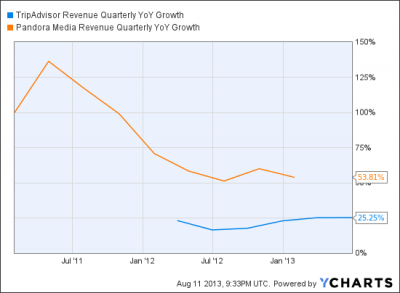 Overall, things have been going well so far in terms of trading in 2013. The one weaker aspect had been my long & short tech stock picks but that is coming back as my average trade has returned 2.40% so far this year which is above my objectives. Of course, that could change but so far it’s been good. I will be making a few more picks hopefully but as has been the case in the past years, I will not open new long & short after the end of August.
You might have seen that I currently have my maximum of 7 live trades so to open a new one, I will be closing one. I will close the trade on Long TripAdvisor (TRIP) and short OpenTable (OPEN) which currently stands at +35.28%. I did like this trade obviously but I don’t love being short OPEN so I’m more than happy taking today’s gain off the table.
Today I’m back with a new long & short trade with two fairly familiar names.Let’s start off by looking at the numbers:
TickerNamePriceEPSPE RatioPE Next YearReturn YTDSales GrowthAnalyst ratingBook ValueBetaRevenue/ShareSales 5Y Avg GrowthEPS 5Y Avg Growth
TRIPTripAdvisor Inc80…
How to Argue With a Couch Potato
– CanadianCouchPotato.com
Last week, Advisor.ca published a debate under the heading “Faceoff: Index, friend or foe?” The arguments against passive investing should be helpful to mutual fund salespeople trying desperately to defend their turf in the face of overwhelming evidence that they are failing investors. Here’s a summary of the arguments in the article, along with some helpful tips:
1. Imply that large funds are more likely to outperform
Example: “The best-performing mutual funds are usually the ones with the most AUM, a fact glossed over by promoters of the passive option.”
Start by implying that investors who chose funds with more assets under management (AUM) have a greater probability of outperformance. This won’t be easy, because your client might notice you’ve got it backwards. He might explain how funds grow in assets after they have performed well, because advisors chase performance. He might explain the concept of survivorship bias. Finally, he might ask you for data showing a correlation between fund size and future performance, which will be awkward, because there is none…
1. Imply that large funds are more likely to outperform
Example: “The best-performing mutual funds are usually the ones with the most AUM, a fact glossed over by promoters of the passive option.”
Start by implying that investors who chose funds with more assets under management (AUM) have a greater probability of outperformance. This won’t be easy, because your client might notice you’ve got it backwards. He might explain how funds grow in assets after they have performed well, because advisors chase performance. He might explain the concept of survivorship bias. Finally, he might ask you for data showing a correlation between fund size and future performance, which will be awkward, because there is none…
When mutual funds are a good idea
– moneysense.ca
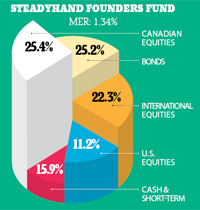 Shannon Dalziel, a fee-based investment adviser at PWL Capital in Toronto, knows all too well that mutual funds have a terrible reputation. It’s not uncommon for her clients to balk at the very notion of using them—and it’s easy to understand why. Canada’s mutual fund industry is mired in a tradition of outrageous fees, hidden sales charges, and self-interested salespeople who have eroded the public’s trust.
So it’s little wonder that exchange-traded funds—which usually have much lower fees—are often perceived as the only investment tool for savvy savers. “What many people don’t seem to realize is the structure of mutual funds is perfectly sound,” Dalziel says. “When used correctly, mutual funds can be very appropriate for certain types of investors.”
There’s no question ETFs are one of the best things to happen to Canadian investors in decades, but they’re not for everyone. For starters, you normally pay commissions to buy and sell them, which makes them unsuitable for small accounts (you typically need at least $50,000 to make them cost-effective) or those who make preauthorized monthly or biweekly contributions…

