
How to go about securing the best Retirement Plan in Canada.
Latest News




Retirement Income for Life: Why Canadian retirees love Frederick Vettese’s books and his PERC + MORE Feb 22nd
Since I turn 71 soon, my attention is naturally becoming focussed on the inevitable question of what to do when my registered retirement savings plan (RRSP) must be collapsed. Do I keep it as a registered retirement income fund (RRIF)? Or should I convert it into an annuity? Maybe I do a combination.... More »
How foreign withholding taxes affect returns + MORE Jul 29th
In our newly revised white paper, Justin Bender and I explain the hidden cost of foreign withholding taxes on U.S. and international equity ETFs. I gave an overview of the most important points in my previous blog post. Now let’s look at one of the more subtle ideas: how those taxes affect your pe.... More »
RRIF withdrawals: What should seniors with million-dollar portfolios do? Nov 16th
Ask MoneySense
I have invested well and now I am in my 80s. My RIF is almost $3 million and is going to attract heavy taxes. My other investments are about $2 million, some with capital gains which we are going to donate to charity.
Any suggestions on how to reduce the huge tax liability? Should .... More »
CPP payment dates this year, and more to know about the Canada Pension Plan + MORE Aug 30th
In Canada, no retirement plan is complete without considering the CPP. Whether you’re approaching retirement or still several years away from it, the Canada Pension Plan will likely play a role in your retirement income. How big a role depends on several factors. You may have other questions, too..... More »
Making sense of the markets this week: September 17, 2023 Sep 21st
Kyle Prevost, creator of 4 Steps to a Worry-Free Retirement, Canada’s DIY retirement planning course, shares financial headlines and offers context for Canadian investors.
U.S. inflation battle: Mission not accomplished
Despite increasing interest rates and hawkish talk from the U.S. F.... More »
What Snowbirds Need to Know About Cross-Border Banking
– walletpop.ca
 Filed under: Credit Cards, Family Finances, Retirement and RRSPs, Travel, HolidaysEvery year, half a million retired Canadians head to Florida for extended periods of time to escape freezing temperatures and snow shoveling. However, it’s not all fun in the sun. One thing snowbirds need to consider is how to handle their finances while in the U.S.
Here’s what snowbirds need to know about cross-border banking.
Continue reading What Snowbirds Need to Know About Cross-Border BankingWhat Snowbirds Need to Know About Cross-Border Banking originally appeared on Walletpop Canada on Mon, 16 Sep 2013 11:54:00 EST. Please see our terms for use of feeds.Permalink | Email this | Comments
Should I join my company pension?
– canoe.ca
Starting a new job can be a nerve-wracking and yet exciting experience.
The Great TFSA Race: Enter for your chance to win
– moneysense.ca
 Perhaps the federal government’s greatest gift to those who aspire to financial independence is the TFSA, or Tax Free Savings Account, introduced in 2009. With $25,500 cumulative contribution room rising to $31,000 as of January 2014, TFSAs have now attracted a significant amount of capital. Consider that between them, couples will soon have $62,000 available that will be largely free from the clutches of the tax person.
In the early days, the mere $5,000 that was available initially seemed so insubstantial that many tended to give the vehicle short shrift. Certainly, many baby boomers felt TFSAs were too little and too late for their purposes, although they would look with a certain amount of envy at millennials and young investors with a 40-year investing time horizon ahead of them—indeed, many financial gurus have calculated that merely by maxing out TFSA contributions over such a time frame, that alone would be sufficient to ensure a comfortable retirement: no RRSP or employer pension plan contributions necessary! (We would of course advocate doing all of those things, since saving too much is a far better problem to have than saving too little…
One in five may never fully retire: global study
– moneysense.ca
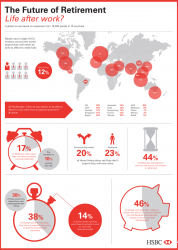 A global retirement survey finds 12% of workers in 15 countries—including almost one in five (17%) Canadians—expect they’ll never have enough money to fully retire.
The HSBC’s The Future of Retirement: Life After Work, being released today, found 54% of Canadian retirees who were unable to realize their retirement dreams cited having less money than they expected to have. Tellingly, almost two-thirds (64%) of the 16,000 people surveyed globally who had entered semi-retirement said they wish they’d kept working full-time for longer. The online survey was conducted between July 2012 and April 2013, and included 1,046 Canadians.
Still, for those who set their retirement plans early enough in life, working-age people globally still expect to retire on average by age 63, which is just two years later than the previous generation (their parents), who retired on average by age 61.
When retirees were asked about the best financial advice they ever received, the most popular response (and one I’d plump for) was “Start saving at an early age…
More Canadians Entering Defined Contribution Pension Plans
– rhondasherwood.com
 Do you understand how your pension plan is structured? More employers offering this benefit are turning away from the Defined Benefit pension plan (DB Plan) and offering their workers a Defined Contribution Pension Plan (DC Plan) instead. You’ll have to consider your options carefully to make the most of your choices within this structure for your pension plan.
Defined Benefits Pension Plans
A Defined Benefits Pension plan would be the preferred method of calculating pension benefits for most employees. It is based on years of service multiplied by a percentage of your salary over the last few years you worked for the company. (Since you probably earned your highest salary during this time, this would be to your advantage.)
If you work for the government, your defined benefit plan may provide you with 60-70 percent of your average salary over your last several years of service once you have reached the 30 or 35 years of service level.
This type of plan is independent on market performance and is usually adjusted for inflation…

