
How the coronavirus pandemic could change the way we think about retirement in Canada Apr 29th
Britain ready to confront expected Brexit volatility, treasury chief says + MORE Jun 27th

Pembina Pipeline posts 1st-quarter profit of $74.3 million + MORE May 5th
Surviving the present, investing in the future: Gen Z’s financial balancing act Sep 13th
At least 3 killed after Zimbabwe troops fire upon protesters in clash over vote results - CBC.ca Aug 1st
4.5 year – 2.60%
– ratesupermarket.ca
Making smarter asset location decisions
– moneysense.ca
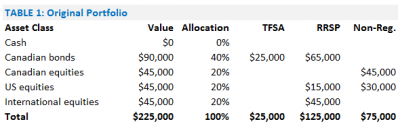 Last week’s posts about tax loss selling prompted some interesting questions about asset location in the comments section. Holding your ETFs and index funds in the most tax-efficient accounts can have a big impact on your long-term returns. But although it’s often easy to set up a portfolio with proper asset location, it can be a challenge to maintain the right balance when you add new money.
Say you’re using the Global Couch Potato portfolio spread across three accounts. Your TFSA and RRSP are maxed out at $25,000 and $125,000, respectively, and you have another $75,000 in a non-registered account. Your optimal asset location would look like this:
So far, so good. But now you’ve won second prize in a beauty contest and received a $25,000 windfall. Since you can’t add it to your tax-sheltered savings, you put the money in your non-registered account. Then you enter the new values into your rebalancing spreadsheet and discover your portfolio is now off its target:
The naive way to rebalance your portfolio would be to make all the transactions in your non-registered account…
Making Smarter Asset Location Decisions
– CanadianCouchPotato.com
 Last week’s posts about tax loss selling prompted some interesting questions about asset location in the comments section. Holding your ETFs and index funds in the most tax-efficient accounts can have a big impact on your long-term returns. But although it’s often easy to set up a portfolio with proper asset location, it can be a challenge to maintain the right balance when you add new money.
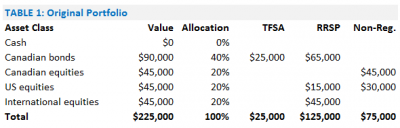
Say you’re using the Global Couch Potato portfolio spread across three accounts. Your TFSA and RRSP are maxed out at $25,000 and $125,000, respectively, and you have another $75,000 in a non-registered account. Your optimal asset location might look like this:
So far, so good. But now you’ve won second prize in a beauty contest and received a $25,000 windfall. Since you can’t add it to your tax-sheltered savings, you put the money in your non-registered account. Then you enter the new values into your rebalancing spreadsheet and discover your portfolio is now off its target:
The naive way to rebalance your portfolio would be to make all the transactions in your non-registered account…
Marriott International posts $160M 3Q profit on higher rates, occupancy, more group bookings
– canadianbusiness.com
The hotel chain, best known for brands like Courtyard, Ritz Carlton and Fairfield Inn, reported net income of $160 million, or 53 cents per share, for the three months ended Sept. 30. That was up from $143 million, or 45 cents per share, in the 2012 third quarter.
The Bethesda, Md.-based company changed its reporting calendar and this year’s quarter is eight days longer than last year.
Marriott reported $3.16 billion in revenue, up 16 per cent from $2.73 billion last year.
Analysts, on average, expected earnings of 45 cents per share and revenue of $3.04 million, according to FactSet.
The company’s revenue per available room — or REVPAR — was $104.77, up 4.8 per cent from the prior year. Analysts had predicted it would be $104.
The figure is an important gauge for the industry because it measures occupancy and rates…
Shoppers to benefit from Sears closures
– moneysense.ca
 (Photo: Simon Hayter/Profit)
The shuttering of five more major Sears Canada stores in Ontario and B.C., including the flagship Eaton Centre location, couldn’t have come at a better time for consumers.
Sears Canada spokesperson Vincent Power confirmed to MoneySense that all five stores are fully stocked for the holidays and will be offering liquidation-type sales on much of those goods in the coming weeks. That means rare, steep discounts on in-demand items. Expect the most aggressive sales to coincide with the Black Friday shopping weekend (Nov. 29-Dec. 1) and continue thereafter.
“Starting in a few weeks (shoppers) are going to see liquidation signs and at that point those prices will stay that way until merchandise is cleared,” Power said, adding that the best deals will be on fashion, toys and housewares since the retailer is less likely to redistribute those goods to other stores in the chain. Appliances, electronics and furniture (excluding floor models) are less likely to be significantly reduced and will be sent back to stock rooms…

