

Should I use money from my TFSA to contribute to my RRSP? It depends … Feb 6th

As feds consider Bombardier’s plea, Notley calls on Ottawa to support Alberta + MORE Feb 22nd

Financial independence and travel: Can you have both? Apr 24th
The best high-interest savings accounts in Canada for 2025 + MORE Sep 22nd

EU moves to shore up borders, boost refugee co-operation with Turkey - Hamilton Spectator + MORE Oct 16th
Reader Question – Should I invest directly in the USA outside registered accounts?
– myownadvisor.ca
I invest in dividend paying stocks for a few key reasons:
I like it when companies pay me money every month or quarter,
In many cases, these companies increase their dividends every year, providing some inflation protection, and
In a non-registered account, the Canadian stocks I own qualify for the dividend tax credit.
I invest in indexed ETFs for a few key reasons:
To achieve market performance less minuscule money management fees,
To provide great diversification, beyond Canadian stocks and ETFs, and
To somewhat “set and forget” part of my retirement portfolio.
Beyond my Canadian dividend paying stocks, I also hold a few U.S. dividend paying stocks but only in my RRSP. The TFSA is OK for U.S. stocks and U.S.-listed ETFs but not an ideal location since any dividends received from these U.S. investments get hit with 15% withholding taxes in the TFSA and cannot be recovered…
Facebook ($FB) A Much Better Value Than Twitter ($TWTR)
– IntelligentSpeculator.net
 I had mentioned that I’d be very reluctant to short a stock like Twitter (TWTR). I do stand by that statement and doubt I’d short it anytime soon. There is too much risk involved in betting against a stock that has so much potential, an incredibly volatile stock, etc. That being said, as much as I was tempted to buy Facebook right after the IPO, I’m not getting that feeling when I look at Twitter. It looks incredibly expensive to me. There is certainly a possibility that Twitter will be one of those stocks like Amazon (AMZN) and LinkedIn (LNKD) that ends up getting away. I am willing to take that risk though as I feel like here are stocks with higher upside risk with less risk. The obvious comparison to Twitter is Facebook of course. Why?
-Facebook was the last big tech stock to go public
-They are both part of the new “social web”
-The both had many question regarding their profitability
-etc
Comparisons Stop There
Yes, the Twitter IPO has certainly gone much smoother…
Carrick on money: Canada’s favourite travel reward cards are…
– theglobeandmail.com
Worst Mutual Fund Ad of the Year?
– CanadianCouchPotato.com
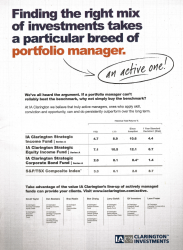 The mutual fund industry loves to sell past performance, and it’s not above massaging the data to make that performance look even better. But every now and then an advertisement appears that sets the bar even lower. Michael Callahan, a financial planner in Ottawa, recently sent me an ad for IA Clarington Investments that might be the worst one I’ve seen yet. “I figured you might welcome an opportunity to rip this one to shreds,” he wrote. Challenge accepted.
First there’s the time frame. The ad says the company believes active managers “can and do persistently outperform over the long-term.” But as explained in the fine print (microscope not provided), the year-to-date returns in the first column of the table are for the period ending March 31, so we’re talking about three months. We get 12-month returns in the second column, and the third column gives the funds’ returns since their inception. Problem is, the three funds spotlighted here were launched in the late summer of 2011, so they had been around for all of 18 to 19 months when these returns were calculated…

