
Retirement planning getting you down? There are always smart ways to plan the financial aspects of your retirement.
Latest News


Are Canadians Getting the Most From Their Retirement System? + MORE Sep 17th
Depending on where you live and work, the answer to this question will vary. In addition to potentially having a workplace pension plan, Canadians have private options such as RRSPs and TFSAs, as well as several government products to navigate such as CPP, OAS and GIS. Depending on which province yo.... More »
Reducing risk in an RESP: How to invest as your kid approaches college or university + MORE Oct 5th
If you’ve opened a registered education savings plan (RESP) for your child or grandchild, congratulations. You’ve taken the first step towards financing their future college, university or trade school education. And now your family can start benefiting from generous government grants worth thou.... More »
Can you delay a RRIF withdrawal? Jun 6th
Ask MoneySense
I read you can base your RRIF withdrawals on your wife’s age to minimize them. Can you please explain exactly what that means? My wife is seven years younger than me, and I am 68. I already have a small RRIF, set up for the pension benefit. When I hit 71, when I convert my RRSP to a.... More »
Why contributing to a TFSA is a good resolution Dec 28th
If nothing else, tax-free savings accounts (TFSAs) have been a boon to Canadian financial writers and bloggers. Two noteworthy examples: A blog on Boomer & Echo by CFP Robb Engen (also a MoneySense ETF expert panelist for the annual Best ETFs in Canada feature) comparing TFSAs to registered reti.... More »
Slashing debt is Canadians’ number one priority in 2018 + MORE Dec 30th
TORONTO — Canadians are keen to lighten their debt loads in 2018, according to an annual opinion survey conducted for CIBC.
The Toronto-based bank says debt reduction or elimination was the top priority for 25 per cent of the poll respondents.
Paying bills or just getting by .... More »
Why you don’t need an emergency fund
– moneysense.ca
 (Artpartner/Getty Images)
Q: I know when you work you should have an emergency fund to cover about six months of your expenses. In retirement, how much emergency/contingency fund should I have?—Renuka
A: You’ve put an interesting twist on a common financial planning question, Renuka. I should start by saying that I’m not a big fan of the six-month emergency fund rule, at least in a traditional sense. I’ve heard six months of income as well as six months of expenses, but since most people spend almost everything, it’s more or less the same thing.
The median family income in Canada according to the 2011 census was $76,000. After tax, depending on province of residency, tax deductions and credits and how that income is split between two spouses, the median family takes home about $60,000. A six-month emergency might therefore be about $25,000.
If a family keeps $25,000 in cash earning 1% over a period of 25 years—if they can even scrape it together in the first place—they might pay an incremental $27,344 in interest if they’re simultaneously carrying debt at 4%…
The coming health benefits shock for retirees: Mayers
– thestar.com
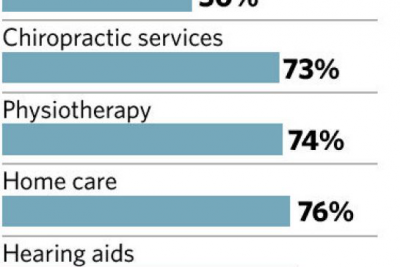 Many Canadians believe things like glasses, drugs and nursing homes will be paid for in retirement by our universal health care. They should think again.
 Getty Images
TORONTO – Two-thirds of Canadians say their biggest concern as they get older is their health, but less than a quarter report that they’ve planned or saved up for health costs in retirement, according to a survey conducted for Sun Life Financial (TSX:SLF).
The 2014 Sun Life Canadian Health Index found that 66 per cent of those surveyed said deteriorating health was their biggest worry going into old age.
Only 22 per cent said they had made financial plans for unexpected health emergencies once they stopped working even though more than half (53 per cent) said they worried about the cost of drugs and medical treatments.
Forty-seven per cent said worried about needing more long-term care than they have the money for, while 45 per cent said they fret over whether they’ll outlive their savings.
Among a subgroup of 444 retirees polled, 69 per cent said they did not stop working on the date they planned, with 41 per cent of that group citing health concerns as the mean reason they had to leave work early…
If there is No Mandatory Retirement, Why Stop Working?
– rhondasherwood.com

The idea of retirement (stopping work at a certain age) is one that has only existed for a relatively short time. In 1927, the Old Age Pensions Act came into effect, and it granted a pension of $20.00 per month ($240.00) per year to British subjects who had lived in Canada for at least 20 years. Only seniors who with an income of less than $365.00 per year, including pension benefits, were eligible for the pension.
In British Columbia, there is no longer any mandatory retirement law. Unless you are working in a career field where physical ability is a job requirement, such as a firefighter or a police officer, your employer can’t force you to stop working once you reach a certain age. After you turn 65, would you want to continue earning a pay cheque if you have a choice in the matter?
Why You May Choose to Continue Working in Retirement
Financial Necessity
Some people continue working after 65 for financial reasons, especially if they are employed by smaller companies which don’t have defined employee pension plans…
The Future of Blackwater and Other Guns for Hire
– online.wsj.com
 Paying for a soldier’s health care and retirement pension is far more costly than hiring contractors, even at exorbitant rates.
