
There are plenty of retirement plan options in Canada! Stay on top of the best plans right here.
Latest News



How will a pension buyback impact your income tax return? + MORE Apr 7th
Q. I plan to do a pension buyback for my service with the Government of Canada. Can I deduct the lump sum payment from my total income if I fully pay the amount at once? And will the total income reported on my T4 be reduced if I choose to deduct a certain amount from each pay stub? Looking forward .... More »
Is the Longevity Pension Fund a cure for retirement income worries? Jun 15th
Many retirees and near-retirees are enthused about the June 1 release of Purpose Investments Inc.’s Longevity Pension Fund. (For the sake of space, we’ll refer to it as LPF henceforth.)
Taking on the challenge of providing retirement income for the vast army of people who don’t have classica.... More »
Your retirement investments did well this year. You can thank Donald Trump + MORE Dec 23rd
You may dislike the man, but his business-friendly policies, trade truces and lower interest rates all helped lift North American markets, writes Gordon Pape..... More »
Should I rely on REITs for better investment returns? + MORE Mar 31st
Q: As a retiree, I need to maximize my return on investments. I notice there are a number of income trusts that have significant yields and I was wondering if there is an ETF made up of income trusts. While I know this income is fully taxed my plan was to keep such an ETF in a TFSA. I have a REIT ET.... More »
Posthaste: Retirement out of reach for almost 40% of working Canadians over 50 - Financial Post Feb 1st
Posthaste: Retirement out of reach for almost 40% of working Canadians over 50 Financial PostPosthaste: Only about a third of Canadians over 50 say they can afford to retire Yahoo Canada FinanceRetirement ‘becoming unaffordable’ for many Canadians. What can they do? &n.... More »
Who’s in and who’s out of Ontario’s pension plan: Mayers
– thestar.com
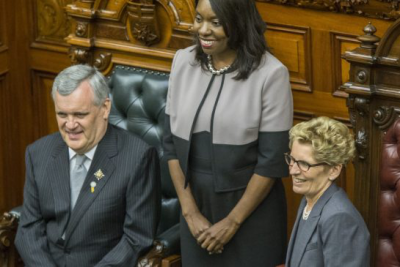 The province wants to cast a wide net to include as many of us as possible in its goal of building a provincial pension plan by 2017.
Decumulation resources for retirees
– moneysense.ca
 (Getty Images)
With 10,000 American baby boomers turning 65 every day, plus 1,200 Canadian boomers, there is fast approaching a major sea change in how this generation handles their investments.
When you’re working, things are somewhat automatic. Your employer deposits your paycheque into your bank account perhaps every second week, conveniently withholding income taxes at source. Perhaps you’ve automated your savings program and pension contributions.
In short, you are in wealth accumulation mode, and so likely is your financial adviser, since he or she is also probably personally in the same mode.
But once you turn 65 or cease to draw a full-time salary, you are now in the “decumulation” zone. We devoted a column to decumulation in the September issue of MoneySense, in which we highlighted a new undertaking by John Por called the Decumulation Institute.
Last week, I attended the second meeting of this group, which includes Malcolm Hamilton, the retired actuary who continues to be quoted by this magazine and others…
 Logically, we should save for retirement first, then buy and pay off a house, and nearing retirement have children. Life doesn’t work like that.
Ontario launches consultations on new pension plan
– moneysense.ca
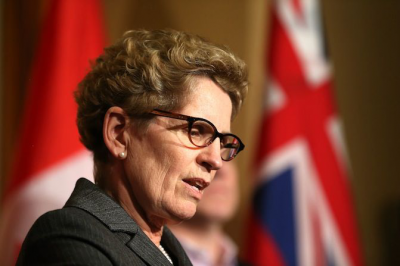 Ontario Premier Kathleen Wynn (The Canadian Press)
TORONTO – Ontario’s Liberal government is looking for public feedback on its plan to create a provincial pension plan with mandatory contributions from workers and employers.
The government released a consultation paper on “key design questions” such as a minimum income threshold — the $3,500 used by the Canada Pension Plan is suggested — and on exactly who would be eligible for the provincial plan.
Associate Finance Minister Mitzie Hunter says about two-thirds of Ontario workers do not have a workplace pension, so virtually all of them would be required to join the Ontario Retirement Pension Plan.
The government will phase-in mandatory 1.9 per cent contributions from employers and workers over two years, starting with larger companies in 2017 before moving on to smaller operations like convenience stores and dry cleaners.
Business groups like the Ontario Chamber of Commerce say requiring workers to pay up to $1,643 a year for a provincial pension — and forcing their employers to match those contributions — will drive up costs and result in fewer jobs…

