
The “Big Five” Canadian banks offer investment funds and include Royal Bank of Canada, Toronto Dominion Bank (TD Canada Trust), Bank of Nova Scotia, Bank of Montreal and Canadian Imperial Bank of Commerce (CIBC). Let’s explore the best place for you to invest.
Latest News


The best student credit cards in Canada for 2024 + MORE Oct 7th
When you’re at a new restaurant, do you have to see the menu before you order? Or do you eat what your foodie friend says is good, knowing it’ll be amazing? The answer can help you decide how to pick a new credit card. Some people want the ability to compare their options side-by-side; others wa.... More »
How Vida Gabriel Is Making Carbon-capture Technology Even Greener + MORE Oct 31st
When Vida Gabriel was working on her master’s at the University of Ottawa in 2017, she met Sean Wilson, a chemical engineer, at a student holiday potluck where Wilson drew her name for Secret Santa. Gabriel, who was studying how to make polymers biodegradable, offered to help Wilson with grant app.... More »
The best low-fee U.S. index mutual funds + MORE Aug 7th
Maggie is trying to choose an index mutual fund for U.S. equities [MoneySense].... More »
High interest rates and unemployment: Expectations for June’s rate announcement + MORE May 10th
The odds of a June interest rate cut from the Bank of Canada (BoC) appear to have fallen after the latest jobs report from Statistics Canada showed employment jumped by 90,000 last month. The jobs gain far surpassed forecasters’ expectations and marked the largest employment increase in more than .... More »
Are low interest rates doing more harm than good? + MORE Jul 15th
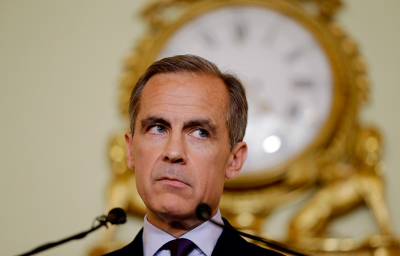
Mark Carney was oddly framed by TV cameras when he made his hasty post-Brexit address the morning after the United Kingdom voted to leave the European Union. Standing behind a lectern, but in front of an open doorway, the governor of the Bank of England appeared as though trapped inside a box. It wa.... More »
Hydro One reinstates power to board of directors as Ontario plans IPO
– theglobeandmail.com
Groups’ oversight powers were removed by the province as the government announced plans to sell off 60 per cent of the electricity company
Lacking consensus on retirement withdrawal strategies
– myownadvisor.ca
Learn, save, invest and prosper by subscribing to My Own Advisor.
If you think you’re confused about how best to accumulate assets for your financial future you haven’t seen anything yet. This is my takeaway from reading a recent Globe and Mail article about “decumulating” wealth.
Academic research seems to show that withdrawing 4% of your portfolio every year, and increasing your withdrawals with the rate of inflation, will ensure you not only have enough income to cover expenses but you likely won’t outlive your money either over a 30-year retirement span. This of course assumes you’ve saved “enough money” for retirement in the first place to cover expenses. I’ve estimated what our retirement number might be and here it is.
William Bengen, a financial planner with a background in aeronautical engineering, was the father of the 4% rule – stress-testing over decades what a safe withdrawal rate might be. His conclusion:
to weather any sort of market storm that includes a Great Depression or a Great Recession retirees should withdraw no more than 4% of their portfolio in any given year…
When ETFs wind down
– moneysense.ca
Q: I received a notice that an ETF I own will be closed within the next few months. Is it better to sell it now or wait until the termination date?
–S.H.
A: ETFs are now available for just about every niche sector and exotic asset class, so it shouldn’t be surprising when some of these fail to attract investor dollars. If an ETF cannot attract enough assets to be sustainable within a couple of years, the provider may decide to shut down the fund.
ETF closures have been relatively uncommon in Canada, but this year has seen several death sentences. In June, BlackRock announced it will be shuttering six products, including the iShares Broad Commodity (CBR), the iShares China All-Cap (CHI), iShares Oil Sands (CLO) and the iShares S&P/TSX Venture (XVX). Earlier in the year Horizons also terminated its broad commodity ETF as well as couple of its leveraged ETFs.
What should you do if you learn that an ETF you own will soon be shut down? To help answer this question, I reached out to Mark Noble, head of sales strategy, communications and public relations at Horizons ETFs…
Buying U.S. stocks with a weak Canadian dollar
– moneysense.ca
Q: I wonder what you think of buying U.S. stocks? “Top Picks” usually names several stocks traded on the NYSE or NASDAQ as good investment buys. Using a discount brokerage, you have a choice of “settlement funds” in Canadian dollars or U.S. dollars. Is there an advantage one way or the other and similarly if I sold a U.S. stock? Or with the Canadian dollar as bad as it is, is it still worth even considering the purchase of U.S. stocks?
—Phil
A: I think that the most important decision in building a portfolio is asset allocation, Phil. Fees and taxes are also important, but a portfolio built of top picks that are all from the same sector is risky and unlikely to generate the same risk-adjusted returns as a well balanced portfolio.
On that basis, I would caution a do-it-yourself investor from building a portfolio of top picks. I’d be more inclined to build a portfolio based on what pieces are missing and fill them in with the best options.
Assuming that you are doing that, Phil, a well-diversified portfolio should ideally include U…
Setting a slightly better tone for Q2 oilpatch earnings season, Husky Energy reported a second-quarter profit of $120 million, down 81 per cent from the same quarter a year earlier, but with improved cash flow.

