
All about Canadian Savings. Learn the ins and outs and get the latest news.
Latest News


“Which reverse mortgage is right for me?” Sep 12th
When Vancouver condo owners Maggie and Rob found out they were on the hook for $400,000 in improvement costs to their building and unit as required by an assessment from their Strata Council, they weren’t sure what to do. (We’ve changed their names and some details to protect their privacy.)
.... More »
Should I trust my advisor or accountant? + MORE Jul 20th
(Martin Barraud/Getty Images)
Q: We seem to be in a financial dilemma. Different perspectives on RRSPs at a time when my husband is retired and I am going to retire. He has a pension, I do not. The accountant is of the opinion that we should start converting our RRSP monies into cash, which is wh.... More »
How much credit card debt does the average Canadian have? + MORE Nov 7th
As the country re-opens after COVID-related restrictions, Canadians are faced with a worrying financial picture. Many have moved, others are looking to travel, and the cost of living is ballooning with unusual rates of inflation. Meanwhile, the Bank of Canada (BoC) rate hikes designed to curb these .... More »
Capital gains when selling property to family + MORE Apr 20th
Q: Do I have to pay income tax if I inherited a property jointly with my sister and she bought me out for less than half the appraised value of the property?
—Johanna
A: Asset sales between family members can be tricky to facilitate at a family level, let alone from a tax perspective. Ther.... More »
The best high-interest savings accounts in Canada for 2025 + MORE Mar 18th
Savings comparison tool
Find the best and most up-to-date savings rates in Canada using the comparison tool below. Plus, use the filters to assess your estimated return based on the size of your balance.
Advertisement
Why trust us
MoneySense is an.... More »
TFSA, tax changes: Time to review your financial plan
– moneysense.ca
 OTTAWA – The tax rules are changing in 2016 and even if Canadians don’t make enough to be hit by the new top federal income tax rate, their financial plans are going to need to be reviewed.
The vast majority of Canadians will not be affected by the new tax bracket for income over $200,000 a year, but everyone will see their tax-free savings account contribution limit be reduced back to $5,500 for 2016.
Combined with the new lower tax rate for income between $45,282 and $90,563, even those who aren’t in the top one per cent of income-earners should take a look at their finances to ensure they’re on track.
Peter Bowen, vice-president of tax and retirement research and solutions at Fidelity Investments, says for many people this might be the most important tax planning season they’ve ever had.
“With the changes just implemented both to tax rates and TFSAs, everybody needs to take care to make sure their tax planning is right for their own situation,” he said. “We always encourage people to get financial advice, but with these changes in place, it is more important than ever…
A new report by Statistics Canada says automatic increases in registered pension plans are most helpful to people who don’t save much in registered retirement savings plans.
Ottawa posts $941-million deficit for October
– macleans.ca
OTTAWA – The Canadian government ran a $941-million deficit for October compared with a $3.21-billion deficit in the same month last year.
Ottawa’s fiscal monitor says the improvement came as revenue increased 11.1 per cent, boosted by higher personal income tax and Goods and Services Tax revenues.
The results of a year ago included a one-time adjustment downward due to the introduction of the Conservative government’s income-splitting plan for families and a doubling of the children’s fitness tax credit.
The newly elected Liberal government is planning to discontinue income splitting.
Program spending for October 2015 increased by 0.4 per cent, while public debt charges fell 6.4 per cent.
For the April to October period, the government posted a surplus of $634 million compared with a deficit of $3.95 billion in the same period a year earlier.
Revenue for the first seven months of the fiscal year was up 8.7 per cent, while program spending was up 6.6 per cent. Public debt charges fell 3…
Ottawa’s fiscal monitor says the improvement came as revenue increased 11.1 per cent, boosted by higher personal income tax and Goods and Services Tax revenues.
The results of a year ago included a one-time adjustment downward due to the introduction of the Conservative government’s income-splitting plan for families and a doubling of the children’s fitness tax credit.
The newly elected Liberal government is planning to discontinue income splitting.
Program spending for October 2015 increased by 0.4 per cent, while public debt charges fell 6.4 per cent.
For the April to October period, the government posted a surplus of $634 million compared with a deficit of $3.95 billion in the same period a year earlier.
Revenue for the first seven months of the fiscal year was up 8.7 per cent, while program spending was up 6.6 per cent. Public debt charges fell 3…
Money tips for dating in retirement
– moneysense.ca
Q: “I am a 58-year-old widowed male, in good physical and financial shape. I have no debts, own my home outright and recently retired with a pension. My daughter has forewarned me that dating is not like it was 40 years ago. How do I protect myself if I connect with a lady and the relationship goes south?
—Joe Lidster, Kamloops, B.C.
A: Your daughter is right: Dating in the era of Tinder and eHarmony is very different from your first go round. And you’re different too: financially established, in retirement and, by the sounds of it, a very good catch. So you’re right to date with some caution. The key is to understand each other’s values around money. You don’t need to talk about specific numbers but you do want to get a sense of how this person likes to spend and save. Setting clear expectations about who pays for what is a good exercise in communication that will either further solidify your bond, or bring you closer to breaking up. Eventually, you should go through the big stuff like net worth and cash flow—as an outstanding divorce settlement, no retirement savings or high credit card debt may or may not be a deal-breaker…
—Joe Lidster, Kamloops, B.C.
A: Your daughter is right: Dating in the era of Tinder and eHarmony is very different from your first go round. And you’re different too: financially established, in retirement and, by the sounds of it, a very good catch. So you’re right to date with some caution. The key is to understand each other’s values around money. You don’t need to talk about specific numbers but you do want to get a sense of how this person likes to spend and save. Setting clear expectations about who pays for what is a good exercise in communication that will either further solidify your bond, or bring you closer to breaking up. Eventually, you should go through the big stuff like net worth and cash flow—as an outstanding divorce settlement, no retirement savings or high credit card debt may or may not be a deal-breaker…
Credit card mistakes millennials are making
– moneysense.ca
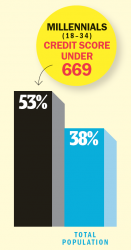 It seems that cost-conscious millennials are so down on being in debt that many are avoiding credit cards altogether. But in doing so they’re missing out on the opportunity to start building a credit history, which is crucial for securing loans, renting apartments and getting the best insurance rates. These are the findings from a recent NerdWallet study, which reported that 31% of U.S. adults between the ages of 18 and 34 have never applied for any type of card. What’s more, 28% of these surveyed millennials had credit scores between 300 and 579, far below an optimal 700 that gets you the best lending rate from the banks. Bottom line: Using a credit card responsibly is one of the easiest ways to improve a low credit score.
The post Credit card mistakes millennials are making appeared first on MoneySense.

