
How to go about securing the best Retirement Plan in Canada.
Latest News


How GICs can help you save for your short-term goals + MORE Nov 23rd
Let’s talk about short-term savings. By short-term, we’re talking about putting away money for a few months, or even a few years, for a big goal, like a vacation, a wedding or a down payment on a home. Where should you put your savings so they’ll be secure and work for you?
When saving,.... More »
CPP payment dates this year, and more to know about the Canada Pension Plan + MORE Aug 30th
In Canada, no retirement plan is complete without considering the CPP. Whether you’re approaching retirement or still several years away from it, the Canada Pension Plan will likely play a role in your retirement income. How big a role depends on several factors. You may have other questions, too..... More »
How to start saving for retirement at 45 + MORE Mar 14th
Saving for retirement at age 45 means you’ll have a 20-year runway toward a traditional age 65 retirement. But what’s your starting point? The National Bank of Canada suggests that by age 40 you should have 2.1 times your annual income saved for retirement, while the U.S.-based firm Fidelity rec.... More »
The best RRSP investments 2022 Jan 11th
A registered retirement savings plan (RRSP) is an investment that is registered with the Canadian federal government. RRSPs are often described as being “tax-advantaged.” That means you don’t pay income tax on the amount you are contributing to an RRSP, in the year you earn that contribution. .... More »
Selling stocks at a loss in a TFSA: What it means for your contribution room Apr 12th
Ask MoneySense
I lost $20,000 dollars in my TFSA account in the market correction, and my broker sold the losing stocks. Can I put more money in to bring me back up the to the limit the government allows?—Wayne
Capital losses in a TFSA
A capital loss is when you sell an investment at a lowe.... More »
Have financial resolutions? You need a plan, too
– moneysense.ca
OTTAWA – Increasing retirement savings, reducing debt or putting away more for your child’s education may be on your list of new year resolutions, but to make them more than wishful thinking you need a plan.
To help make your financial new year’s resolution stick, portfolio manager Amy Dietz-Graham of Bank of Montreal says to make it automatic.
Whether it is increasing the amount you save or paying off that last stubborn balance on a line of credit, she suggests setting up regular payments.
“Then it is not something that you have to think about,” she said.
“It takes a lot of the pressure off of you having to constantly remind yourself to keep on top of a resolution. Just make it automatic.”
Fix your money problems and get #MoneyFit »
Dietz-Graham’s new year resolution is to start saving to buy a cottage with her husband. It will take more than 2016 to reach their ultimate goal, but she has set a target for their savings for the year.
She said it’s important to set specific goals so that progress can be measured…
To help make your financial new year’s resolution stick, portfolio manager Amy Dietz-Graham of Bank of Montreal says to make it automatic.
Whether it is increasing the amount you save or paying off that last stubborn balance on a line of credit, she suggests setting up regular payments.
“Then it is not something that you have to think about,” she said.
“It takes a lot of the pressure off of you having to constantly remind yourself to keep on top of a resolution. Just make it automatic.”
Fix your money problems and get #MoneyFit »
Dietz-Graham’s new year resolution is to start saving to buy a cottage with her husband. It will take more than 2016 to reach their ultimate goal, but she has set a target for their savings for the year.
She said it’s important to set specific goals so that progress can be measured…
How to retire at 55 on $55,000 a year
– moneysense.ca
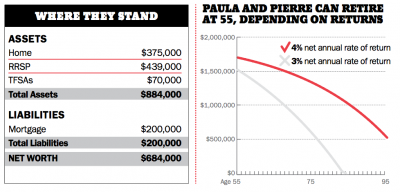 Paula Lorimer and husband Pierre Sopel save $30,000 annually. They hope to retire at age 55 with a net annual income of $55,000.
The current situation
Paula Lorimer, 40, is a psychologist living in Montreal. Right now, Paula is self-employed but is looking forward to changing gears at age 55. “I’ve worked hard and want time to do some teaching, attend workshops and do more volunteer work,” says Paula, who is married to IT manager Pierre Sopel, also 40. Paula handles the couple’s finances and the two of them are on track to pay off their $375,000 house in 13 years. As well, the couple has $509,000 total in RRSPs and TFSAs, mostly invested in a mix of dividend, equity and fixed-income mutual funds, averaging a 5% net annual rate of return. Paula figures they can save about $30,000 annually—$18,000 annually through authorized payment plans to her RRSP and TFSA, and another $12,000 annually at year-end to top up retirement savings. Pierre also puts $3,600 annually into his company’s defined-contribution pension plan, an amount his company matches…

