

The best high-interest savings accounts in Canada for 2025 + MORE Jun 4th

How to invest as a teenager in Canada + MORE Aug 13th

Investing in your 40s + MORE May 3rd

Rolling in the Debt: Canada sees a rise in Household Debt + MORE Mar 22nd

What is an emergency fund and how to build one + MORE Apr 11th
Couch Potato works with employer retirement plans
– moneysense.ca
Most employer-sponsored plans allow you to save painlessly through payroll deductions—often with a top-up from your company. Your money then gets invested automatically and your portfolio even gets rebalanced regularly. It’s the ultimate Couch Potato solution, requiring zero maintenance. Here’s how you can make the most of yours.
Understand your plan.
Employer retirement savings plans are usually administered by an insurance company such as SunLife, Standard Life, Manulife, Great West Life and others. They vary a lot, so the first step is understanding how yours is structured.
Many companies offer a defined contribution (DC) pension plan, which is similar to an RRSP, although it’s less flexible…
Cash out your emergency fund
– moneysense.ca
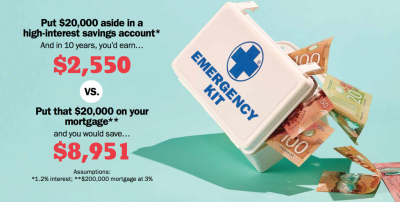 Lots of experts suggest saving six months’ living expenses for emergencies like a job loss or an illness. But if you’re in a financially stable household it makes more sense to use that money elsewhere, and open a line of credit to draw on in the event of a crisis. “Holding a large amount of cash as an emergency fund can be a real waste,” explains Toronto fee-for-service planner Jason Heath. “If you have cash and debt, your cash won’t earn nearly the return that your debt is costing you—meaning, you’re falling behind.” Consider what happens if you take $20,000 of emergency money from your high-interest saving account and instead apply it to your mortgage in the following example:
Over the course of 10 years, you’d lose out on more than $6,400 in interest savings if you go the cash route. But even if you don’t have debt, notes Heath, why hold cash when you can get your money working for you by investing it? Provided you don’t fall into the trap of constantly raiding your line of credit instead of using it as an occasional emergency fund, that’s always the wiser choice…
Major unions say the Liberal government has indicated it will repeal legislation introduced by their Tory predecessors that imposes changes on the civil service’s disability and sick leave system.
Treasury Board President Scott Brison speaks at a campaign event. (Photo: Fred Chartrand/CP)
The Conservatives booked $900 million in savings to the government’s bottom line in last year’s budget, even though negotiations were still ongoing with the unions.
The Harper government’s accounting decision helped its election-year budget predict a $2.4-billion surplus, including the contingency reserve.
The new Liberal government updated the 2015-16 budget projection in November to a $3-billion shortfall — and Ottawa admits another $900 million could be shaved from the public books without the disability and sick leave regime…
How Low Can the Loonie Go?
– ratesupermarket.ca

The loonie continued its swan dive this week, hitting a new low at $68.70 – enough to make consumers – and economists – nervous. Half of those polled expected the Bank of Canada to respond on Wednesday with yet another trend-setting rate cut, but the central bank appears to be riding out the latest currency skirmish.
Read on to get caught up on the latest.
A Lower Loonie Reality: The Consumer Impact
The loonie dropped below 70 cents this week – a 13-year low – and consumers are starting to feel the pain. Economists believe the dollar has further to slide – so how low can it really go? Check out our tips for coping with less spending power and higher prices.
Read Rubina’s Blog | A Lower Loonie Reality
4 Ways to Cope with Rising Grocery Prices
A lower loonie is starting to hit shoppers where it hurts – at the grocery store, where produce and meat prices have skyrocketed. How can you navigate the “cauliflower effect” and still come under your food budget? Frugal living expert Sean Cooper shares his best grocery savings tips…
Should you invest or pay down debt?
– moneysense.ca
 Q: I have the following debt:
Mortgage – $60,000 @ 2.5% variable rate
Line of credit – $20,000 @ 5.7% variable rate
Car loan – $24,000 @ 3.75%
My question is this:
If I was to receive an unexpected infusion of dollars, am I better off to pay off all this debt or invest the money?
I am 62 years old and the thought of being debt free is very appealing, but also want to make the best financial decision for the long run.
–David
A: Paying down debt and investing are good financial choices. Both will increase your net worth and accelerate your financial independence. The question of whether you should do one or the other is a personal one, David.
If you reduce your debt, you have a guaranteed rate of return equal to the rate of interest you are avoiding. For example, paying off the $20,000 line of credit will “save” you having to pay interest of 5.7% and “earn” you a 5.7% rate of return on your “investment.” Consider it like buying a 5.7% GIC.
If you could otherwise invest the money in a taxable, non-registered account, you would have to be able to earn more than 5…

