
The “Big Five” Canadian banks offer investment funds and include Royal Bank of Canada, Toronto Dominion Bank (TD Canada Trust), Bank of Nova Scotia, Bank of Montreal and Canadian Imperial Bank of Commerce (CIBC). Let’s explore the best place for you to invest.
Latest News



The Magnificent 7 versus the other 493 S&P 500 companies: What’s the better investment? + MORE Oct 1st
The tech sector, driven by some of the world’s largest companies—Apple, Alphabet, Amazon, Meta, Microsoft, Nvidia and Tesla, also known as the Magnificent 7—has fuelled the markets for about two years now. And this isn’t likely to change any time soon, even if those companies (and the sector.... More »
Investment fees are eating your returns + MORE Mar 16th
How are your investment fees affecting your returns? A new site called the WealthGame.ca has the answer, but you may not like what you learn.
Larry Bates is the founder of WealthGame.ca, which aims to draw attention to the impact fees have on your portfolio. The 25-year financial services industry.... More »
The best high-interest savings accounts in Canada for 2024 Nov 11th
Savings comparison tool
Find the best and most up-to-date savings rates in Canada using the comparison tool below. Plus, use the filters to assess your estimated return based on the size of your balance.
Why trust us
MoneySense is an award-winning magazine, helping Canadians navigate mo.... More »
It’s RRSP season. Don’t forget rule No.1! + MORE Feb 1st
Whatever route you choose, just be sure you save for retirement, writes Gordon Pape..... More »
Before the Bell: Futures rise after solid US, Canada job reports - The Globe and Mail Mar 9th
The Globe and MailBefore the Bell: Futures rise after solid US, Canada job reportsThe Globe and MailU.S. and Canadian stock index futures moved higher on Friday after solid jobs reports from both countries. The Canadian economy added 15,400 jobs in February after a massive loss in January, thanks to.... More »
These aristocrat dividend stars can bring some class to your RRSP
– theglobeandmail.com
Companies that consistently raise payouts are highlighted in an S&P index
Negative interest rates? That’s a negative.
– macleans.ca
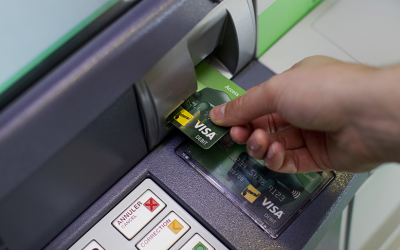 A customer uses an ATM at a Toronto-Dominion (TD) Bank branch in downtown Vancouver, British Columbia, Canada, on Thursday, May 28, 2015. (Ben Nelms/Bloomberg/Getty Images)
The questions never change in economics, goes the old adage about the dismal science. But the answers often do.
Just a few years ago, economists were certain that interest rates could never fall lower than zero. Last week, however, Japan’s central bank announced the interest rate on bank reserves will drop to -0.1 per cent. The European Central Bank’s rate has been in negative territory since 2014; Switzerland, Sweden and Denmark a few years before that. Today nearly a third of the world’s GDP lies in negative-interest-rate territory. It’s become such a common policy prescription that even the Bank of Canada is prepared to consider it. We no longer know how low interest rates can go. So what does it mean to live below zero?
A central bank typically pays interest on the official deposits it requires from financial institutions…
The RRSP guide for investors in their 20s
– moneysense.ca
 Focus on fees
Erin Richard wonders if she’s better off buying mutual funds through the bank or a robo-advisor. For her, it’s a question of deciding between access to better service versus lower-cost funds.
Shortly after Erin Richard’s boyfriend got down on one knee and popped the big question last November, the public relations professional and her fiancé wisely had a frank discussion about money. But it wasn’t the typical talk that most twenty-somethings have, which usually revolves around whether or not to open a joint account, or how much one partner spends versus the other. Instead, the Toronto couple debated where they want to put their retirement savings: with a bank, or with one of Canada’s recently launched robo-advisors. The new automated digital advice services allow you to build a low-fee exchange-traded fund (ETF) portfolio, based on your risk tolerance and time horizon, through your computer screen.
At the moment, Erin, 29, has about $25,000 worth of GICs in an RRSP at her bank…
The RRSP guide for investors in their 30s
– moneysense.ca
 Priority planning
Kori and Tyler Wachniak are dealing with a lot of financial changes these days—including the cost of raising little Carter. Should they focus on their mortgage or RRSPs?
Financial planning is complicated enough as it is, but it may be the most confusing for people in their 30s. This is the age where life brings about a lot of rapid changes—marriage, home ownership, children—and it’s hard enough to pay for all these sizable expenses, let alone save money for retirement. Take Kori and Tyler Wachniak, 30 and 32, respectively, who are just entering this new phase of their lives and are already feeling overwhelmed.
Last February, the Winnipeg-based couple had their first child, Carter, shortly after purchasing their first home the year before. Up until recently, the Wachniaks had fancied themselves fairly good savers. Kori, a pharmacist, has about $43,000 put away—$12,000 in RRSPs and the rest split between two work-related pension accounts. Meanwhile, Tyler, a pilot, has about $60,000 in an RRSP and $60,000 in a TFSA…
Ontario offers $100 million for upgrades to natural gas furnaces, water heaters
– canadianbusiness.com
TORONTO – Ontario is promising a $100 million rebate program to help homeowners upgrade their furnaces, water heaters and insulation, but there are no details on a start date, eligibility rules or amounts.
The goal is to reduce greenhouse gas emissions, and at the same time help create jobs and lower homeowners’ natural gas bills.
Environment and Climate Change Minister Glen Murray says 37,000 customers of Enbridge Gas and Union Gas will be able to have home energy audits to identify energy-saving options.
Once the audit is done, the homeowners will be able to get some financial help — how much is still unknown — to buy a new furnace, water heater or insulation.
About 62 per cent of Ontario homes use natural gas for heating, compared with about 28 per cent for electricity and just three per cent for oil.
Murray says every dollar spent on energy efficiency retrofits can save natural gas customers $1.50 to $4.
Follow @CPnewsboy on Twitter
The post Ontario offers $100 million for upgrades to natural gas furnaces, water heaters appeared first on Canadian Business – Your Source For Business News.
The goal is to reduce greenhouse gas emissions, and at the same time help create jobs and lower homeowners’ natural gas bills.
Environment and Climate Change Minister Glen Murray says 37,000 customers of Enbridge Gas and Union Gas will be able to have home energy audits to identify energy-saving options.
Once the audit is done, the homeowners will be able to get some financial help — how much is still unknown — to buy a new furnace, water heater or insulation.
About 62 per cent of Ontario homes use natural gas for heating, compared with about 28 per cent for electricity and just three per cent for oil.
Murray says every dollar spent on energy efficiency retrofits can save natural gas customers $1.50 to $4.
Follow @CPnewsboy on Twitter
The post Ontario offers $100 million for upgrades to natural gas furnaces, water heaters appeared first on Canadian Business – Your Source For Business News.

