
How to go about securing the best return for your investment in Canada.
Latest News


Synthetic identity fraud: The scam where there’s no real victim to find + MORE Sep 16th
Ever heard of synthetic identity fraud?
It’s a kind of fraud that costs Canadians billions of dollars every year, but awareness around it is lacking. A victim may not even know they’ve been victimized.
Equifax Canada notes that synthetic identity fraud can be difficult to detect with tradi.... More »
Real Matters picks bankers, aims for $125-million in IPO + MORE Apr 21st
The company is targeting an enterprise valuation of more than $1-billion with the offering, sources say
.... More »
'A lot of work to do' for GM, Unifor as 3900 GM workers face strike deadline - CBC.ca + MORE Sep 19th
CBC.ca'A lot of work to do' for GM, Unifor as 3900 GM workers face strike deadlineCBC.caCanada's autoworkers' union Unifor and General Motors Co made little progress resolving the key issue of new investment in contract talks late on Sunday, the union's president said, just .... More »
Fairfax Financial companies face nearly $1bn in Q3 losses due to natural disasters + MORE Nov 3rd
TORONTO _ Fairfax Financial Holdings Ltd. (TSX:FFH) says hurricanes and other natural disasters in the latest quarter hit its portfolio companies with more than $1.2 billion in losses.
The Toronto-based company says the insurance industry in the third quarter saw some of the largest catastrophe loss.... More »
Vision Pro: Apple's new augmented reality headset unveiled - BBC Jun 5th
Vision Pro: Apple's new augmented reality headset unveiled BBCApple unveils augmented-reality headset, revamped Mac lineup at annual conference The Globe and MailApple Announces Very Fancy 'Facial Computer' KotakuApple stock: Why a headset could send shares even high.... More »
Quebec ditches stock images in new twist on tourism advertising
– theglobeandmail.com
Danny Kean, who has been blind since birth, is the new face of the tourism campaign which hopes to show the province in a new way
British PM Cameron admits he held stake in father's offshore trust – Reuters Canada
– news.google.ca
Reuters CanadaBritish PM Cameron admits he held stake in father's offshore trustReuters Canada(Reuters) – British Prime Minister David Cameron acknowledged in a TV interview on Thursday that he once had a stake in his late father's offshore trust, which was revealed in the "Panama Papers" leak from a law firm. Cameron told ITV News that he had …Panama Papers: UK's PM Cameron admits to profiting from father's offshore holdingsGlobalnews.caDavid Cameron admits he did have a stake in father's offshore investment fund after Panama Papers leakTimes of IndiaPanama Papers: British PM Cameron admits he profited from father's offshore fundAsiaOneNBCNews.com -RT -The Daily Courier (subscription) -The Australianall 521 news articles »
Don’t sweat the small asset allocation details
– moneysense.ca
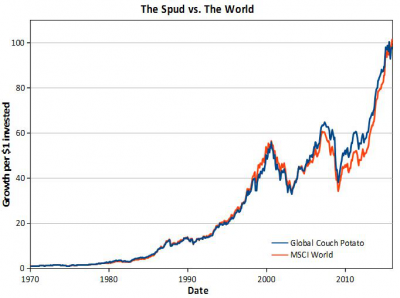 Many investors fret about the small details when it comes to how to divvy up their equity asset allocations. But some wildly different allocations haven’t mattered much to returns over the long haul.
You can see the impact of big differences in stock allocations by studying the returns of two variations of the couch potato portfolio.
The original–or classic–couch potato advocated putting an equal amount of money into Canadian bonds, Canadian stocks, and U.S. stocks. On the other hand, the global variant puts equal amounts into Canadian bonds, Canadian stocks, U.S. stocks, and international stocks.
If you focus only on the stock part of both portfolios, the first has 50% in U.S. stocks and 50% in Canadian stocks while the second has about 33.3% in Canadian stocks, 33.3% in U.S. stocks, and 33.3% devoted to international stocks. That’s a pretty big difference.
Both options also deviate markedly from the global stock market. The MSCI World index provides a handy way to track the developed world’s stock markets…
Data gaps show need for better foreign buyer stats
– moneysense.ca
 (Getty Images / Michael Blann)
The Canada Mortgage Housing Corporation (CMHC) recently released their April 2016 edition of the Foreign Ownership in Condominiums report.
The report aims to reveal the share of foreign ownership based on the age of the condominium building.
Not surprisingly, the report found that foreign ownership is most prevalent in new condo buildings in Toronto and Vancouver. But here’s the thing: The report only examines condo purchases by foreign buyers. It does not examine the percentage of foreign ownership in single residential homes—the one segment of the real estate market that has witnessed astronomical price increases.
CMHC acknowledges this weakness stating in the report: “Despite a range of statistics suggested by various studies on the size of foreign ownership, available factual information remains scarce.”
Actually, this lack of information was the impetus behind CMHC’s decision to start collecting data on foreign ownership in condo purchases…
Judge: Govt wrongly ignored costs to MetLife of threat tag
– canadianbusiness.com
WASHINGTON – A federal judge says the government acted unreasonably by ignoring the costs to MetLife of being targeted for stricter supervision as a potential threat to the financial system.
U.S. District Judge Rosemary Collyer says she decided to strike the government’s labeling of MetLife because it was “arbitrary and capricious.” The federal regulators who make up the Financial Stability Oversight Council failed to consider possible financial harm to the insurance giant from the action, backtracking on their own standards, Collyer wrote.
Her opinion, which had been kept under seal, was made public Thursday. In a ruling last Wednesday, Collyer removed the council’s labeling of MetLife Inc. as “systemically important” — requiring closer oversight.
Her ruling — which the government will appeal — dealt a setback to its policy for preventing another financial crisis using new legal tools.
By ignoring potential costs to MetLife and failing to observe its own standards — and then not explaining why — the FSOC has made its process for deciding whether to designate companies “fatally flawed,” Collyer wrote in her opinion…

