
How to go about securing the best return for your investment in Canada.
Latest News
Aurora acquires stake in medical pot company The Green Organic Dutchman Holdings + MORE Jan 5th
EDMONTON, B.C. _ Aurora Cannabis Inc. has signed deals to acquire an initial minority stake in The Green Organic Dutchman Holdings Ltd. and to purchase up to 20 per cent of TGOD’s annual cannabis production.
Aurora (TSX:ACB) says it plans to acquire a 17.62 per cent stake in the privately held.... More »
And just like that, Peloton shares tank after fatal cameo in Sex and the City reboot - CBC News Dec 10th
And just like that, Peloton shares tank after fatal cameo in Sex and the City reboot CBC NewsPeloton responds as 'And Just Like That...' kills off major character Yahoo News CanadaPeloton Spokesperson Reveals Company Didn’t Know Details of ‘And Just Like That’ Story Line .... More »
South Africa, Zimbabwe look for mining revival under new leaders + MORE Feb 26th
The downfall of former presidents Jacob Zuma and Robert Mugabe is seen as the best opportunity in many years to remove the steep barriers to investment in both countries.
.... More »
Coworking space demand soars as career patterns shift, firms cut costs + MORE Oct 27th
A deal between one of Canada’s oldest retailers and a fast-growing U.S. startup that wants to convert portions of its flagship stores into shared offices is the latest evidence that coworking spaces are increasingly hot properties _ and demand for retail real estate is cooling.
This week, Huds.... More »
Kylie Jenner, Forbes spar over story on billionaire status - CTV News May 30th
Kylie Jenner, Forbes spar over story on billionaire status CTV NewsForbes Strips Kylie Jenner of Billionaire Status as It's Revealed She Was Inflating Her Net Worth Yahoo StyleKylie Jenner is no longer a billionaire, according to Forbes Globalnews.ca‘Forbes’ Revo.... More »
Quebec ditches stock images in new twist on tourism advertising
– theglobeandmail.com
Danny Kean, who has been blind since birth, is the new face of the tourism campaign which hopes to show the province in a new way
British PM Cameron admits he held stake in father's offshore trust – Reuters Canada
– news.google.ca
Reuters CanadaBritish PM Cameron admits he held stake in father's offshore trustReuters Canada(Reuters) – British Prime Minister David Cameron acknowledged in a TV interview on Thursday that he once had a stake in his late father's offshore trust, which was revealed in the "Panama Papers" leak from a law firm. Cameron told ITV News that he had …Panama Papers: UK's PM Cameron admits to profiting from father's offshore holdingsGlobalnews.caDavid Cameron admits he did have a stake in father's offshore investment fund after Panama Papers leakTimes of IndiaPanama Papers: British PM Cameron admits he profited from father's offshore fundAsiaOneNBCNews.com -RT -The Daily Courier (subscription) -The Australianall 521 news articles »
Don’t sweat the small asset allocation details
– moneysense.ca
 Many investors fret about the small details when it comes to how to divvy up their equity asset allocations. But some wildly different allocations haven’t mattered much to returns over the long haul.
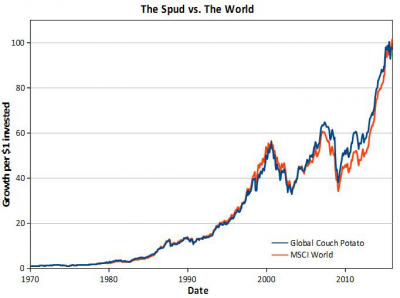
You can see the impact of big differences in stock allocations by studying the returns of two variations of the couch potato portfolio.
The original–or classic–couch potato advocated putting an equal amount of money into Canadian bonds, Canadian stocks, and U.S. stocks. On the other hand, the global variant puts equal amounts into Canadian bonds, Canadian stocks, U.S. stocks, and international stocks.
If you focus only on the stock part of both portfolios, the first has 50% in U.S. stocks and 50% in Canadian stocks while the second has about 33.3% in Canadian stocks, 33.3% in U.S. stocks, and 33.3% devoted to international stocks. That’s a pretty big difference.
Both options also deviate markedly from the global stock market. The MSCI World index provides a handy way to track the developed world’s stock markets…
Data gaps show need for better foreign buyer stats
– moneysense.ca
 (Getty Images / Michael Blann)
The Canada Mortgage Housing Corporation (CMHC) recently released their April 2016 edition of the Foreign Ownership in Condominiums report.
The report aims to reveal the share of foreign ownership based on the age of the condominium building.
Not surprisingly, the report found that foreign ownership is most prevalent in new condo buildings in Toronto and Vancouver. But here’s the thing: The report only examines condo purchases by foreign buyers. It does not examine the percentage of foreign ownership in single residential homes—the one segment of the real estate market that has witnessed astronomical price increases.
CMHC acknowledges this weakness stating in the report: “Despite a range of statistics suggested by various studies on the size of foreign ownership, available factual information remains scarce.”
Actually, this lack of information was the impetus behind CMHC’s decision to start collecting data on foreign ownership in condo purchases…
Judge: Govt wrongly ignored costs to MetLife of threat tag
– canadianbusiness.com
WASHINGTON – A federal judge says the government acted unreasonably by ignoring the costs to MetLife of being targeted for stricter supervision as a potential threat to the financial system.
U.S. District Judge Rosemary Collyer says she decided to strike the government’s labeling of MetLife because it was “arbitrary and capricious.” The federal regulators who make up the Financial Stability Oversight Council failed to consider possible financial harm to the insurance giant from the action, backtracking on their own standards, Collyer wrote.
Her opinion, which had been kept under seal, was made public Thursday. In a ruling last Wednesday, Collyer removed the council’s labeling of MetLife Inc. as “systemically important” — requiring closer oversight.
Her ruling — which the government will appeal — dealt a setback to its policy for preventing another financial crisis using new legal tools.
By ignoring potential costs to MetLife and failing to observe its own standards — and then not explaining why — the FSOC has made its process for deciding whether to designate companies “fatally flawed,” Collyer wrote in her opinion…
U.S. District Judge Rosemary Collyer says she decided to strike the government’s labeling of MetLife because it was “arbitrary and capricious.” The federal regulators who make up the Financial Stability Oversight Council failed to consider possible financial harm to the insurance giant from the action, backtracking on their own standards, Collyer wrote.
Her opinion, which had been kept under seal, was made public Thursday. In a ruling last Wednesday, Collyer removed the council’s labeling of MetLife Inc. as “systemically important” — requiring closer oversight.
Her ruling — which the government will appeal — dealt a setback to its policy for preventing another financial crisis using new legal tools.
By ignoring potential costs to MetLife and failing to observe its own standards — and then not explaining why — the FSOC has made its process for deciding whether to designate companies “fatally flawed,” Collyer wrote in her opinion…

