
How to go about securing the best rate and plan for your credit card in Canada.
Latest News




Canada’s best credit cards for grocery purchases 2020 + MORE Sep 3rd
Everybody’s got to eat, which makes groceries a spending category with a lot of earning potential. How you capitalize on those purchases is up to you, but whether you’re looking for cash back, rewards or points to use at your favourite supermarket, we’ve got your best bets right here. Select t.... More »
Rising household debt could be drag on long-term growth: federal document + MORE Aug 26th
Even debt-free Canadians could eventually feel a pinch from someone else's maxed-out credit cards, suggests research presented to senior officials at Canada Mortgage and Housing Corp..... More »
March 14 Update: Bid for an upgrade on Air Canada flights, Aeroplan hotel conversion bonus & more + MORE Mar 14th
News, Tips & Tricks Air Canada launched a new initiative to sell unsold premium class seats. Like several other airlines you can now bid on premium class seating (Premium Economy or Business Class) on select routes. Simply go the Air Canada Bid Upgrade Page and input your reservation det.... More »
Last day to book Fairmont's Stay Close Offer - Every 2nd night free plus earn double points & elite status credit + MORE Mar 16th
TODAY IS THE LAST DAY TO BOOK THIS OFFER FOR STAYS UNTIL JUNE 30 For nearly nine months now we've provided an abundance of coverage on Fairmont Hotels' Stay Close offer. It has been one of the best hotel promotions to emerge during the pandemic and this is a reminder that there are only two we.... More »
18 new Avion Select & RBC Offers from A&W, McDonald’s, Microsoft, Sephora & more Oct 14th
Here is the latest update for RBC Offers and Avion Select Card Linked Offers that are featuring bonus points, statement credit and discount promotions for using your RBC card and/or Avion Select linked cards at select retailers! Be sure to login to your RBC account right away to load these offers (i.... More »
A fascinating look at Camus’s The Stranger
– macleans.ca
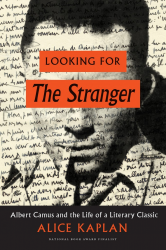 Looking for the Stranger by Alice Kaplan (No credit)
LOOKING FOR ‘THE STRANGER’
By Alice Kaplan
Published on the heels of Michael Gorra’s Portrait of a Novel and Peter Finn and Petra Couvée’s The Zhivago Affair—fascinating works about the cultural, historical and personal provenance of Henry James and Boris Pasternak novels—Kaplan’s equally stellar new book about Albert Camus’s absurdist-minimalist masterpiece, The Stranger, confirms the arrival of a promising new genre: the “novel biography.”
With its unusual combination of an Algerian setting and American noir style, Kaplan describes The Stranger’s impact as “a blood transfusion to the genre of the novel.” Written in 1940 during a lonely sojourn in a Paris apartment and inspired by Camus’s work as a court reporter in his native Algiers, The Stranger explores colonial ethnic tensions and the author’s own humanist philosophical leanings through the story of Meursault, a French Algerian whose failure to weep at his mother’s funeral influences his receiving of the death sentence for the murder of a (famously nameless) Arab man…
Tim Wu delivers a screed about advertising
– macleans.ca
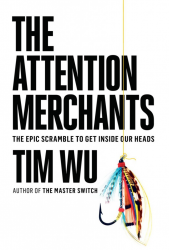 The Attention Merchants by Tim Wu (No credit)
THE ATTENTION MERCHANTS
By Tim Wu
Humanity is in crisis, Tim Wu asserts—not so much because of climate change, or inequality, or the rise of the alt-right, but because . . . look, a baby sloth! Sorry. Where was I? We’ve become, in Wu’s words, “‘homo distractus, a species of ever-shorter attention span known for compulsively checking his devices.” We’ve (d)evolved thusly due to what Wu calls “attention merchants,” those who make a profit by capturing and selling our attention.
Wu, a law professor at Columbia and the author of The Master Switch (2010), offers a caustic, illuminating history of advertising. He explains how the concept of turning customers into products did not originate with social media, charting its rise from the early days of the ad-driven New York Sun in the 1830s through the gradual colonization of radio, TV, computers and smartphones.
Wu connects dots between the early 20th-century snake-oil salesmen who were sold readers’ attention by newspapers, and 21st-century online advertisers that snare our eyes when we look at clickbait…
A fascinating look at Camus’s The Stranger
– macleans.ca
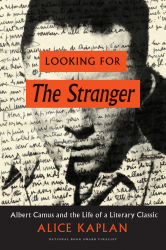 Looking for the Stranger by Alice Kaplan (No credit)
LOOKING FOR ‘THE STRANGER’
By Alice Kaplan
Published on the heels of Michael Gorra’s Portrait of a Novel and Peter Finn and Petra Couvée’s The Zhivago Affair—fascinating works about the cultural, historical and personal provenance of Henry James and Boris Pasternak novels—Kaplan’s equally stellar new book about Albert Camus’s absurdist-minimalist masterpiece, The Stranger, confirms the arrival of a promising new genre: the “novel biography.”
With its unusual combination of an Algerian setting and American noir style, Kaplan describes The Stranger’s impact as “a blood transfusion to the genre of the novel.” Written in 1940 during a lonely sojourn in a Paris apartment and inspired by Camus’s work as a court reporter in his native Algiers, The Stranger explores colonial ethnic tensions and the author’s own humanist philosophical leanings through the story of Meursault, a French Algerian whose failure to weep at his mother’s funeral influences his receiving of the death sentence for the murder of a (famously nameless) Arab man…
Tim Wu delivers a screed about advertising
– macleans.ca
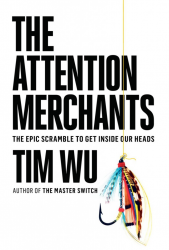 The Attention Merchants by Tim Wu (No credit)
THE ATTENTION MERCHANTS
By Tim Wu
Humanity is in crisis, Tim Wu asserts—not so much because of climate change, or inequality, or the rise of the alt-right, but because . . . look, a baby sloth! Sorry. Where was I? We’ve become, in Wu’s words, “‘homo distractus, a species of ever-shorter attention span known for compulsively checking his devices.” We’ve (d)evolved thusly due to what Wu calls “attention merchants,” those who make a profit by capturing and selling our attention.
Wu, a law professor at Columbia and the author of The Master Switch (2010), offers a caustic, illuminating history of advertising. He explains how the concept of turning customers into products did not originate with social media, charting its rise from the early days of the ad-driven New York Sun in the 1830s through the gradual colonization of radio, TV, computers and smartphones.
Wu connects dots between the early 20th-century snake-oil salesmen who were sold readers’ attention by newspapers, and 21st-century online advertisers that snare our eyes when we look at clickbait…
Canada’s biggest banks moving to analytics for credit assessments
– theglobeandmail.com
Equifax is using Canada – and its financial institutions – as the first market for the new approach

