
The “Big Five” Canadian banks offer investment funds and include Royal Bank of Canada, Toronto Dominion Bank (TD Canada Trust), Bank of Nova Scotia, Bank of Montreal and Canadian Imperial Bank of Commerce (CIBC). Let’s explore the best place for you to invest.
Latest News

Donald Trump's tariffs cement costly recovery from Hurricane Florence - Toronto Star Sep 17th
Toronto StarDonald Trump's tariffs cement costly recovery from Hurricane FlorenceToronto StarWASHINGTON—The tariffs U.S. President Donald Trump has slapped on imports from China, Canada and other countries —as well as new tariffs he is expected to announce late Monday —are almost certain .... More »
Short-seller research firm Hindenburg responds to Trevor Milton's resignation - CNBC Television Sep 21st
Short-seller research firm Hindenburg responds to Trevor Milton's resignation CNBC TelevisionNikola stock collapses after founder resigns over fraud allegations The Next WebNikola's Trevor Milton Resigns, GM Is Still In Torque NewsNikola Doesn't Look Much Like Tesla .... More »
Two men charged in death of Markham real estate agent as search continues for murder suspect - CP24 + MORE Dec 17th
Two men charged in death of Markham real estate agent as search continues for murder suspect CP24View Full Coverage on Google News.... More »
How much credit card debt does the average Canadian have? Sep 22nd
As the country re-opens after COVID-related restrictions, Canadians are faced with a worrying financial picture. Many have moved, others are looking to travel, and the cost of living is ballooning with unusual rates of inflation. Meanwhile, the Bank of Canada (BoC) rate hikes designed to curb these .... More »
S&P 500 hits record high, equals longest bull-run + MORE Aug 21st
The benchmark S&P 500 touched a record high on Tuesday and equalled its longest-ever bull-market run, as U.S. stocks rose on encouraging earnings reports and hopes that the United States and China could resolve their tariff dispute..... More »
How to avoid a value trap
– moneysense.ca
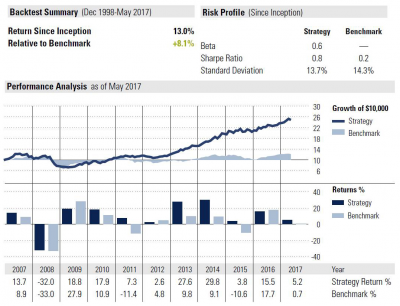 The concept of value investing is certainly not a new to investors, nor is the notion of a value trap (when stock price takes a dive and the looks like a better value). To help to circumvent this against, investors may use momentum type indicators in combination with value metrics.
Here is one strategy that does just that. This strategy uses Morningstar CPMS* to ranks stocks within the S&P/TSX 60 index on the following factors:
3M price momentum (average price over the past six months as a percentage change from the same figure three months ago)
Quarterly earnings momentum (latest four quarters of trailing earnings compared against the same figure one quarter ago)
Latest quarterly earnings surprise (the difference between the latest reported quarter of EPS, compared against the street consensus estimate just prior to the report).
5 year normalized EPS growth (this measures the rate of growth of earnings for a company over a five year period)
The first three factors above measure short term fundamental growth in the company, while the last factor measures over a longer period of time…
Is there a way to buy ETF shares on a monthly savings plan?
– moneysense.ca
 Q. Does anyone offer a way to buy ETF shares on a regular basis, like a savings plan designed to add a small amount each month? Or is the only option to wait until you have saved enough cash to make an order worthwhile? – Peter, Cambridge, Ont.
A. ETFs offer a long list of benefits, but one of their drawbacks is that they don’t make it easy to invest small amounts. That’s because almost all brokerages charge a commission to buy and sell ETFs: usually $7 to $10 per trade. If you’re contributing $200 per month, a $10 commission is 5% of every purchase. That will quickly erode any benefit you might get from the ETF’s lower management fees.
If you’re looking to invest small amounts with ETFs, you have a few options:
Use a robo-advisor. There are now many online platforms that allow you to build an ETF portfolio with small amounts of money and regular contributions, including Wealthsimple, Nest Wealth and Modern Advisor. Every time you add money, it’s used to buy new shares, and you’re not charged any trading commissions: instead, you pay a small percentage of your account (usually 0…
Should I switch all at once?
– moneysense.ca
 A couch potato investor named Remi sent me the following question:
I want to move away from my stocks and mutual funds in order to build a Couch Potato portfolio with ETFs. What is the best way to do this? Should I sell everything at once and pay all of the taxes this year, or should I sell my assets over a longer period, like two to three years?
Many investors in Remy’s situation have made that all important first-step: committing to an indexed strategy. But now they’re unsure about how to liquidate their existing portfolio and build the new one. Should you clean house and do it all at once, or take a more gradual approach?
This is an easy decision if all of your investments are in RRSPs and TFSAs. Since there are no tax consequences to selling your existing holdings, you should just liquidate all the holdings right away. But Remy is investing in a non-registered account, and if he’s held his stocks and mutual funds for several years, he’s probably sitting on large unrealized capital gains, so selling these securities would result in a significant tax bill…
Corrupt realtors should face higher fines, Ontario real estate group says
– theglobeandmail.com
Ontario Real Estate Association says tougher penalties should be on the agenda as province gets ready to review rules governing agents

