
The “Big Five” Canadian banks offer investment funds and include Royal Bank of Canada, Toronto Dominion Bank (TD Canada Trust), Bank of Nova Scotia, Bank of Montreal and Canadian Imperial Bank of Commerce (CIBC). Let’s explore the best place for you to invest.
Latest News


Capital gains tax when renting out your former principal residence Jul 25th
Ask MoneySense
If a person moves to find work, does not sell their home, and rents in the new location for several years, is the original home subject to capital gains if they sell it? It has been rented out in the interim.
—Hugh
Do you pay capital gains when you rent out a former principal.... More »
Protests to target Carney's global investment summit as it kicks off in Toronto Sep 14th
The protest will begin at Nathan Phillips Square then move to the AGO, where hundreds of the summit's attendees will be gathering for a private gala..... More »
In Humboldt, sorrow, love and loss take the ice on game night Apr 9th
Al and Jean Gaetz were in their arena seats in Row 8, in Section U near the blue line on Sunday, just as they were planning to do if their beloved Humboldt Broncos had reached Game 6.
They’ve held Broncos season tickets since 1973; they billeted young players for decades. Al, still selling real es.... More »
TSX weighed down by resource stocks, loonie remains above 82 cents US + MORE Sep 9th
TORONTO _ Canada’s main stock index is moderately lower this morning, weighed down by resource stocks.
The Toronto Stock Exchange’s S&P/TSX composite index declined 41.52 points to 14,983.01, after 90 minutes of trading.
In New York, the Dow Jones industrial average climbed 46.53 poi.... More »
Canadian exporters feel pessimistic on NAFTA uncertainty, seeking new solutions + MORE Dec 16th
TORONTO _ Nearly one-quarter of Canadian exporters believe they are negatively affected by looming NAFTA renegotiation uncertainty and are turning to creative solutions to succeed even if the free trade agreement fails, according to a poll by Export Development Canada.
The federal agency supporting .... More »
How to avoid a value trap
– moneysense.ca
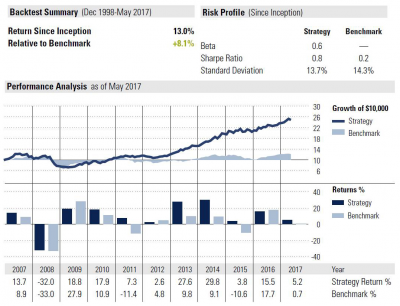 The concept of value investing is certainly not a new to investors, nor is the notion of a value trap (when stock price takes a dive and the looks like a better value). To help to circumvent this against, investors may use momentum type indicators in combination with value metrics.
Here is one strategy that does just that. This strategy uses Morningstar CPMS* to ranks stocks within the S&P/TSX 60 index on the following factors:
3M price momentum (average price over the past six months as a percentage change from the same figure three months ago)
Quarterly earnings momentum (latest four quarters of trailing earnings compared against the same figure one quarter ago)
Latest quarterly earnings surprise (the difference between the latest reported quarter of EPS, compared against the street consensus estimate just prior to the report).
5 year normalized EPS growth (this measures the rate of growth of earnings for a company over a five year period)
The first three factors above measure short term fundamental growth in the company, while the last factor measures over a longer period of time…
Is there a way to buy ETF shares on a monthly savings plan?
– moneysense.ca
 Q. Does anyone offer a way to buy ETF shares on a regular basis, like a savings plan designed to add a small amount each month? Or is the only option to wait until you have saved enough cash to make an order worthwhile? – Peter, Cambridge, Ont.
A. ETFs offer a long list of benefits, but one of their drawbacks is that they don’t make it easy to invest small amounts. That’s because almost all brokerages charge a commission to buy and sell ETFs: usually $7 to $10 per trade. If you’re contributing $200 per month, a $10 commission is 5% of every purchase. That will quickly erode any benefit you might get from the ETF’s lower management fees.
If you’re looking to invest small amounts with ETFs, you have a few options:
Use a robo-advisor. There are now many online platforms that allow you to build an ETF portfolio with small amounts of money and regular contributions, including Wealthsimple, Nest Wealth and Modern Advisor. Every time you add money, it’s used to buy new shares, and you’re not charged any trading commissions: instead, you pay a small percentage of your account (usually 0…
Should I switch all at once?
– moneysense.ca
 A couch potato investor named Remi sent me the following question:
I want to move away from my stocks and mutual funds in order to build a Couch Potato portfolio with ETFs. What is the best way to do this? Should I sell everything at once and pay all of the taxes this year, or should I sell my assets over a longer period, like two to three years?
Many investors in Remy’s situation have made that all important first-step: committing to an indexed strategy. But now they’re unsure about how to liquidate their existing portfolio and build the new one. Should you clean house and do it all at once, or take a more gradual approach?
This is an easy decision if all of your investments are in RRSPs and TFSAs. Since there are no tax consequences to selling your existing holdings, you should just liquidate all the holdings right away. But Remy is investing in a non-registered account, and if he’s held his stocks and mutual funds for several years, he’s probably sitting on large unrealized capital gains, so selling these securities would result in a significant tax bill…
Corrupt realtors should face higher fines, Ontario real estate group says
– theglobeandmail.com
Ontario Real Estate Association says tougher penalties should be on the agenda as province gets ready to review rules governing agents

