
How to go about securing the best savings strategy in Canada.
Latest News



Capital gains when selling property to family + MORE Mar 20th
Do I have to pay income tax if I inherited a property jointly with my sister and she bought me out for less than half the appraised value of the property?
—Johanna
Capital gains and transferring property between family
Asset sales between family members can be tricky to facilitate at a family leve.... More »
Wealthsimple Cash review 2024 + MORE Jul 16th
Wealthsimple Cash is a high-interest chequing/savings account that offers one of the highest interest rates in Canada. It has appealing yields and includes a prepaid Mastercard with no foreign exchange fee, so many consumers are naturally attracted to the account. Is it any good? The short answ.... More »
How to fill out a personal tax return for 2023 + MORE Dec 18th
Whether it’s your first time or if you’re a newcomer to Canada, you’ve come to the right place. This step-by-step guide will help you navigate through filling out your tax return.
The most popular method to file your tax return is by using online tax software. According to the Canada Revenu.... More »
Best fixed-income ETFs for Canadian investors 2026 + MORE Apr 29th
With the downturn in stock markets in 2026, many investors are grudgingly coming around to the realization that they need exposure to other asset classes in their portfolios. And the most readily available is bonds, which have the advantage, historically, of being negatively correlated to stocks. Th.... More »
Prepare for lower weekly benefits with 18-month mat leave + MORE Jan 25th
OTTAWA — When Ottawa announced changes to EI parental leave benefits last year that will allow new mothers to receive benefits for 18 months, Heather Wilson was excited about the possibility of spending more time with her baby.
But after digging into the changes, Wilson and h.... More »
Canadians Ill-Prepared for a Rate Hike; Unprecedented Debt Imminent
– ratesupermarket.ca
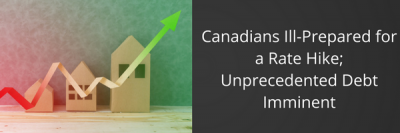
A new report finds Canadians are facing a future where an unprecedented amount of household income will go towards debt servicing.
The Household Indebtedness and Financial Vulnerability report by the Parliamentary Budget Officer is raising concerns on the level of household debt amongst Canadians. The report suggests that debt is increasing at such a sharp pace, many Canadians will be ill prepared for even a slight hike in interest rates.
In just the first quarter of 2017, household debt reached a record level of a 174 per cent of disposable income – meaning, on average, we owe $1.74 of every $1 we make.
Since interest rates have been at record lows for so long, the PBO warns that if rates were to soon rise, “The financial vulnerability of the average household would rise to levels beyond historical experience.”
The Debt Servicing Ratio (DSR) has remained stable at 14 per cent since 2009. This means that Canadians on average use 14 per cent of their after-tax income to make mortgage payments, and pay off credit card and line of credit debt…
Should you use RRSPs to pay down the mortgage?
– moneysense.ca

Q: My husband and I will have good pensions.
He is thinking that we should cash out our RRSPs to pay down our mortgage.
He thinks that we will be taxed the same amount either way. Your thoughts?
—Linda
A: Some people struggle with whether they should invest or pay down debt. I think there are good arguments for debt repayment over investing in some cases.
For one, Linda, I’m not a fan of having a big emergency fund in cash earning 1%, while your mortgage or other debt is at 3% or more. It’s a guaranteed losing proposition. Some people like the safety net of an emergency fund. I’d rather someone have a modest cash balance and a secured line of credit as an additional emergency fund which you hopefully never use.
If you forever have $10,000, $20,000 or more sitting idle in cash, you could be missing out on RRSP, RESP or TFSA contributions or have debt that continues to accrue interest at a higher rate in the meantime.
Ask a Planner: Leave your question for Jason Heath »
RRSPs can be a bit different, Linda…
Should You Accept That Pre-Approved Credit Limit Increase?
– ratesupermarket.ca

If you faithfully pay your loans, mortgage and credit cards each month, then you’ve probably received a call or letter from your bank with the news that you were pre-approved for a credit increase or a line of credit.
You might be thinking, I don’t even use all the credit I currently have. I don’t need an increase.
But guess what? Turning down a pre-approved credit increase may actually hurt your credit score.
Why you were offered an increase
If you already have an account with a bank, and it pre-approves you for a credit increase or new line of credit, it’s typically because you are being recognized for being a good customer. By diligently paying off your card every month and staying on top of your current loans, your bank now trusts that you will pay them back if they increased your limit.
Exclusive offer from RateSupermarket.ca: For a limited time, apply for a President’s Choice Financial® Mastercard® through RateSupermarket.ca and get a $150 e-gift card & up to 20,000 PC® points when you activate your card…

