
How to go about securing the best savings strategy in Canada.
Latest News


Amar earned $117,799 last year. But he is a freelance photographer with an unpredictable income. How can he sock away more savings? + MORE Oct 17th
Amar is 31 years old and lives in an affordable shared apartment. How can he increase his savings when his monthly income is never the same?.... More »
26 ways the 2018 Ontario Budget affects your wallet + MORE Mar 29th
If there’s any way to describe the 2018 Ontario budget, it’s the word “free”. From free preschool daycare to free university tuition, to free drugs for those age 65 and over, there’s freebies for everyone—and lots of tax credits too.
Low-income earners and social assistance recipients
.... More »
Best in show: How to find and invest in market leaders + MORE Apr 10th
Canadians approach retirement planning in many different ways, but there’s one thing we can all benefit from: a strategy to save enough to retire comfortably and even generate income after we stop working.
But many of us don’t feel financially ready to stop working. According to a 2022 survey.... More »
The best high-interest savings accounts in Canada for 2024 Sep 17th
Savings comparison tool
Find the best and most up-to-date savings rates in Canada using the comparison tool below. Plus, use the filters to assess your estimated return based on the size of your balance.
Why trust us
MoneySense is an award-winning magazine, helping Canadians navigate mo.... More »
TFSA contribution room calculator + MORE Jan 16th
Find out your current tax-free savings account (TFSA) contribution limit by using this calculator.
TFSA is a bit of a misnomer. While you can use it for straightforward savings, think of it more accurately as an investment holding account to store things like exchange-traded funds .... More »
Canadians Ill-Prepared for a Rate Hike; Unprecedented Debt Imminent
– ratesupermarket.ca
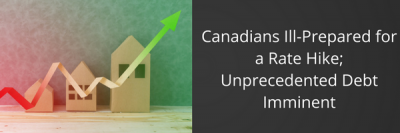
A new report finds Canadians are facing a future where an unprecedented amount of household income will go towards debt servicing.
The Household Indebtedness and Financial Vulnerability report by the Parliamentary Budget Officer is raising concerns on the level of household debt amongst Canadians. The report suggests that debt is increasing at such a sharp pace, many Canadians will be ill prepared for even a slight hike in interest rates.
In just the first quarter of 2017, household debt reached a record level of a 174 per cent of disposable income – meaning, on average, we owe $1.74 of every $1 we make.
Since interest rates have been at record lows for so long, the PBO warns that if rates were to soon rise, “The financial vulnerability of the average household would rise to levels beyond historical experience.”
The Debt Servicing Ratio (DSR) has remained stable at 14 per cent since 2009. This means that Canadians on average use 14 per cent of their after-tax income to make mortgage payments, and pay off credit card and line of credit debt…
Should you use RRSPs to pay down the mortgage?
– moneysense.ca

Q: My husband and I will have good pensions.
He is thinking that we should cash out our RRSPs to pay down our mortgage.
He thinks that we will be taxed the same amount either way. Your thoughts?
—Linda
A: Some people struggle with whether they should invest or pay down debt. I think there are good arguments for debt repayment over investing in some cases.
For one, Linda, I’m not a fan of having a big emergency fund in cash earning 1%, while your mortgage or other debt is at 3% or more. It’s a guaranteed losing proposition. Some people like the safety net of an emergency fund. I’d rather someone have a modest cash balance and a secured line of credit as an additional emergency fund which you hopefully never use.
If you forever have $10,000, $20,000 or more sitting idle in cash, you could be missing out on RRSP, RESP or TFSA contributions or have debt that continues to accrue interest at a higher rate in the meantime.
Ask a Planner: Leave your question for Jason Heath »
RRSPs can be a bit different, Linda…
Should You Accept That Pre-Approved Credit Limit Increase?
– ratesupermarket.ca

If you faithfully pay your loans, mortgage and credit cards each month, then you’ve probably received a call or letter from your bank with the news that you were pre-approved for a credit increase or a line of credit.
You might be thinking, I don’t even use all the credit I currently have. I don’t need an increase.
But guess what? Turning down a pre-approved credit increase may actually hurt your credit score.
Why you were offered an increase
If you already have an account with a bank, and it pre-approves you for a credit increase or new line of credit, it’s typically because you are being recognized for being a good customer. By diligently paying off your card every month and staying on top of your current loans, your bank now trusts that you will pay them back if they increased your limit.
Exclusive offer from RateSupermarket.ca: For a limited time, apply for a President’s Choice Financial® Mastercard® through RateSupermarket.ca and get a $150 e-gift card & up to 20,000 PC® points when you activate your card…

