
Canada has several major banks and many schedule II banks – but with rates and plans all over the map, it’s difficult to know where to bring your business. Our aim is to help you navigate Canada’s banking options to discover which one suits your needs best.
Latest News

The best student credit cards in Canada for 2024 + MORE Oct 7th
When you’re at a new restaurant, do you have to see the menu before you order? Or do you eat what your foodie friend says is good, knowing it’ll be amazing? The answer can help you decide how to pick a new credit card. Some people want the ability to compare their options side-by-side; others wa.... More »
The best high-interest savings accounts in Canada for 2024 + MORE Aug 19th
Save
The best high-interest savings accounts in Canada for 2024
Here are the accounts offering the highest interest rates and lowest fees.
Compare now
Tap the button for more details.
W.... More »
The best high-interest savings accounts in Canada for 2025 + MORE Jun 3rd
Savings comparison tool
Find the best and most up-to-date savings rates in Canada using the comparison tool below. Plus, use the filters to assess your estimated return based on the size of your balance.
Advertisement
Why trust us
MoneySense is an.... More »
Can you build a 40/30/30 portfolio with ETFs? Aug 22nd
The unique market conditions of the 2022 bear market exposed a major flaw in the traditional 60% stocks/40% bonds balanced portfolio used by millions of investors. That year was defined by two forces: surging inflation across both the U.S. and Canada, and aggressive interest rate hikes by their resp.... More »
The best high-interest savings accounts in Canada for 2024 + MORE Jul 18th
Save
The best high-interest savings accounts in Canada for 2024
Here are the accounts offering the highest interest rates and lowest fees.
Compare now
Tap the button for more details.
W.... More »
Lending Loop Review: Peer-to-Peer Lending in Canada
– canadianfinanceblog.com
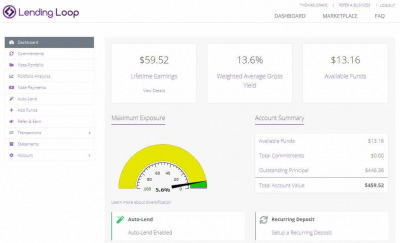 Peer-to-peer lending (P2P) has been around for a long time, exploding in popularity in recent years with advances in online technology. An investment vehicle once limited to large corporations and institutional investors, it’s now available to regular investors like you and me.
With a mandate of supporting Canadian small business, while also providing fixed income investors with an alternative to the GIC products offered by banks and credit unions, Lending Loop has established itself as Canada’s premier peer-to-peer lending platform. There are other competitors, but they deal exclusively with large, institutional investors.
In this article, I’ll show you how to use Lending Loop as an investment platform, by pooling your funds with thousands of other lenders, with the potential of earning attractive rates of interest on your money. The best part is that you can get started with as little as $200, and signup is completely free.
I’ve invested a small amount of test money with Lending Loop and really like it…
Should You Apply For a Loan or Line of Credit?
– ratesupermarket.ca

Banks offer a variety of products to give you access to cash. But is every borrowing option the same? If you’re weighing the alternatives, you may struggle with the choice between a loan and line of credit. Only you can decide what’s best for you, but there are some factors to consider. Those include your personal spending habits and your plans for the extra source of funding.
What’s the Difference?
Once you’re approved for a line of credit, you don’t have to use it right away. The credit line is available for you to draw from as you need, but you’ll have to make regular payments on any balance. It’s considered a revolving form of credit, where you get the available credit back after you’ve made the agreed upon payments. Some lines of credit only require that you pay the interest on any outstanding balance.
A loan typically comes as cash in one lump sum. You pay it off in fixed installments. Once it’s paid off, it’s paid off…
Should You Apply For a Loan or Line of Credit?
– ratesupermarket.ca

Banks offer a variety of products to give you access to cash. But is every borrowing option the same? If you’re weighing the alternatives, you may struggle with the choice between a loan and line of credit. Only you can decide what’s best for you, but there are some factors to consider. Those include your personal spending habits and your plans for the extra source of funding.
What’s the Difference?
Once you’re approved for a line of credit, you don’t have to use it right away. The credit line is available for you to draw from as you need, but you’ll have to make regular payments on any balance. It’s considered a revolving form of credit, where you get the available credit back after you’ve made the agreed upon payments. Some lines of credit only require that you pay the interest on any outstanding balance.
A loan typically comes as cash in one lump sum. You pay it off in fixed installments. Once it’s paid off, it’s paid off…

