
Province Bringing in New Rules for Mortgage Brokers - VOCM + MORE Oct 21st

New to Canada? Here’s how the Scotiabank newcomer offer can help Dec 17th
TDSB announces new CEO and new chief financial officer under new governance structure + MORE May 22nd
Making sense of the markets this week: August 6, 2023 Aug 4th
Ford's $19.5 billion EV writedown signals tough road ahead for legacy carmakers - Reuters Dec 16th
The Cost of Living Is Through the Roof—Can You Use It to Leverage a Raise?
– canadianbusiness.com
Ottawa-based think tank, Canadian Centre for Policy Alternatives, recently published a new study that calculated how much workers would need to make in a 40-hour workweek in order to spend no more than 30 per cent of their income on housing (what they call “rental wage”). Unsurprisingly, rental wages are much higher than the hourly minimum wage in every province. In B.C., for example, you need to be making at least $27.54 an hour to afford a one-bedroom. (The minimum hourly wage in the province is $15.65.) In Ontario, you need to make $25.96 an hour for a one-bedroom (where the minimum hourly wage is $15.50). And the unaffordability is top of mind for everyone: Financial planning and education body FP Canada’s 2023 financial stress index finds that money is the leading source of stress for Canadians, for the sixth year in a row…
We’re in the midst of a cost-of-living crisis—with sky-high grocery prices and mortgage rates that would have been inconceivable 18 months ago. To fight inflation, the Bank of Canada (BoC) has increased the policy interest rate by a total of 475 basis points (4.75%) since March 2022 (a basis point is equal to one hundredth of a percentage point). But is it helping?
Thankfully, yes, it is. Inflation fell to 2.8% in June, within the BoC’s target band of 1% to 3%, but ultimately the central bank would like it to reach 2%. And it may be too early to celebrate, because certain goods, such as groceries, remain stubbornly expensive (grocery prices were up 9.1% year-over-year in June), and gas inflation is down (prices fell 21.6% year-over-year in June) simply because prices were so high last year.
How much more financial pain lies ahead? How high could interest rates go in Canada?
The impact of BoC rate hikes so far
When the BoC increases or decreases its interest rate, the banks follow suit…
How much are solar panels in Canada?
– moneysense.ca
Are solar panels worth the cost in Canada?
A solar panel system can help you to reduce your carbon footprint, but from a financial perspective, solar may or may not make sense for your home. As a starting point, here’s what you’ll need to consider:
Your household’s energy consumption—if your monthly and annual energy needs are low (for example, the monthly bill is well under $100), the cost of a solar system probably isn’t justified, but if your electricity needs are much higher, that’s a stronger argument in favour of going solarThe size and scope of the solar photovoltaic (PV) system needed to match your electricity demandsHow efficient your system will be based on the size and angle of your roof and which direction it faces with respect to the sun (southern exposure is best)How much sunshine and snow your area typically getsHow much you’re willing to spend
The average Canadian household uses 11,135 kilowatt hours (kWh) of electricity per year, but your usage depends on the climate where you live, the size of your home, how airtight and well insulated it is and—one of the biggest factors—your energy consumption habits…
Making sense of the markets this week: July 30, 2023
– moneysense.ca
 Kyle Prevost, editor of Million Dollar Journey and founder of the Canadian Financial Summit, shares financial headlines and offers context for Canadian investors.
U.S. tech stocks continue to devour the old world
Tech and telecom earnings highlights this week
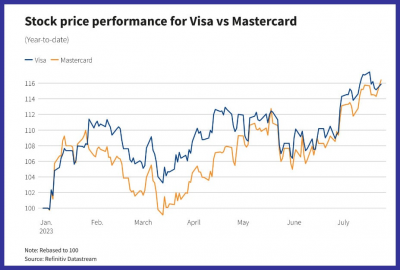
The U.S. tech earnings machine keeps on humming. While Microsoft did lower its guidance for the rest of the year, all three tech giants outperformed expectations again this quarter. When juxtaposed against the year-to-date performance of not-so-trusty old telecommunications firms at Verizon and AT&T, the comparison is rather stark. (All numbers below are presented in U.S. dollars.)
Alphabet (GOOGL/NASDAQ): The internet search giant pleased shareholders again this week, as earnings per share came in at $1.44 (versus $1.34 predicted), and revenues were $74.6 billion (versus $72.82 billion predicted). Cloud revenue and YouTube ads were star performers this quarter for the company. Share prices were up 7% in after-hours trading on Tuesday…
The FHSA is a type of registered account that allows you to contribute up to $8,000 annually, up to a lifetime limit of $40,000, to save for the purchase of your first home.FHSAs became available on April 1, 2023. However, availability is currently limited and will vary by financial institution. Many are expected to launch their FHSA later in 2023.
Canadians can now boost their savings for a down payment on a home with a new type of registered account. The first home savings account (FHSA), also referred to as the tax-free first home savings account, creates up to $40,000 in tax-free savings room for first-time home buyers. In this article, we’ll explain why the FHSA was created, how it works and how you can maximize its potential—even if you have no immediate plans to buy a home.
Frequently asked questions about FHSAs
{
“@context”: “https://schema.org”,
“@type”: “FAQPage”,
“mainEntity”: [
{
“@type”: “Question”,
“name”: “Where are FHSAs currently available?”,
“acceptedAnswer”: {
“@type”: “Answer”,
“text”: “On April 1, Questrade became the first company to launch an FHSA in Canada…

