

MoneySense magazine: January 2015 Dec 25th

Timing CPP and OAS with workplace pensions Mar 31st

This 30-year-old freelancer makes $125,000 a year and pays modest rent living with his parents. Should he invest in retirement or buy a home? + MORE Feb 3rd
Student-Made Adidas Ad Will Make You Feel Something Real + MORE Jan 6th
What’s my RRSP contribution limit for 2022? + MORE Dec 21st
Plan your retirement in 6 steps
– moneysense.ca
For more on this topic, pick up The MoneySense Beginner’s Guide to Personal Finance.
The post Plan your retirement in 6 steps appeared first on MoneySense.
Five Things You Should Know About Retiring in Debt
– rhondasherwood.com
 While the ideal situation would be to retire debt-free, a CIBC poll conducted in July 2012 found that nearly 60 percent of retired Canadians have some debt. Retired Canadians may hold less debt than people who are still in the workforce, but the more debt that you hold on to, the less freedom you will have in retirement to do the things you want to do, such as travel or enjoy hobbies. If you retire with debt, you will likely carry it longer than if you were working, and it will have an effect on your cash flow. Here are five things you should know about retiring in debt:
1. Retiring in debt makes meeting your everyday expenses more difficult.
If your mortgage represents 20 percent of your pre-retirement income, you’re probably able to live quite comfortably. Once you retire and you are living on half your previous income, you are faced with having 40 percent of your income going out in mortgage costs. You don’t have any extra money for entertainment, travel, or extra expenses and may be faced with having to downsize your home to access the equity or sell other assets to pay down the mortgage…
Simple Steps For Saving $500 A Month
– walletpop.ca
 Filed under: Budgeting & Planning, Economizer, SavingIf you’re wondering how to squeeze more money out of your monthly earnings, preparing and maintaining a household budget is a great place to start. Once you’ve created a budget, the next step is learning how to reduce your expenses and increase your savings.
Here are some simple steps you can take to carve out $500 in savings each and every month. They do require a few lifestyle changes but nothing dramatic. We left out a big item – eliminating your car – which can save you up to $5000 annually, depending on whether you have car payments along with car insurance, maintenance and gas costs. That $5000 could go a long way toward your retirement or other savings goals. But there are others that are easy to do that’ll collectively take quite a bite out of your spending.
Check the slideshow for 10 ways to shave hundreds off your bills each month.
SLIDESHOW: 10 Ways to Save $500 Every Month
Simple Steps For Saving $500 A Month originally appeared on Walletpop Canada on Tue, 29 Oct 2013 15:55:00 EST…
Canadians proactive but skeptical about retirement, survey finds
– moneysense.ca
 (Photo courtesy of blackrockinvestments.ca)
Canadian investors are more proactive and optimistic about their financial future than their counterparts in the U.S. and elsewhere, according to the first-ever Global Investor Pulse Survey from BlackRock Inc.
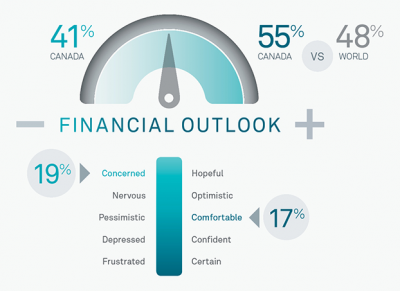
More than half (55%) of the roughly 1,000 Canadian investors with varying incomes polled report feeling positive about their financial prospects, compared with 48% of global investors. Nearly two-thirds (64%) said they take financial planning seriously and 60% use the services of either a personal financial or bank adviser. That’s more than any other country and double the global average (24%).
Still, only half of Canadian investors feel they are in control of their financial future and 36% said they aren’t confident they’ll reach their retirement goals.
“What we’re seeing is an interesting mix of Canadians’ financial conservatism and nervousness coupled with a clear desire to take a more active and informed role in managing their financial futures,” said BlackRock Canada’s Noel Archard in a press release…
Making smarter asset location decisions
– moneysense.ca
 Last week’s posts about tax loss selling prompted some interesting questions about asset location in the comments section. Holding your ETFs and index funds in the most tax-efficient accounts can have a big impact on your long-term returns. But although it’s often easy to set up a portfolio with proper asset location, it can be a challenge to maintain the right balance when you add new money.
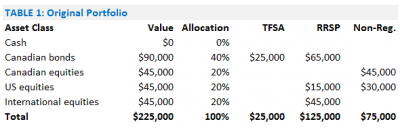
Say you’re using the Global Couch Potato portfolio spread across three accounts. Your TFSA and RRSP are maxed out at $25,000 and $125,000, respectively, and you have another $75,000 in a non-registered account. Your optimal asset location would look like this:
So far, so good. But now you’ve won second prize in a beauty contest and received a $25,000 windfall. Since you can’t add it to your tax-sheltered savings, you put the money in your non-registered account. Then you enter the new values into your rebalancing spreadsheet and discover your portfolio is now off its target:
The naive way to rebalance your portfolio would be to make all the transactions in your non-registered account…

