
All about Retirement Planning in Canada. Learn the ins and outs and get the latest news.
Latest News



How the federal budget affects you + MORE Apr 23rd
The Conservative government introduced its 2015 federal budget on Tuesday evening. While the 518-page document is chock-full of text and charts on topics ranging from foreign direct investment to energy exports, it doesn’t exactly spell out in how it affects real people.
We’ve applied .... More »
Russ Dyck financial advisor Nov 8th
Meet Russ Dyck
Russ Dyck, a Certified Financial Planner and founder of Finovo, specializes in financial planning for professional couples and young professionals. He is passionate about helping clients navigate complex financial decisions with clarity and confidence, tailoring each plan to meet t.... More »
How to plan for retirement for Canadians: A review of Four Steps to a Worry-Free Retirement course + MORE Oct 26th
With November incoming and being Financial Literacy Month in Canada, it seems appropriate to devote this edition of the Retired Money column to a new Canadian DIY retirement course created by MoneySense’s “Making sense of the markets” columnist Kyle Prevost.
Entitled 4 Steps to a .... More »
Planning can help you make sure your retirement savings will last Jun 16th
There are steps you can take to make sure you don’t outlive your retirement savings, writes Ellen Roseman..... More »
Caisse CEO urges institutional investors to ‘think differently’ + MORE Mar 4th
The chief executive officer of Caisse de dépôt et placement du Québec said pension plans and sovereign wealth funds are looking for private investments for their more than $40-trillion of assets
.... More »
Boomers happy working longer, retiring later
– thestar.com
 Most Baby Boomers intend to work after retirement age or never retire at all. But some are making backup plans just in case.
Unwrap portfolio with index mutual funds
– moneysense.ca
 Photograph by Jenna Marie Wakani
The problem
With a paid-for home and six-figure portfolio, the couple’s friends think they have little to worry about. But “I do worry,” says Denise, who at 53 makes a good income as a dental hygienist. However, she enjoys no major benefits or employer-sponsored pension plan. Neither does Mark, 55, who lost his job in April 2011 and has worked only in contract positions since. They were investing $1,200 a month in RRSPs but ceased adding to Mark’s portion in November. The bank “wrap” program they’re invested in charges 2.5%. They’d prefer the lower fees of a “Couch Potato” but “don’t know how to do it ourselves.”
Financial planner Tony de Thomasis, of De Thomas Financial Corp., says the couple are moderate-risk investors and should be comfortable with an asset allocation of 75% equities to 25% bonds and cash. As retirement approaches and if markets cooperate, portfolios would be gradually rebalanced to raise the fixed-income weight by 8% every five years or so…
Retirement spending: You may need less than you think
– moneysense.ca
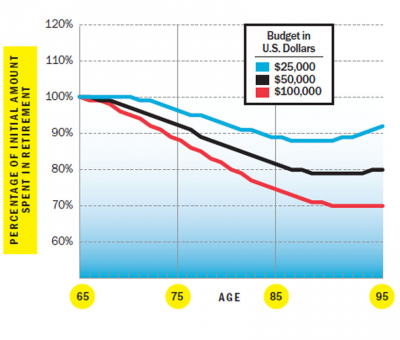 David Blanchett, head of retirement research at Morningstar Investment Management, ran the numbers on the actual spending patterns of retired couples over 30 years. He tracked three annual spending levels: US $25,000, $50,000 and $100,000. He found that as couples aged, they withdrew less than anticipated, mainly because they had simpler lifestyles. As a result, many retirees may need 10% to 30% less in savings than planners suggest.
Source: Morningstar Investment Management
The post Retirement spending: You may need less than you think appeared first on MoneySense.
 You can withdraw money tax-free from your RRSP when buying a home. But you must tell the bank why you’re doing it or face unwanted taxes.
What if You Have Different Retirement Planning Goals?
– rhondasherwood.com

If you are on your second marriage or married late in life, keeping your finances separate seemed like the sensible thing to do. The basic costs, such as the mortgage, utilities, taxes and insurance were split 50/50. You took care of your own personal needs and lifestyle costs. You have your own savings and retirement accounts.
This seems to be working perfectly fine and you assume it will continue on even into retirement. You have your pension from your many years of service that will cover your entire half of the basic costs. You have also aggressively saved over the years. When the mortgage was paid off, your portion of the payments was redirected right into your RRSP. You did everything right with the help of the road map created several years ago with your financial advisor. Retirement planning has never been a worry for you because you took charge and looked after it.
However, it dawns on you one day that you and hubby have never actually discussed retirement and what possibilities lay ahead for you both…

