
There are plenty of retirement plan options in Canada! Stay on top of the best plans right here.
Latest News




Is it best to own a first home as an income property or primary residence? + MORE Jun 1st
Q. I would like to know whether it is better, financially speaking, to own my first house as an income property, or as my primary residence in Ontario. I am single, living with my parents, earn a steady income and have $80,000 in savings. I’ve already purchased a new-construction freehold townho.... More »
What’s the right retirement asset mix if you have a DB pension? + MORE Mar 10th
(Shutterstock)
Q: When calculating your asset mix can you include a pension as part of your bond/cash holdings in a portfolio with a 60% equity, 20% bond and 20% cash mix? If you had a pension that was paying $50,000 a year this would be equal to a million dollar GIC at 5%.
—B. McLeod
A: Hi B. Mc.... More »
Why Chicago's Bonds Are Junk May 14th
The average teacher’s annual pension in 2011 was $77,496..... More »
Why Canada must simplify the tax code + MORE Feb 24th
Aaron Wudrick is the federal director of the Canadian Taxpayers’ Federation.
Are you paying all the tax you’re legally required to pay—and if not, is that okay?
That’s the question at the heart of the controversy over offshore tax havens, whereby mostly wealthy individuals structure their fi.... More »
Paying yourself first Nov 2nd
There is perhaps no single piece of financial advice more frequently repeated than “pay yourself first.” And with good reason. It’s tough to grow savings if you prioritize all your spending needs and wants ahead of putting money away. While some of us fully intend to stash whatever is left at .... More »
Tax-free Savings Accounts Make Savings Easier for Canadians
– rhondasherwood.com
 A Tax-Free Savings Account (TFSA), is an easy way to save for your financial goals throughout your lifetime. It can be used to save for that down payment on your first home or maybe to start a new business. Over time your goals may change. Travel, retirement or other life events may become your priority. Regardless of why you’re saving, the flexibility and tax-free growth TFSA’s offer make them ideal for just about anyone.
Main Benefits of Tax-free Savings Accounts
Tax-free Growth. Regardless of the type of investment you choose for your TFSA contributions, they grow tax free. This, of course, will help you to build your savings faster and achieve your financial goals.
Tax-free Withdrawals. Anytime you need to take money out of your TFSA you can do so without paying any tax. This flexibility makes TFSA a good vehicle to save for short and long term goals.
Quick Facts About TFSAs
As of 2014, any Canadian 18 years of age or older with a social insurance number can open and contribute $5500 annually to a TFSA…
How to avoid Ponzi and pyramid schemes
– moneysense.ca
MONTREAL – Time has yet to heal the painful financial and emotional wounds inflicted on a victim of one of Canada’s most notorious Ponzi fraudsters.
“It’s five years ago now that it happened to us with Earl Jones and we’re still feeling the effects,” says Joey Davis, whose 84-year-old mother, Margaret, lost $200,000 of her retirement nest egg.
The Montreal man behind a $50-million scam that cost many people their life savings was recently released from prison after serving one-third of his 11-year sentence for defrauding 158 investors.
Davis said it was devastating for his mother to lose 90 per cent of her life’s savings, almost throwing her into “a survival mode of existence.”
Like many others, she also endured the shock of having her trust broken by someone who had provided financial advice to her for 27 years.
“Of all the devastation affected I think, surprisingly, the money is the least shocking,” he said in an interview.
Davis said such fraudulent schemes are more widespread than people think…
“It’s five years ago now that it happened to us with Earl Jones and we’re still feeling the effects,” says Joey Davis, whose 84-year-old mother, Margaret, lost $200,000 of her retirement nest egg.
The Montreal man behind a $50-million scam that cost many people their life savings was recently released from prison after serving one-third of his 11-year sentence for defrauding 158 investors.
Davis said it was devastating for his mother to lose 90 per cent of her life’s savings, almost throwing her into “a survival mode of existence.”
Like many others, she also endured the shock of having her trust broken by someone who had provided financial advice to her for 27 years.
“Of all the devastation affected I think, surprisingly, the money is the least shocking,” he said in an interview.
Davis said such fraudulent schemes are more widespread than people think…
Is the 4% rule out of date?
– moneysense.ca
 Getty Images
If there’s one topic guaranteed to get the attention of retirees and would-be retirees, it’s the 4% “safe” annual withdrawal guideline popularized by the American financial planner, William Bengen. I alluded to this last week when I wrote about Wes Moss’s “The 1,000-Bucks-a-Month Rule” rule. (For every $1,000 of monthly retirement income you need $240,000 capital to generate it.) In the book in which Moss revealed this guideline, he clarified that his rule was based not strictly on Bengen’s 4% guideline (plus inflation adjustments) but on a 5% annual withdrawal made up in part from high-yielding “income” investments (like dividends), and partly from a combination of capital gains or breaking slowly into capital.
Here in Canada, whether you’re talking 4% or 5%, things are complicated once you reach your 70s by the fact Ottawa insists on minimum annual withdrawals from Registered Retirement Income Funds (RRIFs) that start at 7% and move sharply higher as the years pass…
How to manage multiple investment accounts
– moneysense.ca
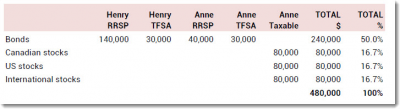 Model portfolios like those I recommend are ideal for investors who have a single RRSP account. But life isn’t so simple once you’ve accumulated a significant portfolio: chances are you’ll be managing two or three accounts, and if you have a spouse there may well be a few more.
In most cases, it’s most efficient to consider both partners’ retirement accounts as a single large portfolio. In other words, there’s no my money and my spouse’s money: there’s only our money. This strategy has a couple of advantages: first, it allows the family to make the most tax-efficient asset location decisions. Second, it keeps the overall number of holdings to a minimum, which reduces transaction costs and complexity.
Meet Henry and Anne, who have a combined portfolio of $480,000. Let’s assume they are the same age and plan to retire at about the same time. Their financial plan revealed that a mix of 50% bonds and 50% stocks is suitable for their risk tolerance and goals. Anne has a generous defined-benefit pension plan and therefore has little RRSP room: most of her personal savings go to a non-registered account…

