
There are plenty of retirement plan options in Canada! Stay on top of the best plans right here.
Latest News


Best high-interest savings accounts in Canada 2021 + MORE Aug 31st
Generally savings accounts offer very low interest rates. So, if you want to earn on your deposits (rather than simply using your account as a temporary “holding tank” or directing to longer-term saving and investing vehicles), a savings account with a high interest is a no-brainer.
However, whe.... More »
How to save (and invest) your first $100,000 + MORE Mar 28th
A popular milestone goal for young adults just starting out is to save $100,000 cash. YouTube and TikTok are buzzing with videos on this very topic, and it makes sense—$100,000 is enough to give you financial breathing room and life-changing options, like making a down payment on a condo or house,.... More »
Is a personal injury settlement taxable, and can it impact OAS or GIS benefits? + MORE Aug 24th
Q. I received a small settlement for an Ontario car accident, which my lawyer says is non-taxable, and so noT4A will be issued. If I deposit the funds into a bank account, will this one-time settlement clawback my OAS and GIS benefits?
–J
A. I’m sorry to hear about your accident, J. Hopefully .... More »
2022 Income Tax: New tax credits for Canadians Nov 30th
It’s that time again… to get all your paperwork ready for tax season. We all know about having our T4 and registered retirement savings plan (RRSP) contribution statements ready, but what about the new tax credits for the 2022 tax filing season? What are they and how do they work? Don’t wo.... More »
Timing the withdrawal of RRSP savings to minimize your tax hit + MORE Sep 14th
Q. I’ve been fully retired since 2018, and living only on government pension (QPP, OAS and GIS). I have some RRSP and TFSA investments, and would like some help with determining when I should start withdrawing funds—and whether I will need to pay tax. I’ll be turning 71 in December 202.... More »
Q. I would like to know whether it is better, financially speaking, to own my first house as an income property, or as my primary residence in Ontario. I am single, living with my parents, earn a steady income and have $80,000 in savings. I’ve already purchased a new-construction freehold townhouse for $320,000 (paid $30,000 in deposit), which will close in August 2020. While I had been planning to rent out this property, I’m wondering if it is better to treat it as my primary residence initially, to take advantage of all the benefits available to first-time home buyers (including the ability to borrow from my RRSP), then change to a rental later.
–Larry
A. I see where you are going with this, Larry. You’re wondering if you can take advantage of the Home Buyers’ Plan now—and, if you don’t, will the fact that your first home purchase is an income property prevent you from participating in any first-time home buyer programs when you do purchase your first primary residence in the future…
–Larry
A. I see where you are going with this, Larry. You’re wondering if you can take advantage of the Home Buyers’ Plan now—and, if you don’t, will the fact that your first home purchase is an income property prevent you from participating in any first-time home buyer programs when you do purchase your first primary residence in the future…
Is this couple on track to leave their 3 kids an inheritance?
– moneysense.ca
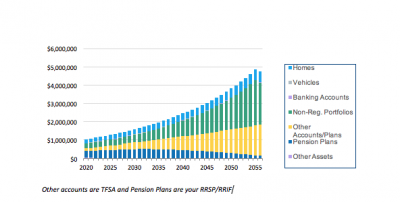 Q. My wife and I are wondering whether we are on track to leave each of our three children an inheritance of $250,000. I’m 63 years old, retired and receiving a monthly OPTrust pension (a type of defined benefit pension) of $3,400 net. When I turn 65, this pension amount will be reduced to about $2,700 net monthly as it is integrated with my CPP.
I plan on taking my CPP and OAS at 65, which I estimate will be $750 and $425 net a month respectively. I currently work part-time, earning about $1,300 net monthly. I plan to keep working part-time until my 58-year-old wife retires in May 2022. She currently nets $3,000 per month from her employment. She has a defined benefit pension with OMERS, which is estimated to pay her $1,900 net monthly until she turns 65, and then will be integrated with her CPP, reducing her pension to about $1,400 net monthly. She also plans on taking her CPP and OAS at 65, which are estimated to be $550 and $425 net monthly.
We own our own home, estimated to be worth $200,000…
 Making $48,000 a year working as a credit analyst, Pat has aspirations of sending her son to university, but that’s a dream that seems unattainable.
Q. I have been concerned about high fees charged on my investments and have been trying to figure out a way to move my funds without getting hit with a huge tax bill. I started with mutual funds and today I have a 60% equity and 40% income balanced portfolio plan. My last statement shows about 5% return over the last 5 years—an okay return but the 2% or more that I pay in fees (there is still not full, complete disclosure, nor and easy to understand information on all the fees charged) make me question whether I am receiving value for the amount charged.
Between my wife and myself, we hold an RRSP, SPRSP, TFSA and LIRA, with a total of about $1 million (less today due to big market drop related to the COVID-19 pandemic). I have been thinking of opening multiple discount brokerage accounts in the same breakdown of account types and transferring all of the registered funds into like accounts and purchasing ETFs with those funds. But the problem I suspect is that once I transfer the registered funds, I will be told I no longer have a large enough investment to qualify for service from our existing advisor, and will have to sell all of the unregistered investments and pay taxes on the sale…
Between my wife and myself, we hold an RRSP, SPRSP, TFSA and LIRA, with a total of about $1 million (less today due to big market drop related to the COVID-19 pandemic). I have been thinking of opening multiple discount brokerage accounts in the same breakdown of account types and transferring all of the registered funds into like accounts and purchasing ETFs with those funds. But the problem I suspect is that once I transfer the registered funds, I will be told I no longer have a large enough investment to qualify for service from our existing advisor, and will have to sell all of the unregistered investments and pay taxes on the sale…

