
Banking in Canada can be a murky subject – one that we hope to shed some light on with a series of highly informational articles.
Latest News

Visa vs. Mastercard: What are the differences—and do they matter? Aug 21st
A frequent question we hear at MoneySense is: Which is better—Visa or Mastercard? When looking for a credit card, there are all sorts of things to consider. What is the interest rate? Can you collect rewards points or cash back for making purchases? Is there a bonus for signing up, and what perks .... More »
Advice for cash-strapped renters and landlords during COVID-19 May 16th
When the COVID-19 pandemic swept across North America in early 2020, it created a wave of income loss that impacted people from all walks of life. While some individuals have been hit harder than others, it’s difficult to find a group or industry that hasn’t been affected. A small segment of the.... More »
Canadian Customers Will Soon Have to Pay More to Use Certain Premium Credit Cards Jun 20th
Canadian customers will soon be subject to additional fees when paying for purchases with certain premium credit cards, now that Visa and MasterCard have entered into a settlement agreement stemming from a class action lawsuit that will see both companies make changes to their “No Surcharge Ruleâ.... More »
How cash ETFs keep your money working Nov 25th
It’s a dilemma for many investors: you want to have cash set aside to hop on investment opportunities that might arise, but you also don’t want the money sitting in your portfolio not collecting any return. Enter cash exchange-traded funds. Experts say there is increasing demand for cash.... More »
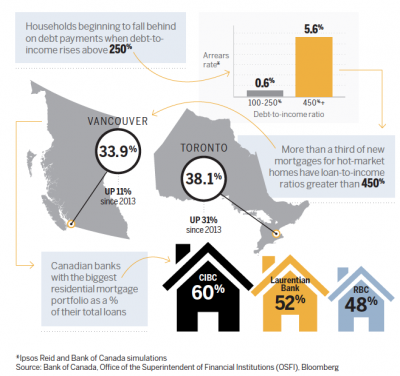
Bank stocks and real estate exposure Oct 28th
Everyone expected the federal government would tighten mortgage rules to halt risky lending practices and curb unsustainable growth in the housing market. No one expected they’d be so tough. Here’s a look at what’s worrying officials about residential mortgages and which banks are most exposed.... More »
Ireland’s unemployment rate falls to 9.8 per cent, 1st time below double digits in 6 years
– canadianbusiness.com
DUBLIN – Ireland’s unemployment rate has fallen to 9.8 per cent, the first time in six years that joblessness levels can be measured in single digits.
Ireland’s quarterly economic report published Thursday found that unemployment has declined from 10.1 per cent since January.
Unemployment ran below 5 per cent for much of the previous decade, thanks to a cheap credit-fueled property boom. That so-called Celtic Tiger economy collapsed amid worldwide credit troubles in 2008, leading to nationalization of most Irish banks and Ireland’s 2010 bailout by European Union partners and the International Monetary Fund. Unemployment peaked at 15.1 per cent in 2012.
Ireland’s economy has steadily improved since the country ended dependence on EU-IMF loans in late 2013. The country is forecast this year to enjoy the strongest economic growth in the 28-nation EU.
The post Ireland’s unemployment rate falls to 9.8 per cent, 1st time below double digits in 6 years appeared first on Canadian Business – Your Source For Business News.
Ireland’s quarterly economic report published Thursday found that unemployment has declined from 10.1 per cent since January.
Unemployment ran below 5 per cent for much of the previous decade, thanks to a cheap credit-fueled property boom. That so-called Celtic Tiger economy collapsed amid worldwide credit troubles in 2008, leading to nationalization of most Irish banks and Ireland’s 2010 bailout by European Union partners and the International Monetary Fund. Unemployment peaked at 15.1 per cent in 2012.
Ireland’s economy has steadily improved since the country ended dependence on EU-IMF loans in late 2013. The country is forecast this year to enjoy the strongest economic growth in the 28-nation EU.
The post Ireland’s unemployment rate falls to 9.8 per cent, 1st time below double digits in 6 years appeared first on Canadian Business – Your Source For Business News.
Four major banks agreed to plead guilty on Wednesday to trying to manipulate foreign exchange rates and six were fined nearly $6 billion in yet another settlement in a global probe into the $5-trillion-a-day market.
Barclays, RBS seen facing $11-billion more in misconduct costs
– theglobeandmail.com
Barclays and RBS were among six banks fined a combined $5.8-billion on Wednesday for rigging currencies

