
Banking in Canada can be a murky subject – one that we hope to shed some light on with a series of highly informational articles.
Latest News



Is It Time to Say Goodbye to Your Starter Credit Card? Jul 28th
Nearly nine out of 10 Canadians have a credit card, according to Payments Canada. Not only that, but Canadians are also heavy credit card users, coming in second to South Korea in credit card volume per capita.
The study found that the extraordinary credit card use is fuelled by key factors such as.... More »
The best GIC rates in Canada for 2026 + MORE Mar 30th
GIC comparison tool
Find the best and most up-to-date GIC rates in Canada using the comparison tool below. Plus, use the filters to assess your estimated rate of return based on the size of your balance.
Why trust us
MoneySense is an award-winning magazine, helping Canadians navigate m.... More »
Despite the ads begging for your trust, banks are not your mom: Don Pittis + MORE Mar 16th
Bombarded by warm and friendly ads, Canadians might be deceived into thinking banks are kindly public services. But they are businesses, although they must work hard to keep our trust..... More »
Number of Canadians using fintech products may triple + MORE Jan 28th
TORONTO – Business consultancy firm EY says it believes the challenge to traditional banks from financial technology, or fintechs, will accelerate rapidly this year.
EY says that until now Canadians have been slow to embrace offerings from companies such as robo-advisers and online lenders.
Citing.... More »
Wall Street might have been a safer place if it had been “Lehman Sisters” Dec 16th
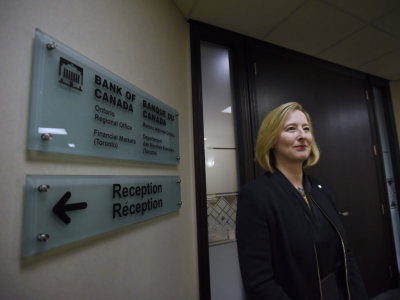
Bank of Canada deputy governor Carolyn Wilkins. (Fred Lum/Globe and Mail/CP)
Bank of Canada senior deputy governor Carolyn Wilkins delivered a lecture in London this fall on the perils of economic life in a time of ultra-low interest rates. By making money incredibly cheap, central banks have create.... More »
Finance minister ‘overstepped’ by wading into central bank’s domain: expert
– canadianbusiness.com
OTTAWA – The federal finance minister raised eyebrows last week by publicly sharing his opinion on monetary policy — not necessarily because of his view on the matter, but because some believe he ventured too far onto the Bank of Canada’s turf.
In response to a reporter’s question, Joe Oliver said the policy measure known as quantitative easing was “not on the table” as a response to Canada’s ongoing economic downturn.
The comment has prompted questions about whether the territorial line between the Conservative government and the central bank has been blurred.
Technically, it’s Bank of Canada governor Stephen Poloz’s call whether to implement quantitative easing, where central banks buy government assets and other securities to boost the supply of money.
“I thought that Minister Oliver overstepped when ruling out (quantitative easing) because it’s not his decision,” said Ian Lee, an economics professor at Carleton University’s Sprott School of Business…
In response to a reporter’s question, Joe Oliver said the policy measure known as quantitative easing was “not on the table” as a response to Canada’s ongoing economic downturn.
The comment has prompted questions about whether the territorial line between the Conservative government and the central bank has been blurred.
Technically, it’s Bank of Canada governor Stephen Poloz’s call whether to implement quantitative easing, where central banks buy government assets and other securities to boost the supply of money.
“I thought that Minister Oliver overstepped when ruling out (quantitative easing) because it’s not his decision,” said Ian Lee, an economics professor at Carleton University’s Sprott School of Business…
Did Joe Oliver overstep?
– macleans.ca
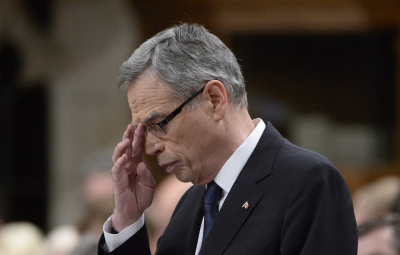
Minister of Finance Joe Oliver delivers the federal budget in the House of Common on Parliament Hill in Ottawa on Tuesday, April 21, 2015. (Adrian Wyld/CP)
OTTAWA — The federal finance minister raised eyebrows last week by publicly sharing his opinion on monetary policy — not necessarily because of his view on the matter, but because some believe he ventured too far onto the Bank of Canada’s turf.
In response to a reporter’s question, Joe Oliver said the policy measure known as quantitative easing was “not on the table” as a response to Canada’s ongoing economic downturn.
The comment has prompted questions about whether the territorial line between the Conservative government and the central bank has been blurred.
Technically, it’s Bank of Canada governor Stephen Poloz’s call whether to implement quantitative easing, where central banks buy government assets and other securities to boost the supply of money.
“I thought that Minister Oliver overstepped when ruling out (quantitative easing) because it’s not his decision,” said Ian Lee, an economics professor at Carleton University’s Sprott School of Business…
Overlooking the Other Sources of Liquidity
– online.wsj.com
 Banks have promoted a myth to preserve a competitive moat around what has been a very lucrative business.
Investors say heed the lessons of Icarus as Nortel marks 15 years after peaking
– canadianbusiness.com
TORONTO – It was 15 years ago this month when Nortel Networks’ shares hit an all-time high of $124.50 on Toronto’s stock market.
The company’s sky-high stock made it by far Canada’s most valuable company at the time — with a market value that briefly surpassed any of the banks and resource companies listed on the Toronto Stock Exchange.
It didn’t last. A few months later, Nortel shares began a bumpy slide that resulted in a worthless stock and the bankruptcy breakup of what was once a global leader in telecommunications networks.
Even though Nortel is now long dead, industry veterans say that, human nature being what it is, most investors won’t learn from its boom and bust.
“I find in this business, people want to believe,” says Ross Healy, chairman of Strategic Analysis Corp., an investor advisory firm.
“People are mesmerized by rising stock prices. They don’t ask if this is coming to a limit. The longer it goes on, the more that they are convinced that it’s going to keep on going on…
The company’s sky-high stock made it by far Canada’s most valuable company at the time — with a market value that briefly surpassed any of the banks and resource companies listed on the Toronto Stock Exchange.
It didn’t last. A few months later, Nortel shares began a bumpy slide that resulted in a worthless stock and the bankruptcy breakup of what was once a global leader in telecommunications networks.
Even though Nortel is now long dead, industry veterans say that, human nature being what it is, most investors won’t learn from its boom and bust.
“I find in this business, people want to believe,” says Ross Healy, chairman of Strategic Analysis Corp., an investor advisory firm.
“People are mesmerized by rising stock prices. They don’t ask if this is coming to a limit. The longer it goes on, the more that they are convinced that it’s going to keep on going on…

