
There are plenty of bank savings account options in Canada! Stay on top of the best plans right here.
Latest News




This 33-year-old analyst makes $100,000 a year including bonus. She paid off her student loans and wants to buy a home. Is now the right time? + MORE Jul 25th
Like many millennials, Anna’s main long-term goal is to save up for a down payment. Now, because of the pandemic, she’s looking to buy sooner than later because of the real estate market..... More »
Eight solid alternatives to the Capital One Costco Mastercard for Canadians + MORE Jun 6th
Costco wasn’t the world’s first retail warehouse club, but in the nearly 35 years since opening in Canada, it’s become a staple shopping destination for families and groups who want deep discounts on bulk buys. The way that Costco works is that it relies on membership—you can’t walk into a.... More »
TFSAs Cut Back to $5,500 in 2016 + MORE Dec 9th
The axe has been swung on Tax Free Savings Accounts – the Liberal government is reverting the annual contribution limit to $5,500 in 2016 from the $10,000 limit implemented this year under former Conservative Finance Minister Joe Oliver.
Bill Morneau, Oliver’s successor, announced the c.... More »
The best high-interest savings accounts in Canada for 2025 + MORE Jul 16th
Savings comparison tool
Find the best and most up-to-date savings rates in Canada using the comparison tool below. Plus, use the filters to assess your estimated return based on the size of your balance.
Advertisement
Why trust us
MoneySense is an.... More »
What types of tax-free savings accounts (TFSAs) exist? + MORE Nov 20th
A tax-free savings account (TFSA) is a fantastic way to earn money on your savings, without having to pay tax on those earnings. Registered by the federal government, TFSAs are available to Canadians aged 18 and older. Unlike a registered retirement savings plan (RRSP), you cannot deduct contributio.... More »
A political primer on taxes
– moneysense.ca
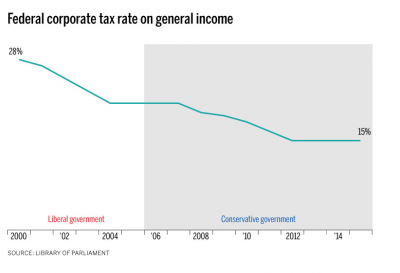 Of all the economic-policy levers a politician can pull, none elicits a reaction like hiking or cutting taxes. Reducing the GST by two points in his early years in office still ranks among Stephen Harper’s most debated moves. More broadly, Tories claim “the family tax burden is at its lowest level in 50 years.” Personal income taxes amounted to 7.4 per cent of gross domestic product when Harper took office in 2006; by 2014, those taxes on individuals’ earnings had notched down to seven per cent of GDP. Over the same period, corporate income taxes fell to 1.9 per cent of GDP from 2.6 per cent.
TALKING TAXES IS A POLITICAL COMPULSION
MPs said the word “tax” 2,617 times in the House of Commons over the first six months of 2015, and more than 20,000 times since the last election. Conservatives make hay out of the number of tax cuts they’ve introduced since 2006; 180 is their most recent claim. The NDP talks mostly about increasing corporate taxes, and Liberals hope to shift income taxes so the middle class pays less…
Paying off the line of credit
– moneysense.ca
Q: I inherited a house three years ago. I thought I got good advice when I went to a financial planner, but it was only to get me onto a line of credit. I am a single full-time working mom, but have had to live off this line of credit. Now it is almost used up and I have no idea what I can possibly do once that happens? Can you please help me at all with this?
—Nancy
A: Generally, I think that inaction is one of the best actions that you can take when you receive an inheritance. People should take their time and evaluate their options and avoid making any rash investment or spending decisions.
If your financial planner recommended a line of credit initially, it may have been that you had high interest rate debt to pay off. If that was the case, the recommendation was a good one, saving you interest costs on your debt.
If not, you must have been in a position where you intended to spend more money than you were making in your full-time job. This is generally a recipe for disaster. The last thing I want to do is to downplay the plight of a single mother, but budgeting doesn’t discriminate, Nancy…
—Nancy
A: Generally, I think that inaction is one of the best actions that you can take when you receive an inheritance. People should take their time and evaluate their options and avoid making any rash investment or spending decisions.
If your financial planner recommended a line of credit initially, it may have been that you had high interest rate debt to pay off. If that was the case, the recommendation was a good one, saving you interest costs on your debt.
If not, you must have been in a position where you intended to spend more money than you were making in your full-time job. This is generally a recipe for disaster. The last thing I want to do is to downplay the plight of a single mother, but budgeting doesn’t discriminate, Nancy…

