
There are plenty of bank savings account options in Canada! Stay on top of the best plans right here.
Latest News



3 financial goals to kick-start the new year + MORE Jan 21st
Over the holidays, many Canadians made new year’s resolutions related to their career, health and family. If you haven’t added any financial goals to your list, now is the perfect time. Let’s look at three things you can do that could significantly impact your financial well-being this year—.... More »
RESP vs RRSP and TFSA: What’s the best option for education savings? + MORE Aug 28th
Welcome to Education Money, a new column that covers the questions and concerns parents and investors have about funding their child’s education. Andrew Lo, CEO of Embark, shares his thoughts and insights on how to make the most of RESPs. To kick off the column, he explains the different options C.... More »
How the Liberals’ re-election impacts RRIFs, taxes and more + MORE May 7th
The Liberals held on to power in the recent federal election, and this has tax implications for Canada’s seniors and other taxpayers—in particular, for retirees and their strategies for their registered retirement income fund (RRIF) this year and possibly in the future.
Reduced RRIF minimum w.... More »
New to Canada? A new way to transfer your credit score + MORE Oct 29th
Equifax Inc. is launching a program to allow newcomers to transfer their foreign credit history to Canada.
The credit reporting company said Thursday that the Global Consumer Credit File will make it easier for immigrants to access services like loans and cellphone plans in Canada by providing th.... More »
Capital gains tax strategies change under new tax rules + MORE Oct 26th
For most Canadians, the new requirement to report the sale of a principal residence will be nothing more than a compliance exercise—but one shadowed by the threat of unrestricted audits and sizeable penalties. To help you negotiate through the new reporting rules, please see the 8 question.... More »
A political primer on taxes
– moneysense.ca
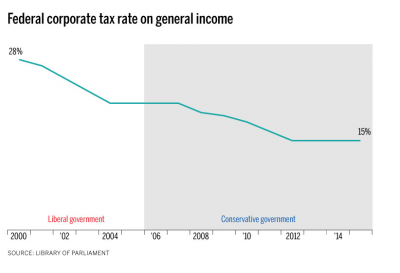 Of all the economic-policy levers a politician can pull, none elicits a reaction like hiking or cutting taxes. Reducing the GST by two points in his early years in office still ranks among Stephen Harper’s most debated moves. More broadly, Tories claim “the family tax burden is at its lowest level in 50 years.” Personal income taxes amounted to 7.4 per cent of gross domestic product when Harper took office in 2006; by 2014, those taxes on individuals’ earnings had notched down to seven per cent of GDP. Over the same period, corporate income taxes fell to 1.9 per cent of GDP from 2.6 per cent.
TALKING TAXES IS A POLITICAL COMPULSION
MPs said the word “tax” 2,617 times in the House of Commons over the first six months of 2015, and more than 20,000 times since the last election. Conservatives make hay out of the number of tax cuts they’ve introduced since 2006; 180 is their most recent claim. The NDP talks mostly about increasing corporate taxes, and Liberals hope to shift income taxes so the middle class pays less…
Paying off the line of credit
– moneysense.ca
Q: I inherited a house three years ago. I thought I got good advice when I went to a financial planner, but it was only to get me onto a line of credit. I am a single full-time working mom, but have had to live off this line of credit. Now it is almost used up and I have no idea what I can possibly do once that happens? Can you please help me at all with this?
—Nancy
A: Generally, I think that inaction is one of the best actions that you can take when you receive an inheritance. People should take their time and evaluate their options and avoid making any rash investment or spending decisions.
If your financial planner recommended a line of credit initially, it may have been that you had high interest rate debt to pay off. If that was the case, the recommendation was a good one, saving you interest costs on your debt.
If not, you must have been in a position where you intended to spend more money than you were making in your full-time job. This is generally a recipe for disaster. The last thing I want to do is to downplay the plight of a single mother, but budgeting doesn’t discriminate, Nancy…

