
Rate Hike Expectations Grow, But How Long Will Higher Rates Last? + MORE Apr 10th

Mortgage borrowing slides to lowest since 2014 + MORE Jun 14th

Six Months was What it Took to Absorb Latest Mortgage Changes! Aug 19th

BoC Drops Key Rate 0.50%-Pts. Will Prime Rate Follow? + MORE Mar 5th

What’s the best way of using your home equity during retirement? + MORE Nov 10th
Another Potential Play for CFF
– canadianmortgagetrends.com
Dealing With Market Drama
– ratesupermarket.ca

To say it has been a chaotic week for your finances would be putting it lightly; a massive market sell-off has spooked investors around the world, and the repercussions for Canadians remain unclear. Will this upheaval have an impact on interest rates and home-grown debt? Read on for the full story.
4 Ways to Weather a Bear Market
If last week’s minor sell-off wasn’t bad enough, investors woke up Monday morning to some brutal numbers. Recent developments in China have investors panicking and dumping shares, leading to a bear market. Despite big losses, it’s important to stick to your strategy – here are tips for staying calm during a market downturn.
Read Barry’s Blog | 4 Ways to Weather a Bear Market
Will Mortgage Rates Rise by 2016?
The Bank of Canada has chopped central rates twice this year to accommodate a slowing economy. Could we be in for another rate decrease in September’s announcement? A recent stock sell-off, global market upheaval and the sliding price of oil all point to the possibility – but a recent report from RBC states the opposite could happen by 2016…
Canada needs an agency to handle real estate bubbles
– moneysense.ca
@media all and (min-width: 1008px) and (max-width: 1264px) {
.tab-nav li.menu-item a{
padding: 22px 18px;
}
}
One of Bank of Canada Governor Stephen Poloz’s deputies spoke about housing this week. Lawrence Schembri was disarmingly calm while tackling a subject that can easily lead to hysterics. There was no mention of bubbles or irrational exuberance, suggesting the central bank continues to believe that the situation is under control.
There are those who think otherwise. But Schembri’s speech showed that the Bank of Canada remains more concerned about the 18% plunge in Canadian commodity prices this year than the 10% jump in the average national resale price of homes since 2013.
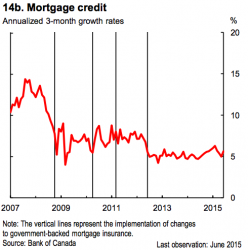
Here’s one reason why:
The red line is the annualized growth rate of household credit since 2007. The dark vertical lines represent the imposition of measures meant to dissuade riskier borrowers from buying homes, such as the narrowing of the amortization period for an insured mortgage to 25 years from 40 years…
Canadian banks defend mortgage verification practices
– moneysense.ca
.tab-nav li.menu-item a{
padding: 22px 18px;
}
}
TORONTO – Some of Canada’s biggest banks are defending their verification practices for mortgage applications in light of recent news that mortgage lender Home Capital Group Inc. cut ties with dozens of brokers over fraud allegations.
A number of mortgage brokers have called for tighter industry rules after Home Capital announced in July that it was suspending 45 brokers over allegations that they falsified client incomes on mortgage loan applications.
Some brokers have suggested that mortgage fraud is likely more widespread than the 45 brokers implicated by Home Capital.
However, executives at the Bank of Montreal, Royal Bank and TD Bank (TSX:TD) stood behind their mortgage verification practices when grilled about the topic by analysts during the banks’ quarterly earnings conference calls this week.
How to pay off the mortgage in 6 years »
TD’s chief risk officer Mark Chauvin said the bank makes calls to employers to verify income, looks at automatic deposits into the accounts of existing TD customers and uses data analysis techniques to assess how reasonable a client’s stated income is…
Don't Jump the Gun Locking Into a Fixed-Rate Mortgage
– walletpop.ca
First things first. Many people do not understand the difference between a fixed and a variable mortgage. A fixed mortgage is locked in for a set term at a set rate, and offers no flexibility. A variable mortgage fluctuates with the market index rate, which can be beneficial in the long run as low rates leave room for you to potentially get ahead on payments. There are pros and cons to both fixed and variable.
On the fixed side, you know what you’re paying for the next three, four, or five years, and you don’t have to worry about the ups and downs of rates. At the same time, being locked in means just that: a hefty penalty that can wipe out any potential equity, defeating the purpose of a low rate in the first place.
On the variable side, there is a risk…

