
All about Canadian credit cards. Learn the ins and outs and get the latest news.
Latest News



People deferring their mortgage payments are making an unpleasant discovery: it can wreck your credit rating Mar 30th
Deferring payment on your mortgage buys you time to deal with COVID-19’s economic havoc, but the people behind your credit score might just see bad news..... More »
Chase Marriott and Amazon Visas come to a complete close on March 15 + MORE Jan 16th
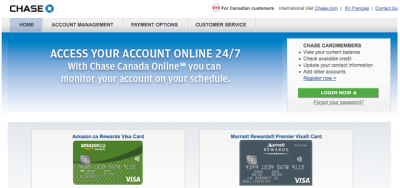
Nearly a year ago Chase stopped accepting new applications for the Amazon.ca Visa and then late in summer 2017 they also stopped accepting applications for the Marriott Premier Visa card. Now we have received the news that both cards will come to a close on March 15 for existing cardholders. This wi.... More »
Should You Give Your Teen a Credit Card? + MORE Dec 16th
Over one-third of Canadians share a joint credit card with their partner, parent, or child, according to a recent survey conducted by Rates.ca. Among the parents who share their credit card with their children, 63% said that managing their children’s purchases is less difficult than it was two ye.... More »
RWRDS Daily Update – December 7 + MORE Dec 8th
Here’s your Rewards Canada update! Your near daily dose of loyalty program, credit card and travel news, bonuses, deals and more. Accor to Air France KLM conversion improved + a bonus! The partnership between Air France and Accor has been enhanced as adjustments have been made to the points tr.... More »
Claim the Family Tax Cut one last time + MORE Mar 30th
(Chris Ryan / Getty Images)
In 2014, the Conservatives introduced this credit, which allows families with children under the age of 18 to shift $50,000 of income from a higher-earning spouse to a lower-earning spouse for total tax savings of up to $2,000 per couple. While the benefit was repealed in.... More »
Third Avenue Management ripples hit global credit, bond risk soars
– theglobeandmail.com
Money manager halts redemptions from high-yield fund while Lucidus Capital Partners liquidates portfolio, putting market ‘in a tantrum’
Why proprietary credit card reward programs are the best option for most Canadians
– RewardsCanada.ca
 This feature article was posted to the main Rewards Canada website last Wednesday December 9th right before our computer crashed. Hence not much action here on Rewards Canada since then!As much as Canadians love their reward programs there are two universal truths: a.) It takes too long to accumulate meaningful points and b.) There are never enough flights available when you want to travel.While I’ve written and conducted numerous media interviews on the topic, the best advice I can offer is to understand your options.At their core, true frequent flyer programs such as Aeroplan are all about rewarding your travel behavior. Sure you can earn miles through your credit card spend but the bulk of your earning power is still associated with travel.The AIR MILES Reward Program funny enough is less about frequent travel and more of frequent shopping. You earn a bulk of your miles by shopping at partner retailers, taking advantage of bonus offers and double or triple dripping by using your associated credit card…
Canadian household debt level rises
– moneysense.ca
OTTAWA – The amount that Canadians owe compared with their disposable income rose in the third quarter.
Statistics Canada says the amount of household debt compared with disposable income rose to 163.7 per cent compared with 162.7 per cent in the second quarter.
That means the average household has roughly $1.64 in debt for every dollar of disposable income.
The increase came as disposable income increased 0.8 per cent, while household credit market debt grew 1.4.
Total household credit market debt, which includes consumer credit, and mortgage and non-mortgage loans, reached $1.892 trillion.
Consumer credit debt was $572.3 billion, while mortgage debt stood at $1.234 trillion.
How to get out of debt »
The post Canadian household debt level rises appeared first on MoneySense.
'Smart chip' debit cards transition going slowly
– creditcards.com
Chips are coming to debit cards, too, but even more slowly than the change to EMV credit cards. Here are the seven things you need to know about the debit chip transition.

