
‘It’s a big investment’: Ottawa announces major investment in Atlantic Canada’s aerospace sector - BNN Bloomberg May 13th
Cannabis producer Aphria fights back against short seller — but it's not enough to stop the stock slide + MORE Dec 4th
White House says next G7 to be held at Trump golf resort in Miami - CBC.ca + MORE Oct 17th
The after-effect of market lows: a drop in fixed mortgage rates Aug 7th
This high-flying stock is a benchmark for the spread of AI + MORE Jan 10th
Canada’s 2017 federal budget isn’t very innovative about driving innovation
– canadianbusiness.com
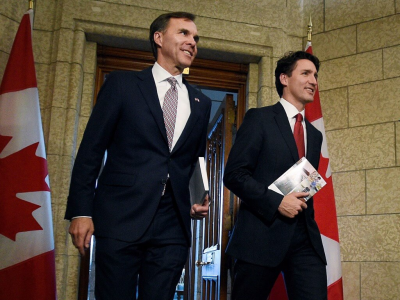
In some ways, Finance Minister Bill Morneau’s second budget is a vanilla-flavoured budget—generally acceptable and unlikely to offend most people. The government stays the course of Budget 2016, expanding on areas like skills and innovation, infrastructure, and Indigenous affairs, with a chapter dedicated to gender-related issues, such as gender budget analysis. There appears to be the intention to act, but in a context of slow growth and growing debt, there were no major new investment announcements or game-changing tax changes.
.cbR{box-sizing:border-box;display:block;width:100%;margin:1em 0;border:1px solid #bbb;padding:.5em}@media (min-width:480px){.cbR{width:250px;margin:0 0 1em 1em;float:right}}Canada’s 2017 Federal Budget is haunted by the spectre of Donald Trump
Take skills and innovation. The rumours were true: the government seems to have put a lot of effort into developing new initiatives and programs to promote growth and develop its workforce. Over five years, the government has promised to invest an additional $5…
Budget 2017’s missed opportunities on innovation
– macleans.ca
 (pexels-photo)
In some ways, Finance Minister Bill Morneau’s second budget is a vanilla-flavoured budget—generally acceptable and unlikely to offend most people. The government stays the course of Budget 2016, expanding on areas like skills and innovation, infrastructure, and Indigenous affairs, with a chapter dedicated to gender-related issues, such as gender budget analysis. There appears to be the intention to act, but in a context of slow growth and growing debt, there were no major new investment announcements or game-changing tax changes.
Take skills and innovation. The rumours were true: the government seems to have put a lot of effort into developing new initiatives and programs to promote growth and develop its workforce. Over five years, the government has promised to invest an additional $5.2 billion in these areas (on top of the $22.6 billion the Institute of Fiscal Studies and Democracy estimates is already being spent). While the investment is material, it pales in comparison to existing spending in the twin policy areas of skills and innovation…
21 ways Budget 2017 will affect your finances
– moneysense.ca

1. Employment Income (EI) premiums are going up to $1.69 per $100 of insurable earnings from the current $1.63 per $100 of insurable earnings.
2. The tax credit for Public Transit Tax Credit on Passes will be eliminated effective July 1st.
3. Tighter rules on investment products you can and can’t hold in your Registered Education Savings Plan (RESP) and Registered Disability Savings Plans (RDSP). Strict investment rules had already been outlined for RRSPs and TFSAs. Make sure you’re holding allowable investment products, otherwise the penalties are onerous.
4. The CRA will continue to receive more funding in 2017 to ensure every Canadian is playing by the tax rules and claiming all eligible taxable income. For 2017, the federal government will be spending an additional $523.9 million on top of the $400 million they spent last fall to track tax cheats and collect money from tax evaders both in Canada and around the world.
5 ways Budget 2017 will hike your Friday night spending
5…
21 ways the federal budget will hit Canadians’ wallets
– macleans.ca
1. Employment Income (EI) premiums are going up to $1.69 per $100 of insurable earnings from the current $1.63 per $100 of insurable earnings.
2. The tax credit for Public Transit Tax Credit on passes will be eliminated effective July 1st.
3. Tighter rules on investment products you can and can’t hold in your Registered Education Savings Plan (RESP) and Registered Disability Savings Plans (RDSP). Strict investment rules had already been outlined for RRSPs and TFSAs. Make sure you’re holding allowable investment products, otherwise the penalties are onerous.
4. The CRA will continue to receive more funding in 2017 to ensure every Canadian is playing by the tax rules and claiming all eligible taxable income. For 2017, the federal government will be spending an additional $523.9 million on top of the $400 million they spent last fall to track tax cheats and collect money from tax evaders both in Canada and around the world.
5. Excise duty rates on alcohol products are going up by 2 per cent effective right now…
6 ways Budget 2017 will affect investors’ taxes
– moneysense.ca

In the weeks leading to the release of Canada’s 2017 federal budget, there was plenty of speculation that Finance Minister Bill Morneau might raise the capital gains inclusion rate, make changes to dividend tax credits, and more. Did the pundits have it right? Here’s everything in the newly minted budget that could affect investors and their pocketbooks:
1. Capital gains inclusion rates –Good news, there are no changes here! The 50% inclusion rate remains untouched in this budget for now at least.
2. Canada Savings Bonds – These investments will be phased out in 2017.
3. Mutual Funds – Mutual funds can be structured in a trust or a corporation. Switch corporations are defined as mutual fund corporations with multiple classes of shares where each class is usually a distinct investment fund. Mergers of two mutual funds into a trust or from a trust to a corporation can be done on a tax deferred basis; this treatment will continue. However effective budget day, the reorganization of a mutual fund corporation into a multiple mutual fund trusts will also be allowed on a tax deferred basis in respect of each class of shares, if all or substantially all of the assets in the class are transferred…

