

2018 will be the year of allyship + MORE Dec 28th

Making sense of the markets this week: November 23 Nov 20th
The 7 best low-interest credit cards in Canada for August 2023 + MORE Aug 5th
Is Dane, 50, on the right track with his early retirement strategy? Nov 22nd

90 days - 1.75% + MORE Mar 9th
US sanctions 12 Russians in Magnitsky case that set off dispute over human rights, adoptions
– canadianbusiness.com
The individuals the Treasury Department sanctioned Tuesday were four prison officials, a judge, court official, a law enforcement investigator and alleged co-conspirators in the fraud case. On the list is Dr. Dmitry Kratov, who was charged in Magnitsky’s 2009 death, but acquitted of negligence in December.
The Magnitsky affair ignited a dispute between Russia and Washington that has included U.S. sanctions against suspected Russian human rights violators and a ban on the adoption of Russian children by Americans.
The sanctions ban U.S. visas for the individuals and freeze assets under U.S. jurisdiction.
The post US sanctions 12 Russians in Magnitsky case that set off dispute over human rights, adoptions appeared first on Canadian Business.
Ask the Spud: Why Do ETF Yields Differ?
– CanadianCouchPotato.com
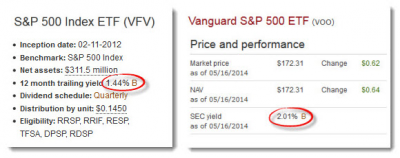 Q: The Vanguard S&P 500 (VFV) currently has a dividend yield of 1.44%, but the US-listed version of the same ETF has a yield of 2.01%. How can these two funds have such different yields when their underlying holdings are exactly the same? – Lindsay
The US and international equity ETFs from Vanguard Canada do not hold their stocks directly: they get their exposure by holding a US-listed ETF. The Vanguard S&P 500 (VFV), for example, simply holds the Vanguard S&P 500 (VOO), which trades on the New York Stock Exchange.
Since the underlying holdings of VFV and VOO are identical, you might expect the two funds to have the same dividend yield. Yet if you visit their respective websites you’ll find the published yields actually vary by 57 basis points. What gives?
More than one way to do the math
Turns out there are several ways to calculate a fund’s yield. Vanguard Canada uses the trailing 12-month yield, which it defines as “the fund’s cash distributions over the past 12 months divided by the end of period net asset value…
Canada’s receptive oil patch in line for trillions in new investment
– theglobeandmail.com
Key Canada Events: Week of May 19-23
– blogs.wsj.com
120 days – 1.70%
– ratesupermarket.ca

