
How to go about securing the best return for your investment in Canada.
Latest News
Cannabis producer Aphria fights back against short seller — but it's not enough to stop the stock slide + MORE Dec 4th
Shares in Canadian cannabis company Aphria Inc. plunged for the second day in a row as the company fought back against allegations from a short seller that its recent slew of overseas takeovers are worthless and designed only to enrich company insiders..... More »
Manulife cutting 700 jobs, consolidating Canadian operations Jun 21st
Manulife Financial Corp. said Thursday it plans to cut about 700 jobs in Canada over the next 18 months as it moves to digitize and combine some of its operations..... More »
How much credit card debt does the average Canadian have? Jun 21st
As the country re-opens after COVID-related restrictions, Canadians are faced with a worrying financial picture. Many have moved, others are looking to travel, and the cost of living is ballooning with unusual rates of inflation. Meanwhile, the Bank of Canada (BoC) rate hikes designed to curb these .... More »
Know your TFSA contribution limit + MORE Oct 6th
For Canadian investors and savers, it’s always some of the best news to come each year: new TFSA room that becomes available each January 1. And for 2022, the TFSA contribution limit is $6,000.
The actual TFSA yearly limit was set at $5,000 back in 2009 when the investment account was first create.... More »
When investing, think like a landlord + MORE Feb 3rd
Markets never move in a straight line, yet if you look at a long-term chart of the S&P 500 you might argue otherwise.
!function(e,t,s,i){var n="InfogramEmbeds",o=e.getElementsByTagName("script"),d=o[0],r=/^http:/.test(e.location)?"http:":"https:";if(/^/{2}/.test(i)&&(i=r+i),window[n]&a.... More »
 (Freeimages.com / Rober Owen-Wahl)
I have a few hundred thousand dollars in mutual funds in my RRSP at a large investment firm. I want to move this money into a self-directed RRSP at an online brokerage. Can they charge me a fee for taking my money elsewhere? If so, is it normal for the brokerage receiving the new money to reimburse these charges? – Bill
Just about every investment dealer charges fees to transfer registered accounts, such as RRSPs and TFSAs. The typical fee is $135 to $150, plus taxes, per account.
Since you’re a departing client, the firm has no real incentive to make you happy, so it is unlikely you’ll be able to negotiate on these fees. The good news is that many brokerages will reimburse these fees when you open a new account and transfer a significant amount of money. But do your research beforehand, because every brokerage has a different policy, it may not be consistent, and they may not advertise it openly.
Bill, the fact that you have a six-figure sum to transfer puts you in a good position…
Closing 1 Trade ($PYPL, $IAC)
– IntelligentSpeculator.net
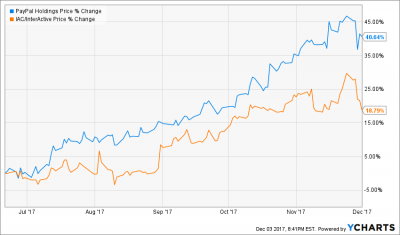 This morning, I will be closing one of the 4 live trades that I currently have on, the one where I went long Paypal (PYPL) vs. Short IAC Interactive (IAC). I continue to be a strong believer in Paypal and you can expect me to buy the stock in 2018 when I get back to trading:) As I wrote recently on SeekingAlpha, I do think Paypal has a very good opportunity to be one of the dominant payment players online which would be incredibly valuable. They are coming under attack from the likes of Apple, Google, and Facebook but I do like their odds.
The 2017 returns stand at 7.71% which is not bad at all. I will be closing the trade on the open today, you can go see this year (and past years) trades here:
http://www.intelligentspeculator.net/livetrades
How to report capital gains tax owed on gifted shares
– moneysense.ca

Q. I have a question about reporting capital gains realized in the United States as a Canadian citizen. When I was younger, I received some certificated shares of DE (NYSE) in a trust account as a gift. The shares have since split 2-1, and I sold all shares online this year. On the trading platform (Computershare), there is no Adjusted Cost Base (ACB) for the shares listed. My questions are:
1) How do I calculate the ACB for these shares?
2) As a Canadian, how do I report the capital gain on my taxes next year? Do I need to file with the Internal Revenue Service (IRS) or can I only file with Canada Revenue Agency (CRA)?
Thank-you for the question, Ben
A. The Adjusted Cost Base (ACB) of the shares, which is a calculation used to determine the cost of an investment for tax purposes, is their fair market value at the time you acquired them. You can find historical pricing online for almost any stock that is still listed. If the stock was acquired before 1972, the ACB will be the value on December 22, 1971…
Threat of Canadian financial crisis eases (but don’t take that to the bank)
– theglobeandmail.com
Canada finally dips below key threshold. Plus, what to expect from the Bank of Canada this week

