
Toronto stock index climbs on banks, industrials + MORE May 23rd
Apple Says Record 2020 Mac Sales Attributed Primarily to MacBook Pro - MacRumors Oct 30th

Would you save 70% of your income so you could retire early? Meet FIRE advocate Scott Rieckens, on track to retire at 41 Oct 9th

A Case for Increased Tenant Screening during the COVID-19 Crisis Nov 13th
When are tax-deferred and tax-free accounts actually taxable? Feb 3rd
Couch Potato Portfolio: Frequently asked questions
– moneysense.ca
It’s a way of investing that relies upon index funds or exchange-traded funds (ETFs). These funds passively track the major stock markets and bond market at very low cost. You put your money into a pre-determined blend of these funds to get wide diversification across different types of stocks and bonds. Once a year you sell off some of your winners and put the proceeds into your losers so your portfolio returns to the original proportions.
What’s so smart about that?
Since you’re paying less in fees than most mutual fund investors, more of the profits go into your own pocket. Also, your wide diversification means that no single disaster can blast a hole in your returns. Finally, the annual rebalancing means that you’re selling high and buying low — which is a much smarter way to invest than the opposite approach.
But isn’t it risky not to have a manager looking after my investments?
Not at all. You can think of the stock market or the bond market as being the sum total of all the mutual fund managers out there…
Constellation Software Q1 profit soars; revenue gains boosted by acquisitions
– canadianbusiness.com
The Toronto-based supplier of software to both government and commercial customers said net income increased 270 per cent to US$33 million or $1.55 per diluted share from US$9 million or 42 cents a share in the same 2014 quarter.
Adjusted income increased 40 per cent to US$75 million or $3.52 a diluted per share from $53 million or $2.52 per share.
Revenue rose to US$423 million from US$395 million.
Revenue in the public sector segment increased $13 million or five per cent to $291 million from $278 million, with a “significant” portion due to 14 acquisitions since the beginning of 2014.
Revenue in the private sector segment was up $15 million or 13 per cent to $132 million from $117 million in the year-earlier period, with a significant portion attributable to 12 completed acquisitions in that segment since the beginning of 2014…
MoneySense magazine: June 2015
– moneysense.ca
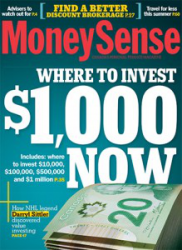 June 2015
Volume 17, Number 3
Download the MoneySense app to read this issue on your tablet or smartphone now, it’s free for subscribers!
You can also find issues of MoneySense magazine along with 100+ other titles on the Next Issue app. Start your 30-day free trial now!
Below is just some of what you’ll find inside this latest issue.
Where to invest $1,000 now
Canada’s best discount brokerages
Find the perfect adviser
Editor’s Letter
Some grifters are hard to spot
By: Duncan Hood
Intelligence
Why teachers are the best investors, five things your headhunter isn’t telling you, how to divide a condo & more
Ask MoneySense
The ins-and-outs of TFSA withdrawals, and how an unused line of credit affects your credit rating
By: Bruce Sellery
Am I On Track
By: Julie Cazzin
Instant Expert
How to get a great deal on a used car
Portfolio Makeover
The two-fund nest egg solution
By: Julie Cazzin
Index Investor
Can ‘home country bias’ be justified? Turns out
in some cases, it can
By: Dan Bortolotti
Financial Independence
How to profit from the new budget right away
By: Jonathan Chevreau
Jacks On Tax
Claim your investment expenses and save big
By: Evelyn Jacks
Family Profile
Joel Wilson had a prosperous career, until disaster struck…
Couch Potato Portfolio: Introduction
– moneysense.ca
Most of us, though, aren’t like that. We want good performance with low risk — but between our jobs and our families we don’t have a lot of time to follow the market.
If that sums up your situation, MoneySense has the perfect portfolio for you. It will not only beat the performance of most people who spend hours on their investing, it will beat about 80% of the money managed by professionals. Best of all, like an ideal houseplant, this portfolio thrives on neglect. It performs superbly even if you pay attention to it for only 15 minutes a year.
We call our approach the Couch Potato strategy. It’s based on the simple fact that the market is smarter than any single individual. If the market says a stock is worth $20 a share, chances are the stock is probably worth somewhere close to $20 a share…
Couch Potato Portfolio: How to set it up
– moneysense.ca
If you’re investing once a year, you should use exchange-traded funds or ETFs. These are index-fund-like investments that trade like stocks on major stock exchanges. Many ETFs charge ultra-low management fees (think 0.2% or less), but to buy or sell them you have to pay a brokerage fee just as if you were buying a stock. The fees aren’t huge in themselves — $9.95 is typical — and if you’re investing once a year, they are a minor annoyance when you consider the low management fees you’re paying.
On the other hand, if you want to contribute monthly, paying $10 a pop for each transaction can send your overall bill soaring. You’re better off to use index mutual funds. You’ll pay a bit more in management fees, but you won’t face brokerage fees on every contribution.
For purposes of illustration, we’ll assume you’re using our Global Couch Potato strategy (for other strategies, see Meet the potato family)…

