
Canopy earnings disappoint as posted loss is nearly four times expectations - The Globe and Mail Jun 21st
How cash ETFs keep your money working Nov 25th
The smart seller’s secret to reducing capital gains tax in Canada + MORE Jul 18th

Can you use the FHSA and HBP together? + MORE Aug 15th
Should you get a 30-year mortgage? + MORE Feb 25th
An aggressive portfolio with a built in safety net
– moneysense.ca

Barry Biner
AGE: 29
PLACE: Ottawa
TFSA TOTAL: $69,000
STRATEGY: Low-cost ETF portfolio
Me and my TFSA
Barry Biner, 29, is a dentist living in Ottawa. He only opened his TFSA in 2013 and for the first three years he played catch up with all this past contribution room. Now that he has, he doesn’t want to fall behind.
To take advantage of the new contribution room that gets added to the TFSA every year, he set up a system where he makes automatic contributions through his bank for of $1,100 a month for the first five months of each year. “TFSAs are a phenomenal investment tool and I now make sure to contribute fully every year,” says Biner. “I’m really disappointed that they reduced the contribution room back down from $10,000 in 2015 back to $5,500 today. I would have loved for it to stay at the higher level.”
More of Me and my TFSA »
Biner is fortunate—he has a solid defined benefit pension plan (DBPP) through his employer so he’s not worried about taking on more risk in his TFSA…
Drowning in debt is the new normal in Canada
– macleans.ca
 The Canadian Press/Ryan Remiorz
On any given day now you can expect to hear at least one economist, public official or financial commentator express grave concern about the mountain of debt Canadians now carry. The bloated debt loads of Canadian households has become a pervasive topic in media. But for all the attention the subject has received, it’s a safe bet that most people still cling to very clichéd notions that only so-called “deadbeats” ever hit the debt wall. Nothing could be further from the truth. The reality is Canadians would be shocked if they could peer into the private financial lives of many of their closest neighbours and friends.
As a licensed insolvency trustee firm, our practice is on the front lines of Canada’s household debt binge and the bad personal finance habits that ensnare so many people. And what we see every day is that the majority of those grappling with serious debt trouble are the most typical individuals and families you could imagine…
Why Canada’s politicians won’t do what it takes on the housing market
– canadianbusiness.com
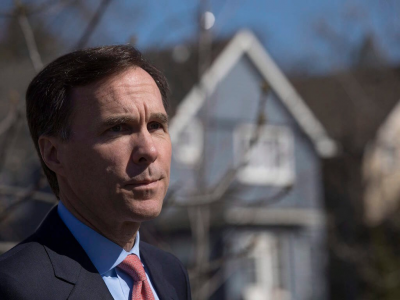 Federal Finance Minister Bill Morneau speaks with the press after a meeting with Ontario Finance Minister Charles Sousa and Toronto Mayor John Tory in April 2017. (Chris Young/CP)
Last fall, Bill Morneau did a rare thing in modern politics. Instead of running away from responsibility, he embraced it. “Let me be clear,” Morneau told the Toronto Board of Trade. “At the end of the day, I am ultimately responsible for supporting financial security, and the stability of the financial system.”
.cbR{box-sizing:border-box;display:block;width:100%;margin:1em 0;border:1px solid #bbb;padding:.5em}@media (min-width:480px){.cbR{width:250px;margin:0 0 1em 1em;float:right}}Ontario’s new housing measures could be too little, too late
The remarks didn’t receive much attention, but they should have. What Morneau did that day was confirm that he would be the decider of what would be done—or not done—to deflate Canada’s various housing bubbles. He had taken some steps to curb demand during his first year in office, such as raising the minimum downpayment for homes priced higher than $500,000…
 Q My husband and I have RRSPs with an advisor and our holdings are all in mutual funds with deferred sales charges (DSCs). We also hold accounts with a discount brokerage, where I hold ETFs that have performed really well. I’m ready to take the plunge and transfer our advisor accounts to our discount brokerage. My father is advising me to sell all the mutual funds and eat the DSCs so we can transfer them immediately. Can you tell me the pros and cons of this strategy and, in your view, if this would worth it for us? — Jane and Ken D.
A I’m going to side with your father on this one. Sometimes it pays to tear the bandage off quickly rather than prolonging the pain.
Deferred sales charges are one of the fund industry’s most destructive practices. When you buy a mutual fund with a DSC, you pay no upfront fee. However, if you sell the fund and change advisors before a specified period (often six or seven years), you’ll pay a heavy penalty. DSCs often start at 6% and decline gradually each year, so on a large portfolio those charges can easily cost you thousands of dollars…

