
BoC held its rate on June 4—here’s why Jun 4th
The best high-interest savings accounts in Canada for 2026 + MORE May 11th
Is Wealthsimple’s new Physical Gold Trading worth it? Dec 17th

Why emotional biases may be riskier than market swings + MORE Apr 17th

Why Vanguard’s ETF aimed at retirees is currently cautious in its asset allocation Feb 27th
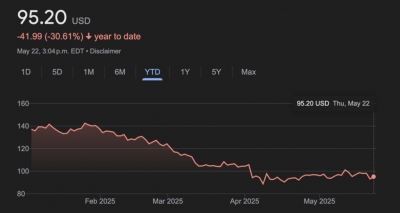 Target’s challenge to revive sales and its status as a cheap chic retailer just got more complicated. The discounter announced on Wednesday that sales fell more than expected in the first quarter, and the retailer warned they will slip for all of 2025 year as its customers, worried over the impact of tariffs and the economy, pull back on spending. Target (TGT/NYSE) also said customer boycotts did some damage during the latest quarter.
The company, long a fierce corporate advocate for the rights of Black and LGBTQ+ people, scaled back many diversity, equity and inclusion initiatives in January, after they came under attack by conservative activists and the White House. Target’s retreat created another backlash, with more customers angered by the retailer’s reduction of LGBTQ+-themed merchandise for Pride Month in June of 2023.
Shares fell 3.5% in midday trading Wednesday.
Source: Google
Target Q1 2025 earnings highlights
Sales: $23.85 billion versus $24.23 billion expected…
Is the stock market going to crash in 2025?
– moneysense.ca
 For a financial journalist, it’s probably the question friends and new acquaintances most frequently ask: Is the stock market going to crash soon?
The short answer I, and any credible market-watcher, will give is: I don’t know. Markets are by their nature unpredictable. A few supposed seers correctly guessed the last bear market, and others will probably foresee the next one. The fact is that someone, somewhere, is always predicting a crash. Like broken clocks, they will be right every now and then.
That said, I can share some certitudes that come from covering the markets for more than three decades.
What we do know about the stock market
MoneySense contributing editor Michael McCullough
The first thing to keep in mind is that major market downturns don’t necessarily manifest over a matter of days. Sometimes stock prices just start slipping and keep going. During the dot-com bust, the Nasdaq Composite Index took 31 months to lose 78% of its value, between March 2000 and October 2002, with the odd bear-market rally in between…
How to invest in Canadian bank ETFs
– moneysense.ca
 Though they’re well represented in Canadian stock indices, you can see why some investors would want even more exposure to Canadian banks. They have enviable dividend growth histories and ample current yields. They offer relatively stable earnings that are not vulnerable to global tariffs or supply-chain shocks. For decades (and with support from the regulatory regime), they’ve successfully fended off all competitors that have tried to breach their moats. Plus, their payouts typically qualify for the Canadian dividend tax credit when held in taxable accounts, making them highly tax-efficient.
But, banks are a different animal than most TSX stocks. Typical valuation metrics like price-to-earnings ratios don’t always apply cleanly because bank earnings are heavily regulated, cyclical and influenced by capital requirements, interest-rate spreads and credit risk—factors that aren’t captured well by earnings multiples alone.
Instead, Canadian investors need to consider balance sheet and risk management metrics…

