
What to expect from Mark Carney’s fiscal update amid high deficits and rising risks - Toronto Star Apr 26th

How AI is changing online fraud May 13th
Carney government to reveal economic statement on April 28 Apr 15th
U.S., Israel launch ‘massive and ongoing’ attack on Iran - The Globe and Mail Feb 28th
How cash ETFs keep your money working Nov 25th
 In the last column, we looked at three recently published financial books, including one I had really looked forward to reading: William Bengen’s A Richer Retirement. It’s the American certified financial planner’s long-awaited follow-up to his ground-breaking book on the so-called 4% Rule.
I had originally planned to focus exclusively on that book but ended up on a related project on my own site, which involved asking more than a dozen financial advisors on both sides of the border what they think of the 4% Rule and the tweaks Bengen covers in his follow-up book. The survey was conducted via LinkedIn and Featured.com, which has long supplied content for my site. You can see the complete set of responses on my blog, but at over 5,000 words, it’s a tad long for the space normally assigned to this Retired Money column.
Here, I focus on the most insightful comments and add a few thoughts of my own. Let’s jump right in.
Trusts and estates expert Andrew Izrailo, Senior Corporate and Fiduciary Manager for Astra Trust, recaps the basic thrust of the original 4% Rule:
“The 4% Rule, created by CFP Bill Bengen in the 1990s, remains one of the most referenced retirement withdrawal guidelines…
GST/HST credit payment dates: When to expect your money in 2025
– moneysense.ca
What is the GST/HST credit?
The GST/HST credit is a tax-free quarterly payment issued by the Canada Revenue Agency (CRA). It’s meant to help lower- and middle-income Canadians offset the goods and services tax (GST) or harmonized sales tax (HST) you pay on daily purchases. It’s automatically deposited into your bank account every three months, or delivered via cheque if you don’t have direct deposit.
How is the GST/HST credit calculated?
The GST/HST credit is calculated based on your net income, marital status, and the number of children in your household, according to the Canada Revenue Agency (CRA)…
Don’t dwell on a possible pullback
– moneysense.ca
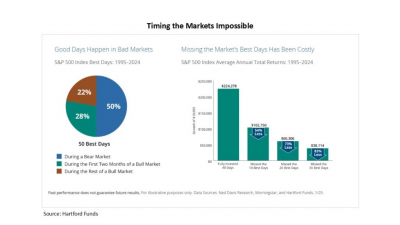 At the time of writing, the S&P 500, Nasdaq Composite, and Dow Jones Industrial Average were all trading at levels hovering around all-time highs. But as we turned into the second half of November, some uncertainty crept into the markets’ performance. A climbing stock market, at least on the surface, should be a time for optimism—but for many investors, it’s cause for concern. Understanding that what goes up eventually comes down, they’re worried about a potential pullback or deeper correction.
Fuelling the current fear of a selloff are the pundits. New York Times financial journalist Andrew Ross Sorkin is comparing today’s booming markets to those of the 1920s before the crash. And Michael Burry, the hedge fund manager who predicted the collapse of the U.S. housing market in 2008, is betting against artificial intelligence stocks Nvidia and Palantir Technologies. This led to the tech-heavy Nasdaq having one of its worst weeks this year. But Nvidia is worth more than US$4…

