

Making sense of the markets this week: September 22, 2024 + MORE Sep 20th
Province Bringing in New Rules for Mortgage Brokers - VOCM + MORE Oct 21st

Why 2026 could be a year to rent, not buy + MORE Jan 28th

Is now the time for retirees to sell stocks and buy GICs? + MORE Aug 10th
Why are Canadians still frustrated with the economy? Nov 5th
Ottawa's easing of mortgage lending rules is the last thing the housing market needs – The Globe and Mail
– news.google.ca
Making sense of the markets this week: April 14, 2024
– moneysense.ca
 Kyle Prevost, creator of 4 Steps to a Worry-Free Retirement, Canada’s DIY retirement planning course, shares financial headlines and offers context for Canadian investors.
U.S. inflation intimidates stock market
We were supposed to be entering the time of the year when inflation should be trending downward and stock markets could get back to a “normal” state of slow growth or perhaps marginal pullbacks.
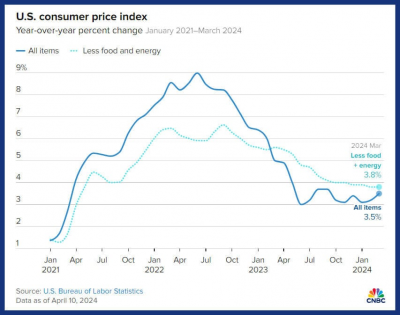
Instead, the U.S. stock market has been on a relatively fast climb, even though high inflation should have begun to drag it down. Something had to give. And on Wednesday, the stock market gave back about 1% of its gains so far this year, as the U.S. Bureau of Labor Statistics reported that the U.S. consumer price index (CPI) jumped 3.5% in March 2024. Core CPI (excluding food and energy) was even higher at 3.8%.
Source: CNBC
Shelter and gas costs were the main culprits in driving the increased CPI number, and were responsible for more than half of the 3.5% increase. New and used cars were bright spots in the report, as they had price declines, when compared to a year ago…
6 ways Canadians can invest in an RESP on a tight budget
– moneysense.ca
There are so many competing priorities for our money these days that contributing regularly to a registered education savings plan (RESP)—especially enough to receive the full $7,200 available through the Canada Education Savings Grant (CESG)—is simply not possible for every family. Many families may need more room in their budgets before they can prioritize education savings.
But investing in an RESP is still worth it, even if you’re unable to reach the lifetime RESP maximum contribution of $50,000 per child. Small amounts can help build and grow your RESP account value over time. Even if cash is tight, here are six suggestions for finding money to invest for your kids while minimizing the financial impacts on your monthly budget…
What are covered call ETFs, and are they good investments?
– moneysense.ca
First, what is a covered call, anyway?
A call option is an agreement that gives a buyer the right to buy a stock at a predetermined price in the future. The seller is compensated for giving the call option buyer the right (or the option) to buy the investment they own. The option is “covered” if the seller owns the underlying stock. Canadian investors can “write” (sell) a covered call option when they want to reduce the risk of owning an investment.
In 1999, Mark Cuban (the minority owner of the Dallas Mavericks but better known as a panellist on Shark Tank) sold Broadcast…

