
MoneySense has a new look Apr 25th
What is a private mortgage and when does it make sense? Sep 1st
Alterna Bank’s Fully Digital Mortgage Apr 6th
How high will interest rates go in Canada? Could they reach double digits? Jul 30th

The Run Down on Reverse Mortgages: What Are They and Why Do Home Owners Get Them? + MORE Jun 17th
 First-time homebuyers may need to lower their expectations under the Liberals’ new mortgage rules.
A report by Genworth MI Canada says over one-third of insured mortgages — predominantly borrowed by first-time homebuyers — would have difficultly meeting the requirements.
First-time homebuyers, the company said, would have to consider buying cheaper properties or saving for a bigger down payment.
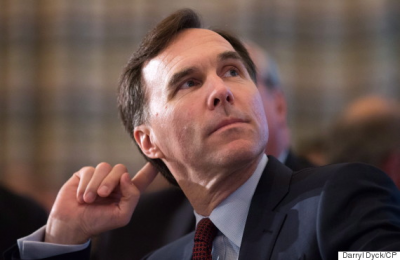
Finance Minister Bill Morneau. (Photo: Darryl Dyck/CP)
Canadian homebuyers generally need to obtain mortgage loan insurance if they put less than 20 per cent down.
Finance Minister Bill Morneau announced new mortgage rules on Monday. The guidelines make it tougher for certain buyers to obtain that insurance.
The new rules require that all insured homebuyers undergo a “stress test” to prove that they could still pay off their mortgages if interest rates rose.
All in all, the requirements could make life difficult for first-time homebuyers — they won’t be able to borrow as much as they did previously and, therefore, may have to settle for cheaper homes…
New Federal Mortgage and Real Estate Rules Announced
– ratesupermarket.ca
You’d have to have been living under a rock – and certainly not in a house – to not know that various experts are concerned the Canadian real estate market is in the midst of bubble that will eventually pop, particularly in the super-hot Toronto and Vancouver markets. Earlier this week, the federal government announced some key financial changes that it hopes will help rein in ever-escalating house prices and help avoid a disastrous crash in the Canadian housing market.
Sweat Equity
The first change is to have mortgage lenders implement a so-called “stress test” to all applicants who apply for a mortgage with less than a 20 per cent down payment (i.e. high-ratio mortgages) to ensure they can still afford to make their payments if – and when – interest rates rise. The way they’ll do that is, no matter what rate you manage to negotiate with your lender, you’ll have to qualify for a mortgage based on the five-year conventional mortgage rate that the Bank of Canada posts every week…
New mortgage rules will affect first-time buyers
– moneysense.ca
 OTTAWA – Canada’s first-time home buyers may have to shelve their dream house fantasies due to lending changes announced this week by the federal government, mortgage brokers say.
Ottawa moved this week to tighten mortgage lending rules that will limit the amount many Canadians can borrow to help ensure that when interest rates rise, they’ll still be able to make their payments.
Mortgage broker Frank Napolitano says that means the size of mortgage many buyers will be able to qualify for will be less once the rules take effect on Oct. 17.
“First-time homebuyers will probably have to probably scale down the type of home that they may have planned to buy,” said Napolitano, managing partner at Mortgage Brokers Ottawa.
.cbR{box-sizing:border-box;display:block;width:100%;margin:1em 0;border:1px solid #bbb;padding:.5em}@media (min-width:480px){.cbR{width:250px;margin:0 0 1em 1em;float:right}}Mortgage insurance changes coming
Under the new rules, a stress test that had only applied to borrowers who opted for variable rate mortgages or fixed rate mortgages with terms less than five years will now be used for all home buyers with less than a 20 per cent down payment…
Mortgage Career
– canadianmortgagetrends.com
Close to retirement: should I invest or pay off debt?
– moneysense.ca
 (Michael Phillips/Getty Images)
Q: I may be coming into an inheritance and I want to know if it would be better to pay off all the debt I have or invest the money? I have the following debt:
Mortgage: $60,000, at 2.5%, variable rate
Line of credit: $20,000 at 5.7%, variable rate
Car loan: $24,000 at 3.75%
I am 62 years old and the thought of being debt-free is very appealing, but also want to make the best financial decision for the long run.
— McFeely, Alberta
Nawar Naji, mortgage broker with Mortgage Architects:
The answer to your question really depends on few factors:
1/ When is your retirement date? i.e, how many more income earning years do you have?
2/ Do you have any other savings, such as RRSPs, that will be used during your retirement years?
Now, if you have a few working years left and you have a retirement plan, then consider paying off the high interest debt first (line of credit at 5.7%). Paying off a depreciating asset (car loan) is not the best idea…

