

Life Insurance vs. mortgage insurance: Let’s break it down + MORE Mar 20th
Mortgages: The Digital Future Oct 7th
Latest in Mortgage News: Financial experts see less risk of an imminent recession + MORE Apr 27th

Special Incentives For Frontline Workers Jul 4th

Housing slump? Recession? Not so fast… Nov 24th
No Early Autumn Change for Canadian Mortgage Rates
– ratesupermarket.ca
The first signs of autumn may have arrived, but that’s the only fall Canadians will witness in the near future; RateSupermarket.ca’s expert mortgage panel has called for the cost of borrowing to remain unchanged throughout the season.
Lenders will stick to current discounts for fixed-rate mortgages as government bond yields remain consistently low. And, while a freshly-minted recession puts pressure on the Bank of Canada to provide stimulus, it’s expected the central bank will wait for the bigger data picture before cutting rates for the third time this year.
Click here to view the best fixed and variable mortgage rates in your region>
Fixed Mortgage Rates: Unchanged
As Chinese market volatility causes pain for equities around the globe, government of Canada bonds continue to be ranked among the safest of investments. Continued interest has kept yields sub-1 per cent, and firmly within a 30-basis point range. Fixed-rate mortgage borrowers will continue to access rock-bottom rates, as low as 2…
5 Ways to Become Debt Free In 10 Years
– walletpop.ca
1. Decrease your interest rates and consolidate
Interest rates are at their lowest in the history of time. Consolidate as much of your debt as possible at the cheapest rate. Re-mortgage or consolidate your debt on a low interest line of credit to save a ton. Try to get your interest rate down to three per cent or lower. This will help you save tens of thousands in interest over the next 10 years. Interest rates aren’t expected to jump higher in the next few years due to the economy, and it is easier to pay more off at lower rates…
More to come.
Earlier on HuffPost:
— This feed and its contents are the property of The Huffington Post, and use is subject to our terms. It may be used for personal consumption, but may not be distributed on a website.
Household debt ratio grew in Q2 as debt increased faster than income
– canadianbusiness.com
The agency says the ratio of household credit market debt to disposable income climbed to 164.6 per cent from 163.0 per cent in the first quarter.
That means Canadians owed nearly $1.65 in credit market debt, which includes consumer credit, and mortgage and non-mortgage loans, for every dollar of disposable income.
Overall, total household credit market debt amounted to $1.874 trillion at the end of the second quarter, up 1.8 per cent from the previous quarter. Disposable income increased by 0.8 per cent.
Household net worth increased 0.9 per cent in the second quarter as non-financial assets, primarily real estate, rose 1.8 per cent while net financial assets edged down 0.1 per cent.
On a per capita basis, household net worth increased to $243,800.
The post Household debt ratio grew in Q2 as debt increased faster than income appeared first on Canadian Business – Your Source For Business News.
Best way to invest a large sum of money
– moneysense.ca
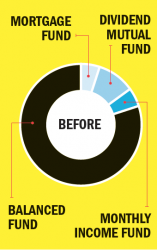
Moyra Thompson, 60, is retired and her $600,000 mortgage-free house is up for sale. “I want to sell before boomers flood the market with homes,” says Moyra, who receives $2,100 a month from two small pensions and will start collecting CPP at age 65. Right now, her $150,000 portfolio is invested in bank mutual funds with an overall management expense ratio (MER) of 1.9%, split evenly between fixed income and equities—but even with an additional $600,000 Moyra is concerned her money won’t last into her 90s. “I’ll need $15,000 net a year from my portfolio. I’m not sure the 50% fixed income and 50% equity split will give me that.”
Certified financial planner Chris Stephenson of Steadyhand Investment Funds in Vancouver says that if Moyra’s goal is to withdraw $15,000 annually from a $750,000 portfolio (an extraction rate of 2%), she’ll have no problems. In fact, this is easily achievable with her current asset mix of 50% stocks and 50% fixed income, and Stephenson sees no reason to change this…

